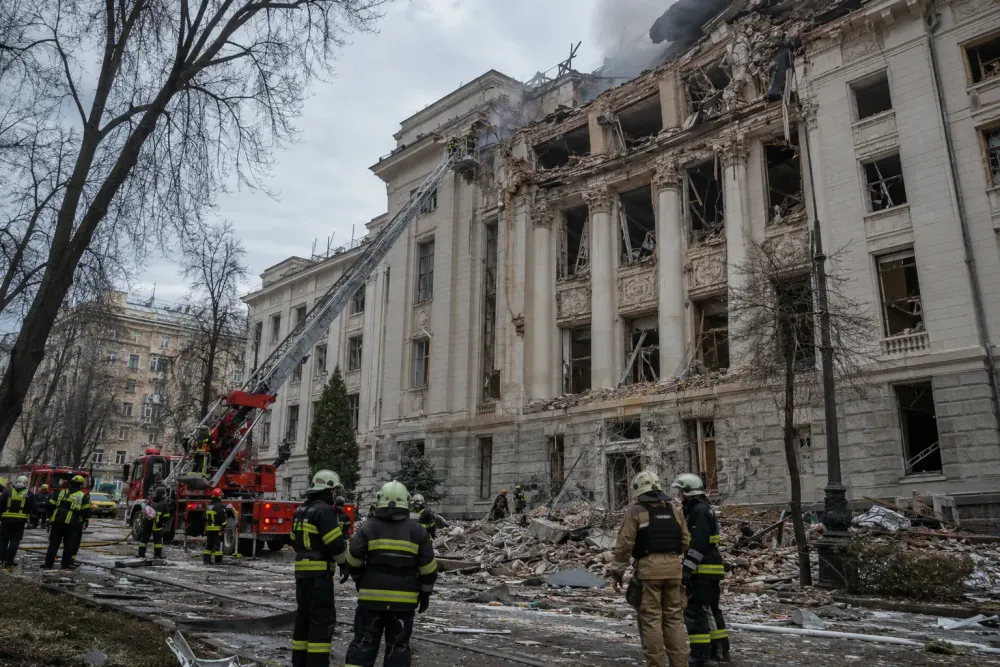
Russia sent more than 120 attack drones across Ukraine on Monday, including 90 jet-powered models, killing at least nine people nationwide and exposing a sharp gap in Kyiv’s ability to stop the faster aircraft. President Volodymyr Zelenskyy said Ukraine intercepted 70% of all drones but only 57% of the jet-powered models, figures reported in his official nightly address and independently summarized by Reuters.
The assault ran through much of September 28 and repeatedly reached central Kyiv. A jet-powered drone struck the National Academy of Sciences, where two people were killed, while another hit a medical center. By late evening, Kyiv authorities reported two deaths and 26 injured people in the capital, including three children. The nationwide toll remained provisional as rescuers searched damaged buildings and regional officials updated casualty counts.
The significance extends beyond a single destructive day. Russia’s shift toward faster, higher-flying drones is changing the economics and tempo of the air war: aircraft that are harder to detect and intercept can be sent repeatedly during daylight hours, forcing air-defense crews, emergency services and civilians to remain on alert for long periods. The result is a new test of whether Ukraine can scale cheaper counter-drone systems quickly enough to avoid relying on scarce, costly missile defenses.
A faster threat strains interception
Propeller-driven Shahed-type drones have long been a central part of Russia’s attacks, but the growing jet-powered variant compresses the time available to identify, track and engage an incoming aircraft. The Washington Post reported that Kyiv still relies on prototype interceptors that have not been deployed at scale. Zelenskyy likewise said new interceptors were being actively tested and used by some combat teams, while acknowledging that performance and mass deployment still required refinement.
The disparity in Monday’s interception figures illustrates the operational problem. If Ukraine’s reported rates are accurate, roughly four in 10 jet-powered drones penetrated defenses, compared with three in 10 across the mixed fleet. Those are government figures rather than an independently audited battlefield accounting, and wartime interception claims are difficult to verify in real time. Even so, the damage documented across multiple cities confirms that a substantial number reached populated areas.
Attacks spread across civilian sites
The Academy of Sciences strike caused a fire and destroyed several floors of the institution’s main office. The academy’s president told the Washington Post that the facility employed about 200 people and was civilian; many workers were away at lunch when the drone hit. The attack killed an assistant to Volodymyr Horbulin, a prominent scientist and former national security official, while Horbulin was injured.
Kyiv’s running incident log also recorded strikes or debris impacts at office buildings, a cafe near a filling station, warehouses, residential areas and a business center. In other regions, Zelenskyy said attacks hit a business center in Dnipro and a residential building in Odesa, with additional strikes in the Sumy and Kharkiv regions. The Associated Press separately documented attacks on apartments, offices and infrastructure across Ukraine, reporting more than 80 injuries as local tallies continued to change.
That evolving accounting explains why early reports differed on the number killed. Zelenskyy’s evening address cited nine deaths nationwide, while later rescue work in Kyiv recovered another body from rubble. Responsible reporting on a continuing mass-casualty event requires preserving the time attached to each number rather than presenting an early count as final.
Moscow frames the strikes as retaliation
Russia did not provide a detailed public explanation for the Academy of Sciences strike. Kremlin spokesman Dmitry Peskov said Ukraine was “paying the price” for attacks inside Russia and that Russian forces would continue striking targets they considered appropriate, according to a separate Reuters report. Moscow routinely says its campaign is directed at military-linked infrastructure; Ukrainian officials say the pattern and locations of the damage show repeated harm to civilian facilities.
Ukraine has also expanded long-range drone attacks against Russian energy and defense sites. The Washington Post reported that a Ukrainian drone wounded four people, including three children, in Russia’s Voronezh region on Monday. That context does not resolve responsibility for individual strikes, but it shows how the expanding drone war is exposing civilians on both sides while diplomatic efforts remain stalled.
Ukraine races to scale cheaper defenses
The immediate Ukrainian priority is to move interceptor drones from testing into reliable mass use. Using an expensive surface-to-air missile against a relatively inexpensive attack drone is difficult to sustain, particularly when barrages continue for hours and are repeated daily. Interceptor drones and mobile teams can lower the cost per engagement, but the 57% figure suggests the faster threat is advancing more quickly than Ukraine’s countermeasure network.
Monday’s attacks therefore mark more than another entry in the war’s casualty ledger. They show that Russia can combine volume, speed and persistence to pressure air defenses and strike deep inside the capital during ordinary working hours. Ukraine has identified a technical response, but the evidence from Kyiv establishes that it has not yet deployed that response at the scale or reliability needed to protect civilian institutions consistently.