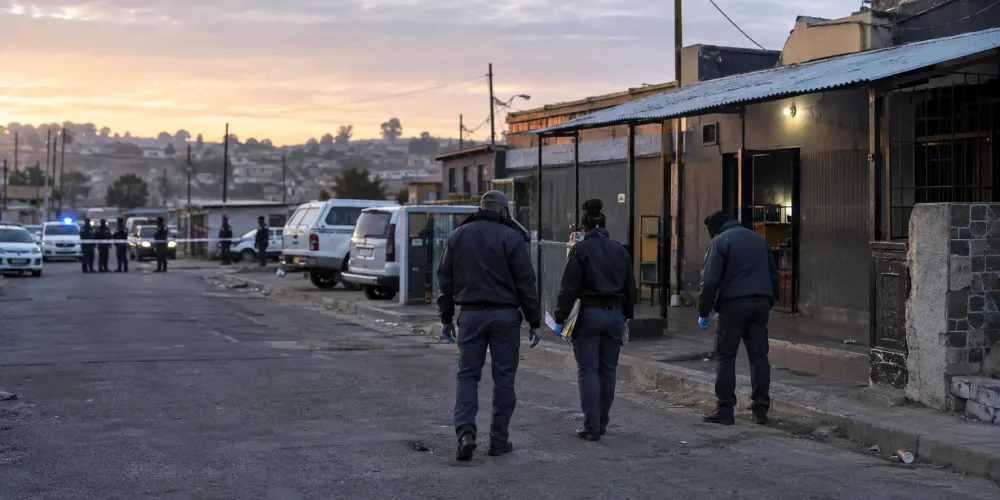
At least 27 people were killed and 26 wounded in two separate mass shootings near Johannesburg and Cape Town within roughly four hours, prompting police manhunts and renewed scrutiny of South Africa’s capacity to disrupt heavily armed criminal groups. Authorities said Sunday that no arrests had been made and that the motives remained under investigation.
Two attacks, hours apart
The first attack began around 9:30 p.m. Saturday at a tavern in Wedela, a mining community west of Johannesburg. Eight gunmen carrying rifles and pistols fired at people outside, moved into the building and continued shooting, according to a South African Police Service statement. Thirteen men and four women died at the scene, and 15 other people were taken to hospitals with gunshot wounds.
Police said the attackers searched some patrons and took their cellphones before leaving in two vehicles. Two vehicles at the tavern were set on fire. Investigators opened 17 murder cases, 15 attempted-murder cases and two malicious-damage cases while specialized detectives searched for the eight unidentified suspects.
At about 1:46 a.m. Sunday, gunmen entered an entertainment venue that also sells grilled meat in Lwandle, east of Cape Town, and opened fire on patrons. Five people died there and five others died after reaching medical facilities, while 11 remained under treatment, according to a separate police account. Western Cape Provincial Commissioner Sizakhele Dyantyi assigned a multidisciplinary team led by serious-violent-crime detectives and increased police deployments in the area.
Investigators keep the cases separate
Police had not publicly linked the two attacks as of Sunday. The Associated Press reported that officers were treating them as distinct investigations, while the Reuters account said police were still working to establish motives and identify the shooters.
Officials cautioned that early theories had not been proved. Gauteng provincial police commissioner Tommy Mthombeni said investigators were examining whether the Wedela shooting could be connected to conflict involving illegal mining. Western Cape police were considering whether the Lwandle attack arose from a local business rivalry. Both possibilities were described as preliminary in an Australian Broadcasting Corporation report based on police briefings.
That distinction matters because a shared national pattern does not establish a common organizer. The timing, large number of assailants in Wedela and use of multiple firearms point to planned violence, but the available evidence does not show coordination between the two scenes. Police have asked witnesses to provide information through the national Crime Stop line or the MySAPS application.
A third mass killing deepens the pressure
The weekend attacks followed another mass shooting in KwaMakhutha, south of Durban, on Sept. 22. Three men entered a house during a gathering and opened fire, killing 11 people and wounding three, police said in a provincial statement. Investigators said some victims had previously drawn the attention of crime-intelligence officers, but they had not confirmed a motive and warned that a feud between rival groups was only one possibility.
Together, the three attacks killed 38 people in less than a week. That concentration does not by itself demonstrate a single surge or trend, yet it raises immediate operational questions about illegal firearms, intelligence collection and the speed with which specialized investigators can identify organized groups. It also places unusual pressure on local police units managing separate crime scenes, witness interviews and forensic examinations at the same time.
South Africa’s latest official household survey found that public confidence in the criminal-justice system remains strained. Statistics South Africa reported in its Governance, Public Safety and Justice Survey that perceptions of safety and experiences of crime vary sharply by location and type of offense. The survey measures household experience rather than the specific shootings, but it provides national context for why a sequence of high-casualty attacks can intensify public anxiety even before investigators determine whether they are connected.
What the investigations must establish
The immediate test is whether police can convert witness accounts, surveillance footage, ballistic evidence and digital records into arrests that withstand prosecution. The Wedela case involves an unusually large suspect group and potentially two getaway vehicles; the Lwandle inquiry must reconstruct a crowded, late-night scene where victims were moved to hospitals. Each factor can complicate identification and evidence preservation.
Political demands are already building. South Africa’s Democratic Alliance called for stronger crime-intelligence capabilities and a clearer response to illegal firearms in an official statement. The party’s claims are advocacy rather than investigative findings, but its intervention reflects the broader pressure on the national government to explain how repeated group attacks will be prevented, not only solved afterward.
For now, the verified facts are narrower: 27 people were killed in the two weekend attacks, 26 were wounded, police were pursuing separate lines of inquiry, and no suspects had been arrested by Sunday. Any conclusion about motive, gang affiliation or coordination would run ahead of the public evidence. The credibility of the response will depend on transparent updates, careful prosecution and whether authorities can identify the firearms and networks behind the attacks.