
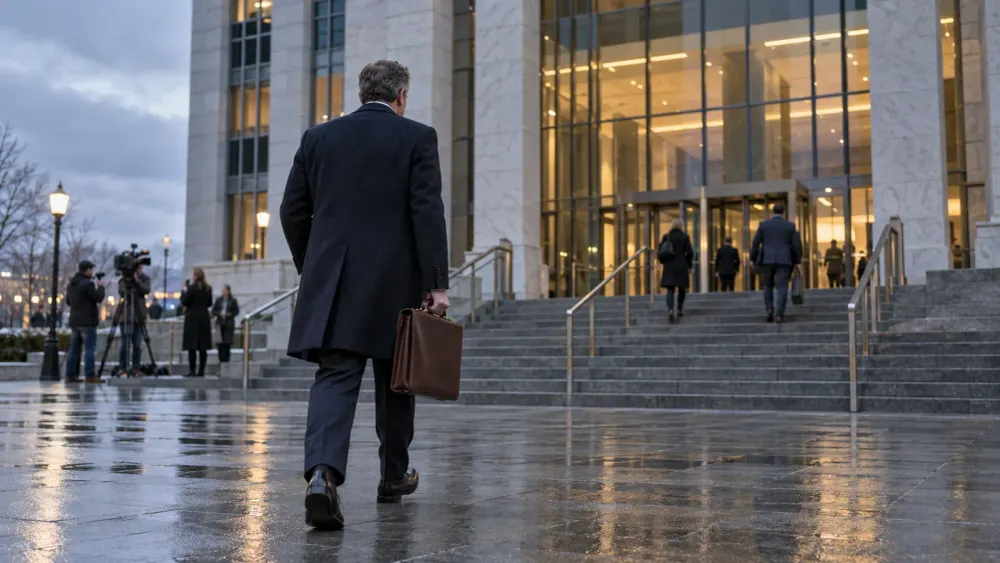
A federal judge has ordered the Trump administration to restore Roger Rogoff as U.S. attorney for the Western District of Washington, ruling that the president cannot unilaterally remove a prosecutor appointed by a federal district court. The preliminary decision revives Rogoff’s authority more than two months after President Donald Trump fired him less than an hour after he took office.
Chief U.S. District Judge Stanley Bastian issued the ruling from the bench Thursday after a hearing in Yakima, Washington. According to accounts from Reuters, The Associated Press and The Washington Post, Bastian concluded that Congress did not give the president exclusive authority to remove a U.S. attorney chosen by the judiciary under the federal vacancy statute.
The order is preliminary rather than a final judgment on every issue in the case. It nevertheless directs the Justice Department not to obstruct Rogoff’s access to the office or prevent him from performing its duties while the litigation proceeds. The department said it disagreed with the decision and would seek a stay and appeal, making the dispute a likely test of how appointment and removal powers are divided among the president, Senate and courts.
That posture matters. A stay from Bastian or an appellate court could pause Rogoff’s return before the underlying lawsuit is resolved. Without one, the injunction governs the parties even as the Justice Department challenges it. The early ruling therefore changes who may exercise the office’s authority now, while leaving higher courts free to adopt a different reading of the statutes.
A vacancy triggered an unusual appointment
U.S. attorneys are normally nominated by the president and confirmed by the Senate. But federal law provides a temporary sequence when a district’s top prosecutor position is vacant. Under 28 U.S.C. § 546, the attorney general may appoint an interim U.S. attorney for up to 120 days. If no presidentially appointed and Senate-confirmed successor has qualified when that period expires, the district court may select someone to serve until the vacancy is filled.
The judges of the Western District of Washington used that authority after the interim appointment expired. A July 15 general order formally appointed Rogoff following a merit-selection process. Rogoff is a former federal prosecutor, former King County Superior Court judge and former director of Washington’s Office of Independent Investigations.
He was sworn in that morning. Less than an hour later, an email from the White House personnel office informed him that the president had directed his removal. Rogoff’s court filing says the administration relied on a separate statute, 28 U.S.C. § 541(c), which states that each U.S. attorney is subject to removal by the president.
Two statutes, one unresolved boundary
The dispute turns on whether the general removal language in Section 541 applies without distinction to prosecutors appointed by judges under Section 546. The administration says the president’s constitutional executive authority and the statute permit removal. Rogoff argues that allowing an immediate presidential dismissal would defeat Congress’s decision to let district courts fill an expired interim vacancy until a Senate-confirmed replacement arrives.
The competing readings expose a structural tension. Section 541 expressly gives the president removal power, while Section 546 expressly authorizes a district court to make a temporary appointment that lasts until the vacancy is filled. Congress did not spell out in Section 546 whether the president may end that judicial appointment first. The case asks the courts to reconcile those provisions without erasing either one.
Bastian accepted Rogoff’s interpretation at this stage of the case. In granting preliminary relief, a court generally decides that the plaintiff has shown a sufficient likelihood of success and faces harm that cannot be adequately repaired later. Rogoff’s attorneys said the judge also found that returning him to office served the public interest. Their post-hearing statement described the order as barring the Justice Department from blocking his access or duties.
The decision does not prevent Trump from filling the Seattle post through the ordinary constitutional process. The president has nominated Pete Serrano, but a permanent replacement would require Senate confirmation. If a nominee is confirmed and qualifies for the office, the judicial appointment ends under Section 546.
A broader struggle over federal prosecutors
The Seattle case is part of a wider conflict over interim U.S. attorney appointments. The administration has removed other court-appointed prosecutors it opposed, while courts have separately questioned efforts to extend favored interim officials beyond statutory limits. Rogoff’s case is distinctive because he sued directly and obtained an order restoring him to office.
U.S. attorneys supervise federal criminal prosecutions and represent the government in civil litigation within their districts, so disputes over who lawfully holds the position can affect investigations, charging decisions and courtroom authority. The Western District of Washington includes Seattle, Tacoma and much of the state’s population.
An appeal could produce a higher-court interpretation of a statutory structure Congress designed to keep federal prosecutor offices functioning during vacancies. Until then, Thursday’s order preserves the judiciary’s appointment and limits the administration’s attempt to displace it. The ultimate question is narrower than a general claim of presidential control over prosecutors: whether a removal provision written for U.S. attorneys overrides the specific tenure Congress gave to a court-appointed officeholder.