
President Donald Trump used an Oval Office announcement on Wednesday to present a proposed $54 billion South Korean investment in Alaska’s long-delayed liquefied natural gas project as a major economic breakthrough—and to credit Republican Sen. Dan Sullivan, who is fighting to keep his seat in one of the country’s most closely watched midterm contests.
The event placed a potentially transformative infrastructure project inside an unmistakably political frame. Trump appeared with Sullivan, Alaska Gov. Mike Dunleavy, Rep. Nick Begich and senior administration officials, praising the senator’s work and arguing that Alaska voters should reward him. The Associated Press and Washington Post both described the announcement as part of a broader White House effort to highlight large investment pledges in states with competitive Senate races.
But the central claim came with an immediate qualification from Seoul: South Korea has not made a final investment decision on Alaska LNG. Korean officials said participation remains subject to domestic legal review and a finding that the project is commercially viable. That distinction—between identifying a project for possible support and committing the money needed to build it—is the most important fact for voters assessing Wednesday’s political presentation.
A large announcement with unresolved terms
Trump said the Alaska project would be part of up to $200 billion in strategic U.S. investments drawn from a broader $350 billion package negotiated with South Korea. The package also includes shipbuilding, nuclear-power projects and a large gas-fired power facility in Texas. The president called the plan a step toward stronger U.S. energy security and closer ties with South Korea.
In its account of the announcement, Reuters reported that Seoul quickly emphasized that Alaska LNG was not settled. South Korea’s industry and trade minister said the government would decide only after reviewing commercial viability and legal requirements. A detailed Korean report likewise described the existing commitment as an agreement to explore investment rather than a binding promise to provide $54 billion.
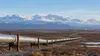
That gap does not mean the project is imaginary. Alaska LNG is a developed proposal with government permits, a private lead investor and a series of supply, labor and prospective customer agreements. Project records say Glenfarne Group controls 75% of the venture while the state-owned Alaska Gasline Development Corporation retains 25%. The plan calls for an approximately 807-mile pipeline from the North Slope to Southcentral Alaska, where gas would be liquefied near Nikiski and shipped to Asian markets.
The project’s public timetable anticipates a pipeline investment decision in 2026, an export-facility decision in 2027 and first LNG shipments in 2031. Those milestones still depend on financing, binding customer commitments and construction execution. A Reuters review found that the project has tentative agreements covering about 13 million metric tons of annual LNG sales but needs additional commitments—and must convert nonbinding arrangements into firm contracts—to support financing.
The project and the Senate race
The White House’s timing gives Sullivan an unusually prominent accomplishment to discuss five weeks before Election Day. The Republican incumbent has advocated for an Alaska gas pipeline for years and stood beside Trump as the president credited him with moving the project forward. An Alaska delegation statement called the announcement the most consequential step yet toward construction and said the project could lower in-state energy costs, create thousands of jobs and open Asian markets for North Slope gas.
Sullivan faces Democrat Mary Peltola, a former U.S. representative who finished ahead of him in Alaska’s open primary. Yet Peltola did not reject the project or the prospect of Korean investment. She welcomed the announcement and presented Alaska LNG as a bipartisan goal, according to the Alaska Beacon. That response narrows the policy disagreement: the campaign contest is less about whether Alaska should pursue the project than about who can credibly claim credit and who is being precise about its status.
Presidents routinely use official events to promote their policy records and support allied candidates. The legal and ethical question is not whether an administration may publicize economic policy, but whether its factual claims accurately describe what foreign partners have committed. What makes this announcement politically potent—and potentially vulnerable—is the contrast between the certainty of the White House presentation and the conditional language from South Korea. The project could ultimately receive substantial Korean backing, but that outcome cannot yet be reported as a completed investment.
What voters can measure
The announcement gives Alaska voters several concrete benchmarks. South Korea must complete its review and specify the amount, structure and timing of any investment. Developers must secure enough binding gas-purchase agreements to finance the pipeline and export terminal. The consortium must reach final investment decisions, and construction must meet a schedule that already extends beyond the current election cycle.
For now, Wednesday produced two valid but different developments: the Trump administration elevated Alaska LNG within a major U.S.-Korea investment framework, while Seoul preserved its ability to reject or reshape the proposal after further review. The politics were immediate. The investment remains conditional.