
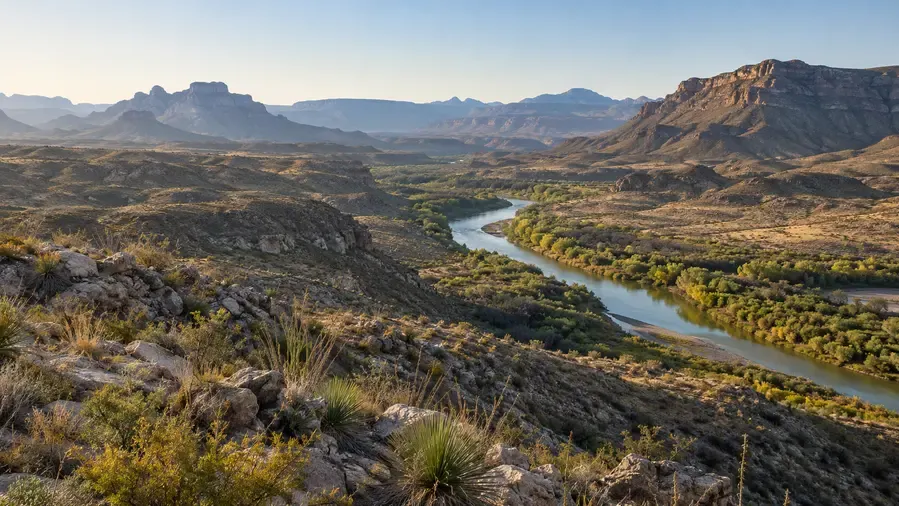
A federal judge has temporarily blocked the Trump administration from building border barriers, roads and related infrastructure across Texas’ Big Bend sector, freezing work in and around one of the country’s most remote national parks while a constitutional and environmental lawsuit proceeds.
U.S. District Judge Kathleen Cardone issued the preliminary injunction Friday after finding that the challengers were likely to succeed on at least one claim and could face serious, irreparable harm without court intervention. The order bars border-barrier construction and ground-disturbing activity unless the government complies with applicable law, according to parallel accounts from Reuters and the Associated Press.
The ruling is preliminary, not a final judgment on the legality of the project or the federal government’s waiver authority. Its immediate effect is more concrete: contractors cannot resume work across the Big Bend sector while the litigation continues unless the government changes course and follows the laws the waiver attempted to set aside.
A regional order with national stakes
Big Bend covers roughly 500 miles of the U.S.-Mexico border, about one-quarter of the entire southern boundary. The administration’s plans include a mix of vehicle barriers, access roads, lighting, sensors and surveillance technology. In the national park, officials had described infrastructure different from the 30-foot steel barriers used elsewhere, but local opposition focused on the roads and ground disturbance as much as the height or design of a wall.
The dispute tests how far the executive branch may go when using Section 102 of the 1996 Illegal Immigration Reform and Immigrant Responsibility Act. That provision gives the Homeland Security secretary authority to waive legal requirements considered necessary for rapid border construction. A July DHS notice expanded earlier waivers and said the Big Bend sector had recorded more than 89,000 Border Patrol apprehensions from fiscal 2021 through fiscal 2025. The department argued that barriers and roads were urgently needed to prevent unlawful entry.
The plaintiffs—Friends of the Ruidosa Church, river guide and landowner Danny William Miller Jr., and the Center for Biological Diversity—argue that the waiver is unconstitutionally broad. Their complaint says the construction would bypass environmental, historic-preservation and public-participation requirements while threatening property access, the Rio Grande corridor and culturally significant sites.
Those are allegations that remain to be proven. Cardone’s injunction indicates that at least one claim has enough legal merit, and the threatened harm enough urgency, to justify preserving the status quo. It does not erase the government’s underlying border-security authority or permanently cancel the projects.
Construction had already become a bipartisan flashpoint
Crews began clearing land in Big Bend National Park in August, prompting protests and several lawsuits. Customs and Border Protection Commissioner Rodney Scott then paused activity while he reviewed the plan and consulted local interests. The pause was temporary, however, leaving open the possibility that work could restart. Friday’s injunction replaces that discretionary pause with a binding court order.
The opposition has crossed party lines. Republican Sen. John Cornyn of Texas urged Homeland Security officials to consult local leaders and reconsider barriers in the parks. In an August letter, Cornyn relayed concerns about damage to landscapes and wildlife, threats to culturally important Native American sites, disrupted migration routes, reduced river access and economic harm to tourism.
Local reporting by the Texas Tribune found that opposition also reflects the region’s unusually low population density and terrain. The Big Bend sector covers vast distances but accounts for a small share of border apprehensions in many years. Federal officials counter that migration routes can shift when enforcement changes elsewhere and that physical infrastructure is meant to prevent future vulnerabilities, not only respond to current traffic.
What happens next
Customs and Border Protection said it remained confident in its legal authority and was working with the Justice Department on next steps. The government can ask Cardone to reconsider, seek appellate review or defend the case on the merits. It could also revise the project, conduct reviews under the laws now at issue or narrow the disputed waivers.
The challengers will still have to prove their constitutional claims. Their case raises questions about separation of powers, delegation of congressional authority, due process and access to judicial review. The government will likely emphasize that Congress repeatedly amended the border-barrier statute while retaining strong waiver language and that national security judgments traditionally receive substantial executive discretion.
The injunction therefore matters beyond one national park. If upheld, it could define limits on an authority used for border projects across multiple administrations. If overturned, it could reinforce the Homeland Security secretary’s ability to suspend a wide range of safeguards for rapid construction.
For now, the ruling does not resolve the national debate over border enforcement. It requires the administration to stop changing the Big Bend landscape while a court decides whether the legal shortcut used to accelerate that work went too far. Further hearings will determine whether the pause becomes a lasting restriction or a temporary interruption.