
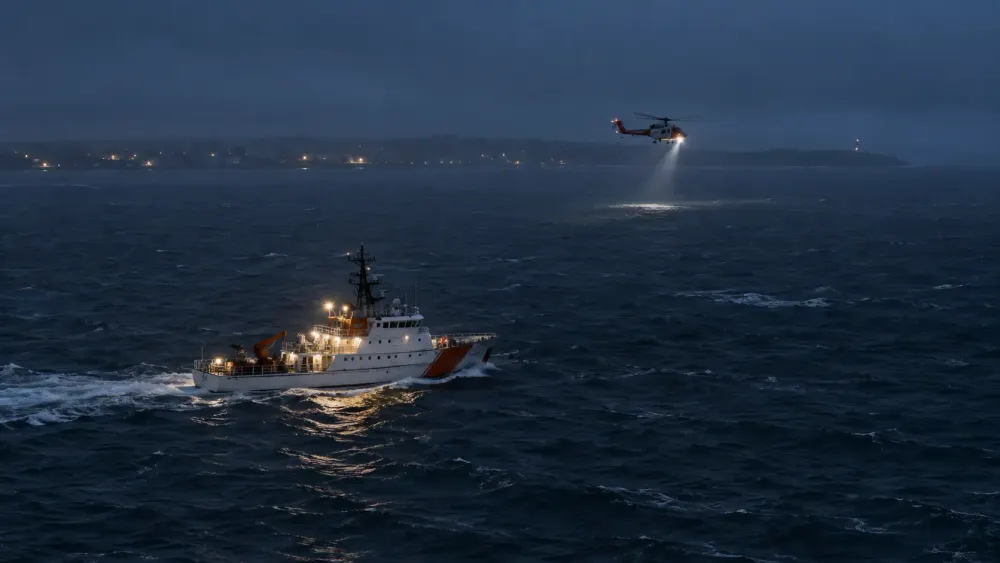
A U.S. Coast Guard search was underway Saturday morning off Nantucket for a medical-transfer jet carrying six people that lost contact with air traffic control while flying from Bermuda to Boston. The aircraft, a Gulfstream G100 registered as C-GRJP, remained unaccounted for as of midmorning, with aircraft and vessels working a search area south of the Massachusetts island.
The Coast Guard Northeast District said the Federal Aviation Administration reported losing contact with the jet early Saturday. The agency identified the route as Bermuda to Boston and said both air and surface crews had been launched. The latest official statement available did not report a confirmed location, wreckage or survivors.
The flight had departed L.F. Wade International Airport in Bermuda for Boston Logan International Airport, according to The Associated Press. Public flight-tracking data listed the trip as a late-night flight of roughly two hours. The aircraft’s FlightAware record identifies C-GRJP as an IAI Gulfstream G100, a twin-engine business jet.
FAA alert moved the case into search-and-rescue response
The FAA issued a Search and Rescue Alert Notice, known as an ALNOT, at about 1:20 a.m. local time, according to an agency statement provided to People. The Coast Guard said it was notified at approximately 2 a.m. The precise sequence between the aircraft’s last communication and the alert had not been fully detailed publicly.
An ALNOT is more than a missing-flight bulletin. Under the FAA’s air-traffic emergency procedures, the notice begins an extensive communications search and gives rescue coordinators information such as the flight plan, last known position and time, and transponder code. If the aircraft is not located through those checks, responsibility moves to the appropriate rescue coordination center for a physical search.
The FAA procedure initially directs facilities to check airports and communications along a corridor generally extending 50 miles on either side of the route from the last reported position to the destination. Search managers can widen that area based on the aircraft’s possible range and new information. Controllers are instructed to refine the last known latitude and longitude with available radar data and to pass later information to rescue teams. Those steps do not reveal what happened to this flight, but they show how a loss of contact is converted into a geographic search plan rather than treated as proof of a crash.
That framework helps explain why the operation quickly combined aircraft and boats. Reports citing the Coast Guard identified an HC-144 surveillance aircraft, an MH-60 helicopter, a 47-foot motor lifeboat from Station Brant Point and the fast-response cutter William Sparling among the assets involved. WCVB in Boston separately confirmed the Coast Guard’s air-and-surface search and the six people aboard.
What is known — and what remains unconfirmed
Authorities have confirmed the aircraft type, registration, route, number of people aboard and the general search area off Nantucket. Multiple reports have described the jet as a medical-transfer or air-ambulance aircraft. The flight record and aviation-photo databases associate the registration with Latitude Air Ambulance, a Canadian medical transport operator, but the company had not issued a public account of the people aboard or the purpose of the flight.
Officials also had not publicly identified the passengers or crew, described any medical patient, or established why communication ended. A local report said the pilot mentioned an electrical problem, but that detail had not been confirmed in the Coast Guard’s public statement or the FAA accounts cited by national outlets. It should therefore be treated as preliminary rather than established fact.
Flight-tracking graphics circulating online likewise cannot establish the cause of a disappearance. Commercial trackers may combine ground receivers, satellite feeds and estimated positions; gaps or abrupt changes can reflect coverage limitations as well as aircraft movement. They are useful for reconstructing a route, but the authoritative record will come from air-traffic data, cockpit or flight-data evidence if recovered, and the federal investigation.
The distinction matters in the first hours of any missing-aircraft case. Search agencies prioritize finding the aircraft and people aboard; accident investigators determine probable cause later, if the evidence supports doing so. The absence of a public update does not itself indicate either progress or failure, and online observations of search patterns cannot reliably show what crews have found.
Implications for travelers remain limited
The active search did not amount to a general closure of Boston Logan, L.F. Wade International Airport or Nantucket Memorial Airport, and authorities had not announced a broader hazard to commercial travel. Travelers using those airports should rely on their airline and official airport channels for individual flight status rather than infer disruption from the search itself.
The event does underscore the role of medical aviation in linking island communities and distant hospitals. Bermuda’s air connections to Boston are used for ordinary passenger travel as well as access to specialized care, and medical-transfer flights operate on demand rather than on published airline schedules. That makes the missing aircraft consequential beyond its small passenger count, while also requiring restraint until families are notified and officials release verified findings.
For now, the operative fact is an active rescue mission. The Coast Guard said it would provide updates as information became available. Until it confirms a discovery or changes the search status, claims about wreckage, cause or the condition of those aboard remain unverified.