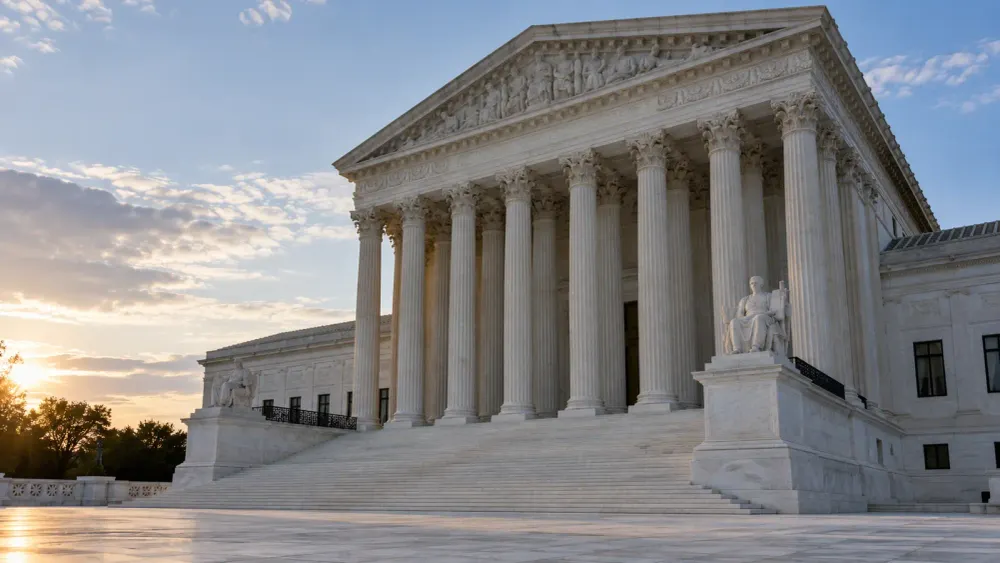
The Supreme Court agreed Thursday to decide whether the federal government may keep certain immigrants in custody throughout deportation proceedings without giving them a bond hearing, taking up a dispute that could affect millions of noncitizens living inside the United States.
In a one-page October 1 order, the justices granted review in Rhoney v. Barbosa da Cunha, No. 26-104. The case asks which of two detention provisions in federal immigration law applies to people who entered without inspection but were later arrested in the country’s interior. The answer will determine whether an immigration judge may consider release on bond while their removal cases proceed.
The Court’s intervention follows conflicting appellate rulings and thousands of challenges to a July 2025 policy that treated people who entered without inspection as “applicants for admission” subject to mandatory detention. Reuters reported that the policy departed from nearly three decades of practice under which many longtime residents could request bond. The Associated Press described the case as a test of a central part of President Donald Trump’s immigration crackdown.
Two statutes, sharply different consequences
The dispute turns on the relationship between Sections 1225 and 1226 of Title 8. Section 1225(b)(2)(A) requires detention of certain “applicants for admission” while the government decides whether they may enter. Section 1226(a), by contrast, generally permits the government to arrest and detain a noncitizen pending a removal decision but allows release on bond or conditional parole.
The administration argues that the statutory definition of an applicant for admission includes anyone present without having been admitted, even if the person has lived in the country for years. Its petition for Supreme Court review says the Fifth and Eighth Circuits adopted that reading, while the Second, Sixth, Tenth and Eleventh Circuits concluded that Section 1226 governs these interior arrests and permits bond hearings. The government said the split created an unworkable geographic patchwork in immigration enforcement.
Past practice is central but not dispositive. The Second Circuit said federal agencies had treated comparable detainees as eligible to seek bond for nearly 30 years. The administration responds that an agency’s prior interpretation cannot override what it sees as the statute’s plain text. The justices will have to determine which reading best fits Congress’s definitions and detention framework.
The challengers argue that Section 1225’s mandatory-detention rule is directed principally at people seeking entry, not longtime residents arrested away from the border. The American Civil Liberties Union, which represents the respondent, said the government’s reading could apply to millions and leave people detained for months or years without an individualized assessment of flight risk or danger. The ACLU’s claims describe its litigation position; they are not findings by the Supreme Court.
The case behind the national dispute
Ricardo Aparecido Barbosa da Cunha, a Brazilian citizen, entered the United States without inspection around 2005 and later applied for asylum. According to the Second Circuit’s decision, he had work authorization, operated a construction business, owned a home and had never been convicted of a crime when immigration officers arrested him in September 2025.
An immigration judge initially found him ineligible for bond under Section 1225. A federal district court ruled that Section 1226 applied instead and ordered the government to provide a hearing or release him. At the hearing, an immigration judge determined that Barbosa da Cunha was neither a danger nor a flight risk and released him on bond. A three-judge Second Circuit panel affirmed the statutory ruling in April, and the full appeals court declined rehearing in September.
The government’s Supreme Court petition emphasizes that other appellate courts read the same statutory language differently. It also notes that the Second Circuit resolved the case through statutory interpretation and constitutional avoidance rather than issuing a stand-alone decision that mandatory detention violated due process. That distinction could shape how broadly the justices rule.
What the Court will—and will not—decide
A bond hearing does not guarantee release or cancel a deportation case. It gives an immigration judge authority to examine whether detention remains necessary while the separate removal process continues. The Supreme Court’s decision will therefore concern the availability of that hearing, not whether Barbosa da Cunha or similarly situated immigrants may ultimately remain in the country.
The practical stakes are substantial. The administration says inconsistent circuit rulings have generated widespread habeas litigation and prevent uniform enforcement. The challengers say eliminating hearings imposes prolonged detention on people who may have families, jobs and deep community ties, regardless of their individual risk. Both AP and Reuters reported that most appellate courts to address the policy have rejected the administration’s interpretation, while the Fifth and Eighth Circuits have accepted it.
The Court did not decide the merits by accepting the case, and its order did not indicate how any justice views the statutory question. Briefing and argument will follow during the term that begins Monday. Until the justices issue a ruling, access to a bond hearing will continue to depend partly on where a detainee’s case arises, leaving the split that prompted review in place.