
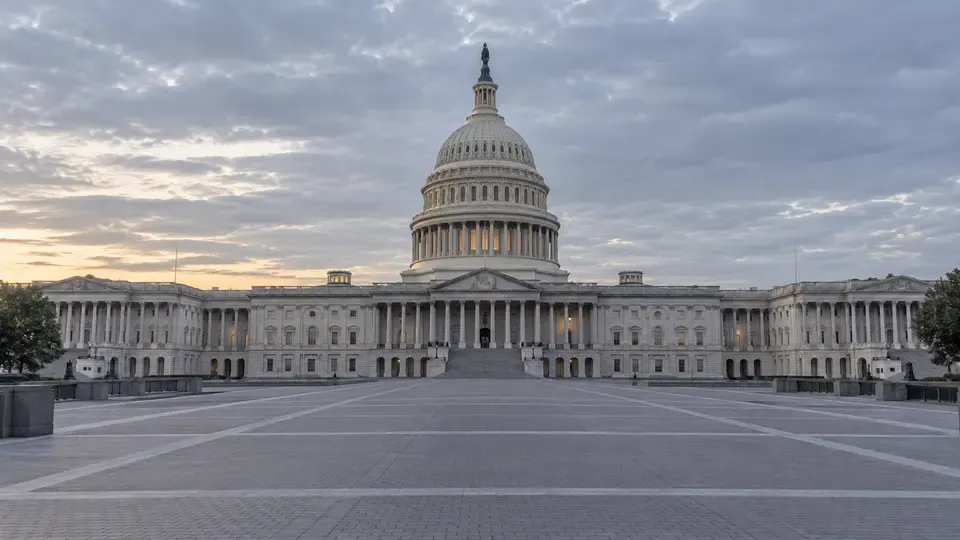
The House voted 220–204 late Tuesday to direct President Donald Trump to remove U.S. forces from hostilities with Iran, approving its third such resolution as the conflict approaches seven months.
The vote on H. Con. Res. 93 was a bipartisan rebuke but not an immediate end to the fighting. The official tally recorded support from all 213 voting Democrats and seven Republicans; 203 Republicans and the chamber’s lone independent voted against it, while nine members did not vote. The concurrent resolution invokes the 1973 War Powers Resolution, a law designed to limit sustained military action undertaken without congressional authorization.
President Trump is expected to reject the measure if it reaches him, and the Senate has not committed to taking it up before lawmakers leave Washington to campaign. Even so, the result matters politically. It widened the Republican break with the White House, put the economic cost of the conflict back at the center of congressional debate and gave both parties a fresh recorded vote less than seven weeks before the Nov. 3 midterm elections.
Republican defections widened
The seven Republicans who voted for the resolution were Tom Barrett of Michigan, Warren Davidson of Ohio, Brian Fitzpatrick of Pennsylvania, Nancy Mace of South Carolina, Thomas Massie of Kentucky, Mariannette Miller-Meeks of Iowa and Zach Nunn of Iowa. Mace, Miller-Meeks and Nunn were new additions to the group of Republican supporters, while the other four had backed earlier efforts.
The change was incremental but visible. An April vote on a similar resolution failed 213–214, with only Massie joining Democrats. By July, another measure passed 214–208 with four Republican votes. Tuesday’s seven GOP votes were still a small fraction of the conference, but they showed that opposition to the war is no longer confined to one Republican dissenter.
The defections also carried electoral weight. Miller-Meeks and Nunn represent Iowa districts where close races can turn on national conditions, while Massie has made opposition to unauthorized military action a defining issue. On the same day as the vote, Massie filed articles of impeachment against Defense Secretary Pete Hegseth, accusing him of carrying out hostilities without congressional approval. The effort is unlikely to succeed, but because Massie filed it as privileged, the House must address it within two legislative days, according to Reuters.
The resolution faces legal and procedural limits
The measure directs the president, under section 5(c) of the War Powers Resolution, to remove U.S. forces from hostilities with Iran. Congress enacted the law after the Vietnam War to require consultation and authorization when military action continues beyond statutory time limits. In practice, presidents of both parties have disputed congressional attempts to constrain their authority as commander in chief.
Tuesday’s vote therefore creates political pressure more readily than an operational order. The Senate would need to pass the same text, and Trump could veto it. Congress would then need two-thirds majorities in both chambers to override him, a threshold the House vote did not approach. Previous House actions have not produced a law requiring the administration to halt operations.
Supporters argue that repeated votes are still a core use of Congress’s constitutional authority. Opponents counter that Iran remains an active threat and that withdrawing forces could limit the president’s ability to protect U.S. personnel and allies. That dispute leaves the central question unresolved: whether Congress can translate a growing bipartisan objection into a binding restriction on a conflict the executive branch continues to conduct.
Costs are reshaping the debate
The vote came hours after the nonpartisan Congressional Budget Office released its first comprehensive estimate of the conflict’s direct military cost. CBO said operations had cost the Defense Department about $38 billion through Aug. 1, including replacement munitions, equipment losses, additional flying hours and fuel. If the fighting remains sporadic, the agency estimated another month would cost about $2 billion; at July’s intensity, the monthly cost would rise to roughly $3 billion.
The CBO analysis also warned that heavy use of missile-defense interceptors would leave inventories reduced for several years. The agency said its estimates carry substantial uncertainty because the Defense Department did not respond to requests for information. It separately found that reduced oil and gas shipments through the Strait of Hormuz, combined with Red Sea shipping disruptions, had pushed energy prices higher and added inflationary pressure.
Those effects connect foreign policy to the domestic campaign. Higher fuel costs reach voters directly, while the prospect of additional war funding competes with other federal priorities. The administration argues that its operations have weakened Iran’s military capacity and that continuing pressure protects U.S. interests. Democrats and the Republican defectors say the absence of explicit authorization and a clear endpoint makes that case harder to sustain.
The midterms now become the next test
The Associated Press described Tuesday’s action as likely the final House war-powers vote before the midterms, when control of both chambers will be decided. That timing makes the resolution both a constitutional challenge and a campaign document: lawmakers must explain not only what authority the president should have, but also how long the conflict should continue and what further costs they are prepared to accept.
The result does not by itself change U.S. military operations. It does, however, sharpen a trend across three recorded votes: the House moved from a one-vote rejection in April to passage in July and a larger bipartisan majority in September. The political significance lies less in the resolution’s immediate legal force than in that widening margin.
For Trump and congressional Republicans, the next question is whether opposition remains a limited faction or expands as candidates return home. For Democrats, the challenge is to convert repeated symbolic victories into either Senate action or an electoral mandate. Until then, the war continues, and Congress’s demand for a larger role remains formally expressed but operationally unfulfilled.