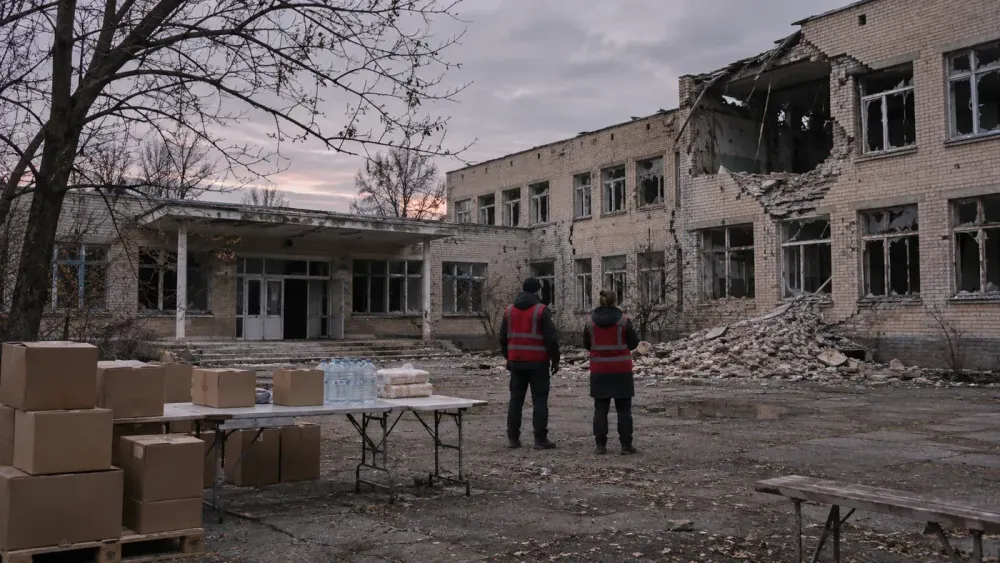
Russian aerial bombs struck a school used to distribute humanitarian aid and a nearby shelter in the southeastern Ukrainian village of Komyshuvakha on Monday, killing at least 24 people as rescue crews searched the ruins. Ukrainian President Volodymyr Zelenskyy later said the toll had risen to 26, while five people remained hospitalized and others were still believed trapped.
Reuters reported that the first bombs hit a school where residents received assistance, followed by nine more bombs aimed at the shelter where people had gathered. The AP independently reported the two locations, the rising toll and continuing searches.
The strike came one day after a six-day humanitarian ceasefire expired in the neighboring Kherson region. That timing does not prove the two events were operationally connected, but it sharply narrows hopes that the limited pause around Oleshky could become a model for broader de-escalation.
A strike in two waves
Ukrainian officials said Komyshuvakha’s school was no longer holding classes because the community lies close to the front. The building and its shelter had instead become a humanitarian site, with aid distributed there each Monday to residents who remained in the village. Zelenskyy said people were present for that scheduled distribution when the first bombs fell.
The second wave struck after emergency workers and police reached the scene and people moved into shelter. Ukraine’s emergency service said two rescuers and four police officers were among the 24 confirmed dead in its detailed count. Two other rescuers were wounded. A gym and outbuilding were destroyed and a fire-and-rescue vehicle was lost.
Those details support the central sequence described by both international news agencies: an initial attack on the aid site, followed by additional bombs around the shelter and response area. They also explain why the casualty count rose quickly during the day as crews reached collapsed sections of the complex.
The death toll remains fluid
Early local reports listed one person killed and two wounded. By late afternoon, officials reported 18 deaths, then 24. The regional authority subsequently announced a day of mourning and said people remained missing. Zelenskyy later put the toll at 26, saying most of those killed were civilians who had come for aid or responders who arrived after the first strike.
Reuters and AP had independently confirmed 24 deaths before the later presidential update. Because recovery work was continuing and officials had not published a final list, all figures remained provisional at publication time.
Ukraine said repeated air-raid warnings and the threat of more attacks slowed work at the site. Photographs and video reviewed by international news organizations showed smoking rubble and a large impact area, but independent investigators had not yet issued a public assessment of the weapon types or targeting process.
A humanitarian opening closes
The bombing followed the expiration of the longest localized pause reported since Russia’s full-scale invasion began in 2022. The truce around Russian-held Oleshky started Oct. 27 to allow food and medicine deliveries, road clearing and the evacuation of civilians from an area cut off by front-line fighting.
Ukraine’s military accused Russian forces of using that pause to rotate units, improve fortifications, strengthen anti-drone defenses and replenish ammunition. The Kremlin said it lacked specific information but assumed Ukrainian forces had also regrouped, calling that standard practice during ceasefires. A Reuters account recorded both positions and noted that Ukrainian and Russian officials agreed the humanitarian obligations were observed while the pause was active.
The Oleshky operation evacuated civilians and delivered aid while both sides maintained enough restraint for the mission to proceed. Earlier reporting described it as the most significant local truce of the war. Komyshuvakha shows how little protection that precedent offered outside the agreed zone once the pause ended.
What is verified, and what is not
The identity and function of the school complex are supported by the Ukrainian government, emergency service, regional authority and two independent news agencies. The initial and follow-on strikes are also consistently described across those sources. The later count of 26 comes from Zelenskyy and had not yet been separately updated by Reuters or AP when this article was prepared.
Russia had not publicly addressed the Komyshuvakha strike in the reports available Monday. That absence leaves unresolved whether Moscow disputes the location, the civilian use of the buildings or the sequence described by Ukraine. It also means there is no Russian account of the intended military objective, if any.
Claims about intent require more evidence than the physical sequence alone. The timing and placement of the second wave raise urgent questions, especially because responders were killed, but a legal judgment would require an investigation into targeting information, weapon guidance, expected civilian presence and the precautions taken by those who ordered the attack.
The consequences extend beyond one village
Front-line settlements depend on fixed distribution points because many residents are older, have limited transport or cannot safely travel long distances. Turning a school into an aid center can concentrate assistance and shelter in one place, but it also creates a predictable schedule that becomes dangerous when fighting reaches the community.
The deaths of rescuers and police compound that risk. Every responder lost reduces the capacity to reach people after the next strike, while renewed attacks can force crews to suspend searches at the moment survivors have the best chance of being found. That pressure can also accelerate evacuation from communities whose remaining residents have few safe alternatives.
A local ceasefire can save lives when its terms are honored, yet it does not create momentum by itself. Extending humanitarian access requires specific agreements, reliable communication and protection for aid workers and rescue crews. Komyshuvakha has made the distance between a one-off pause and sustained de-escalation harder to ignore.