
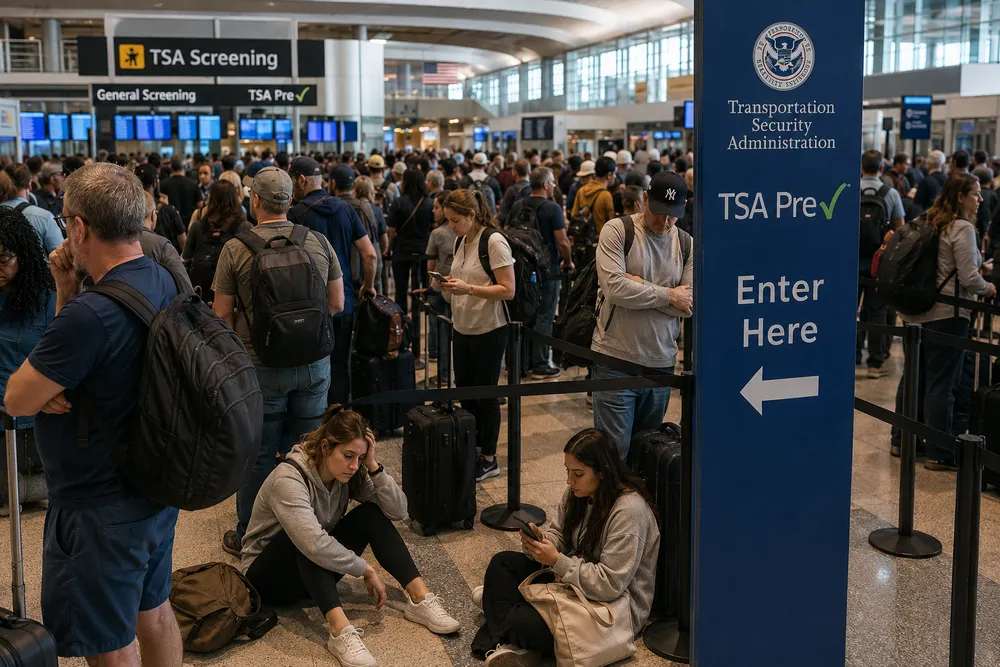
Roughly 700 federal security officers at Tampa International Airport are on track to lose their jobs to a private contractor by May 2027, part of a broader Transportation Security Administration plan that marks the most significant rollback of post-9/11 airport security structure in the program's 25-year history, according to a letter from Democratic Rep. Kathy Castor. The initiative, known as TSA Gold+, would for the first time put private companies in charge not only of screening passengers but of owning and operating the checkpoint technology itself — the scanners and explosive-detection machines that have anchored federal aviation security since Congress created the TSA in the wake of the September 11 attacks.
The TSA notified its employee union last month that Gold+ will launch at three airports: Tampa International, Charleston International in South Carolina, and Des Moines International in Iowa, according to the union representing TSA employees. A contractor is expected to be chosen in September, with Tampa's transition targeted for completion by 2027, according to reporting from the Tallahassee Democrat. Unlike the TSA's existing Screening Partnership Program, which already allows private contractors to staff checkpoints at roughly 20 smaller airports under direct federal oversight, Gold+ contractors would also control the equipment used to detect weapons and explosives — a structural change the union says has never before been attempted at a major commercial hub.
A break with the post-9/11 security model
Airport screening in the United States was privately run before 2001, a system widely blamed for security gaps that contributed to the September 11 hijackings. Congress federalized the workforce that same year specifically to close those gaps. AFGE national president Everett Kelley called Gold+ "a major departure and step backwards" from that framework, arguing the shift echoes an era the country moved away from for a reason, in a statement carried by AFGE. Kelley said decisions of this scale should not proceed "without the input of Congress, the flying public, the local airport authorities, and TSA employees themselves."
Castor, whose district includes Tampa International, made a similar argument in an August 4 letter to the airport's CEO and its governing aviation authority, framing the plan as a threat to both jobs and safety. She noted the timing lands close to the 25th anniversary of the September 11 attacks, writing that "to weaken aviation security now is to forget the lessons learned at great cost and the recommendations of the 9/11 Commission," according to her press release. She also raised a data-security concern largely absent from earlier privatization debates: that handing checkpoint technology to a for-profit vendor could expose travelers' personal information to breach or misuse.
Tampa's rationale: shutdown-proofing the checkpoint
Airport officials frame Gold+ differently — as insurance against the operational chaos caused by federal government shutdowns. During recent lapses in federal funding, TSA officers went unpaid, absenteeism climbed, and airport leaders said as many as 14% of Tampa's screening staff quit outright, with replacements taking up to six months to recruit and train, according to the Tallahassee Democrat. Airport officials argued that predictable staffing matters enormously for a facility moving roughly 70,000 passengers a day, and that privatization "reduces disruption risks caused by lapses in federal appropriations." They also contend a contractor could adopt new screening technology faster than federal procurement rules typically allow.
Under the plan, the contractor would still operate with federal funding and would be legally required to meet the same training and security standards as TSA employees, since those standards are set by federal statute rather than agency discretion. Existing TSA officers in Tampa, Charleston and Des Moines would get first right of refusal on jobs with the incoming contractor, with severance or retirement benefits available to those who don't transition, according to the Guardian.
Part of a much larger workforce shift
Gold+ is one piece of a wider push to shrink the federal screening workforce. The administration's fiscal year 2027 budget proposal would eliminate roughly 8,400 transportation security officer positions — about 14% of the agency's screening staff — with roughly 4,500 of those replaced through a mandatory expansion of the existing Screening Partnership Program to cover all of the country's smaller Category III and IV airports, according to AFGE. That would take the number of U.S. airports using private screeners from about 20 today to roughly 220. Separately, TSA deputy administrator Adam Stahl said in May that Gold+ could eventually incorporate artificial intelligence to replace some human screeners altogether, the Guardian reported.
The administration has also tried twice in the past year — first in March, then again in December — to strip TSA employees of collective bargaining rights entirely; both attempts were blocked by federal judges. Union officials see Gold+ as a parallel track toward the same end. Chris Finlay, a Tampa TSA officer and local union president, told the Guardian that contractors "operate as businesses" rather than out of public duty, recalling a prior experience at another Florida airport where a contractor cut screener pay weeks after promising no change, and citing a 2015 case in which a contractor employee was fired after reporting that a steak knife had passed through a private checkpoint.
What happens next
TSA has publicly defended the plan in more measured terms, telling the Guardian that Gold+ would deliver Tampa "exceptional service to every traveler," improved efficiency and operational stability through the transition. The agency's contractor selection, expected in September, will be the next concrete milestone, followed by a phased handover intended to be complete by mid-2027. Whether Congress or airport authorities intervene before then remains unresolved — Castor's letter explicitly calls on Hillsborough County's aviation authority to reject the plan outright, while AFGE says it is exploring legal options to block it.
For travelers, the immediate experience at Tampa, Charleston and Des Moines is unlikely to change overnight; contractors must meet identical federal security standards and cannot alter screening procedures unilaterally. The larger significance lies in precedent: if a major hub like Tampa successfully transitions its entire screening operation, including equipment ownership, to a private company, it would establish a template the administration has signaled it wants to extend far beyond three airports — reopening a structural debate about who is responsible for aviation security that Congress believed it had settled in 2001.