
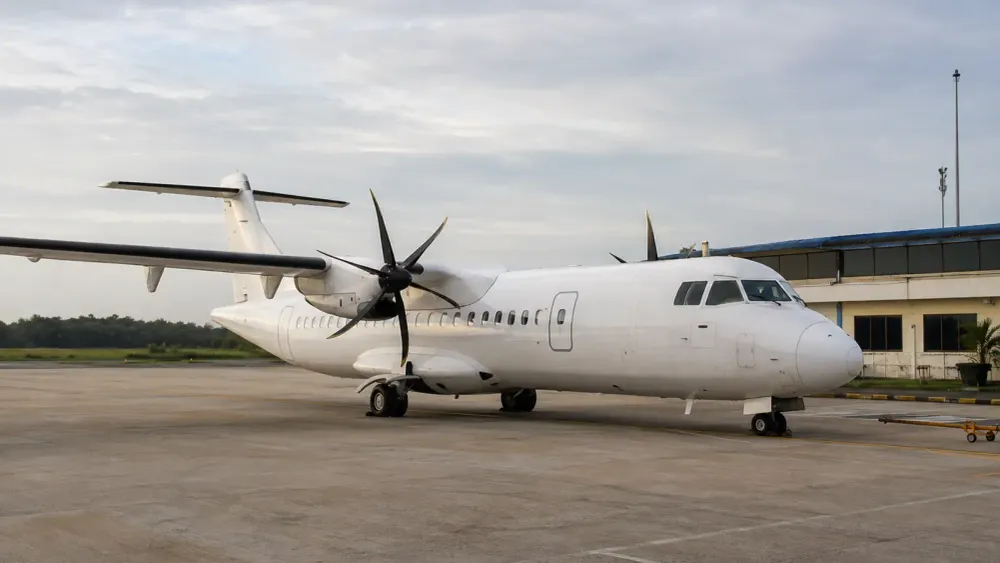
Fly91 placed a firm order Thursday for 40 ATR 72-600 turboprops worth about $1 billion at list prices, committing the two-year-old Indian carrier to one of the largest regional-aircraft expansions now planned anywhere in the world. The agreement calls for deliveries from 2027 through 2032 and would lift the Goa-based airline from six aircraft today to roughly 60 when leased planes are included. ATR said it was its largest firm order in almost a decade and the largest ever from a regional airline.
Fly91 is not simply adding capacity on India’s busiest trunk routes. It is betting that smaller cities can sustain short flights using aircraft designed for lower passenger volumes and shorter runways. Chief Executive Manoj Chacko told Reuters that only about 70 of India’s more than 160 functioning airports receive narrowbody jet service.
Yet an aircraft order is a commitment to future capacity, not proof of future demand. Fly91 has not finalized financing, has not recorded an annual profit and currently receives government support on 98 of its roughly 280 weekly flights. Its expansion therefore tests whether India’s publicly backed airport buildout and regional subsidies can produce durable travel markets after the initial support tapers away.
A Network Built Beyond the Biggest Hubs
Fly91 began commercial service in March 2024 with a deliberately regional model. The carrier says it has since completed more than 15,000 flights and serves 12 cities, with a 13th destination due to open this month. Its disclosure presents the new order as the base for connecting more places that are either unserved or poorly linked, rather than challenging larger airlines flight for flight between Delhi, Mumbai and Bengaluru.
That distinction shapes both the opportunity and the risk. Thin routes may have meaningful demand but not enough passengers to fill an Airbus A320 or Boeing 737 several times a day. A smaller aircraft can match capacity to the market and make a nonstop viable where travelers otherwise face a long surface journey to a metropolitan hub.
Fly91 plans to lease six to eight aircraft before the ordered planes begin arriving in the second half of 2027, taking the fleet to between 12 and 14 by late next year. The order alone would bring the fleet to 46 if every current plane remains, so the company’s roughly 60-aircraft goal implies additional leased capacity. That sequencing gives management a chance to add routes before its purchase deliveries accelerate, but it also requires the carrier to coordinate financing, crews, maintenance and airport slots across several years.
Why Turboprops Fit Smaller Airports
The ATR 72-600 is built for the operating problem Fly91 wants to solve. The manufacturer lists seating for as many as 78 passengers, a full-passenger range of 1,370 kilometers and a takeoff distance of 1,315 meters in standard conditions. Those specifications permit service at airports and on short sectors where a larger jet may carry too many seats or require more runway than the local market and infrastructure justify.
Turboprops trade speed for economics on short flights. Propellers are efficient at lower altitudes and speeds, while a smaller airframe reduces the number of seats an airline must sell to cover a departure. ATR says its aircraft burn about 30 percent less fuel than similar-size regional jets, although that is a manufacturer comparison and actual results depend on route length, payload, weather and airport operations.
The aircraft choice also concentrates technical exposure. A single-type fleet simplifies training, spare parts and maintenance, but makes the airline more dependent on one manufacturer, engine family and delivery schedule. ATR delivered fewer planes than guided in 2025 while reporting 50 net orders, and said it was investing for a 2026 ramp-up. Fly91’s first delivery is still more than a year away.
Government Support Remains Central
India’s Regional Connectivity Scheme, commonly called UDAN, lowers the risk of starting service to smaller airports through viability-gap funding and other concessions. The Civil Aviation Ministry reported that the program had connected 95 airports, supported 677 routes and carried 16.8 million passengers through June 30. Its dashboard put cumulative viability-gap funding at 48.81 billion rupees, making public support a substantial component of the regional market rather than a marginal incentive.
Fly91 illustrates the mechanism directly. Chacko said the airline receives about $1.16 million a month for 98 flights a week, with half the seats on those departures covered by viability-gap funding. That support can allow a route to build awareness and traffic before it is fully commercial, while giving communities more reliable links to jobs, medical care, education and connecting flights.
The government is promoting a larger second phase. Civil Aviation Minister Kinjarapu Ram Mohan Naidu said UDAN 2.0 carries an investment of 288.4 billion rupees to bring more tier-two and tier-three cities into the national economy. The purchase aligns private capacity with that policy, but subsidies do not eliminate the need for fares and schedules passengers will choose once support ends.
The policy’s record is mixed. A March parliamentary answer said 663 routes had been launched by February 28 and 327 had been discontinued. The government attributed closures to the pandemic, aircraft shortages, supply-chain and maintenance problems, airport work and weak demand; it also said 167 discontinued routes linked airports that had become formally served after earlier intervention. Those figures show that launching a route and creating a self-sustaining market are different achievements.
India’s Aviation Growth Is Uneven
The national market is large enough to support ambitious forecasts. India handled about 420 million domestic and international passenger journeys in the fiscal year ended March 2026, according to an industry summary of official data, while its airport network grew from 74 in 2014 to 164 in 2026. The same figures show domestic passenger traffic increased only 1.4 percent in the latest fiscal year, however, a reminder that long-run growth does not move in a straight line.
Current schedules are similarly uneven. OAG counted 23.5 million seats in India for August, down 1.5 percent from a year earlier, with domestic capacity off 0.6 percent. Delhi capacity rose 12.1 percent, while Kerala fell 22.7 percent and Goa, Fly91’s home state, fell 13 percent. The data measure scheduled seats rather than tickets sold, but they show why an airline cannot rely on national growth alone when deciding which smaller-city pairs to serve.
Competition also remains concentrated. IndiGo controlled half of scheduled capacity in August, with Air India at 14 percent. Fly91’s six-aircraft fleet is tiny by comparison, which favors focus but leaves less room to absorb disruption. Regional operators have failed when costs, airport readiness or demand moved against them; July reporting found that only 336 of 669 previously launched UDAN routes were still operating.
Financing and Execution Will Decide the Outcome
The headline value of the order is not the cash Fly91 will necessarily pay. Large aircraft purchases are routinely discounted, and Chacko said the airline secured an undisclosed reduction from the roughly $1 billion list price. He also said financing talks with lessors and lenders were continuing. Fly91 has raised $26.3 million and is seeking another $26.3 million, with existing investors subscribing about one-quarter of the new round, according to Reuters.
Management says the company is debt-free, expects to reach cash break-even by the end of the current financial year and targets accounting break-even one year later. Those are company projections, not audited outcomes. The delivery schedule limits the immediate cash burden, but scaling from six aircraft to roughly 60 will require considerably more capital, trained personnel and dependable maintenance capacity than operating the current network.
For travelers in smaller Indian cities, the order establishes that a carrier and manufacturer are prepared to place real capacity behind a long-promised expansion of regional air service. It does not establish which routes will open, what fares passengers will pay or how many will survive without subsidy. The next evidence will come from Fly91’s interim leases, financing close, early route performance and the government’s design of UDAN 2.0. Those milestones will determine whether Thursday’s order becomes a durable network or primarily a statement of ambition.