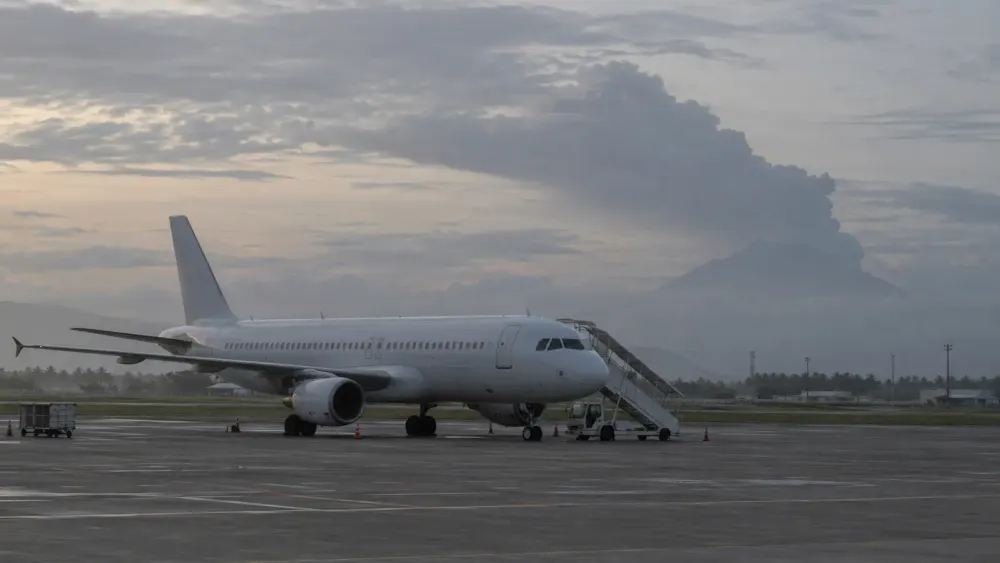
At least 209 flights carrying about 22,800 passengers were disrupted Sunday after ash from Anak Krakatau forced Indonesia to suspend operations at Jakarta’s Soekarno-Hatta International Airport. The halt affected domestic and international services at the country’s busiest gateway, leaving 170 aircraft parked on the apron after an overnight buildup. Authorities reported no casualties or evacuation orders around the volcano, but the scale and altitude of the ash made an immediate aviation response unavoidable.
The airport’s initial closure was extended to 9:30 a.m. local time, according to the first Reuters report. By then, the interruption had reached routes to Singapore, Hong Kong, Sydney, Amsterdam, Seoul, Doha and Kuala Lumpur, as well as major domestic links including Bali, Surabaya, Makassar and Lampung. Cancellations and diversions can continue after a runway reopens because crews, aircraft and airport slots are no longer where airlines planned them to be.
The episode shows why volcanic ash creates a different kind of travel emergency from a thunderstorm or a short mechanical delay. An eruption can be brief while its ash cloud remains mobile for hours, spreads across several flight levels and crosses multiple air-traffic regions. For passengers, the practical question is therefore not simply when the terminal resumes departures, but when airlines can safely rebuild a network around changing atmospheric information.
Two Ash Clouds, Two Operational Problems
Indonesia’s Geological Agency recorded a roughly 30-second eruption at 3:53 a.m. Sunday after activity had intensified since Friday, according to the AP account. Observers identified two distinct ash layers: one reaching about 20,000 feet and another climbing to roughly 50,000 feet. Those heights matter because they overlap both the climbing and descending phases near Jakarta and the cruising altitudes used by long-haul aircraft.
A 3:30 UTC VAAC bulletin from the Darwin Volcanic Ash Advisory Centre sharpened that picture. It described the high-level cloud at flight level 500 as detached from the volcano and moving southwest at about 20 knots. Continuous emissions up to flight level 200 were moving west at about 10 knots, while remnants from an earlier eruption were also drifting east. The bulletin projected both ash areas through the following 18 hours, underscoring that the hazard was evolving rather than ending with the initial blast.
That split creates two planning problems. The lower plume can interfere with approaches, departures and airport surfaces, while the higher plume can block overflight routes far from the cone. Wind changes can also move ash toward airspace that appeared clear in an earlier forecast. Airlines must compare satellite observations, dispersion models, pilot reports and official notices before deciding whether to cancel, reroute or delay a flight.
Why Airlines Do Not Fly Through Ash
Volcanic ash is not soft fireplace residue. It contains hard, abrasive fragments of rock, minerals and volcanic glass. The USGS explains that particles can scour windscreens, pit leading edges and contaminate instruments. Inside a hot jet engine, glassy material may melt, adhere to components and then solidify, disrupting airflow and potentially causing compressor stalls or a loss of thrust.
The hazard is broader than the engines. IATA guidance identifies possible damage to electrical, pneumatic and hydraulic systems, along with abrasion and sensor problems. Ash clouds can be difficult to distinguish from ordinary clouds at night or in poor visibility, and weather radar is not designed to provide pilots with a dependable map of airborne ash. Avoidance, backed by specialist monitoring, remains the core defense.
International coordination is built around an ICAO network of volcano observatories, volcanic ash advisory centers, meteorological offices, air-traffic control centers and notice-to-airmen services. Its purpose is to move observations quickly from scientists to the people dispatching and flying aircraft. A related ICAO contingency plan stresses collaborative decisions and operator risk assessments. It also notes that ash deposited on a runway can degrade braking, so a clear flight path alone does not necessarily make an airport usable.
Jakarta’s Hub Creates Cascading Delays
Soekarno-Hatta concentrates a large share of Indonesia’s domestic connections and international traffic. When 170 overnight aircraft cannot depart, the consequences spread beyond travelers booked on the first canceled flights. An aircraft scheduled to fly Jakarta–Makassar may later be assigned to another city pair; its crew may reach duty-time limits; and a gate intended for an arriving flight may still be occupied. Every delay consumes some of the spare capacity needed for recovery.
The 209 affected movements included the busiest domestic disruption on services to Makassar, while Singapore was the most affected international destination, AP reported. The route list illustrates the airport’s reach: regional shuttles, resort traffic and intercontinental connections were caught by the same closure. Travelers connecting through Jakarta may miss onward flights even when their first airport is far from the ash cloud.
Airlines usually restart cautiously rather than release all waiting aircraft at once. Dispatchers must confirm that the route and destination remain viable, airports must sequence accumulated departures and arrivals, and ground teams must handle passengers and baggage from disrupted rotations. Some aircraft may need inspection if ash exposure is suspected. A closure lasting several hours can therefore leave timetable effects that persist through the day or into the next operating period.
Travelers Face a Moving Target
Passengers should verify status through their airline’s app, website or contact center before traveling to the airport. An airport reopening announcement does not guarantee that a particular aircraft or crew is ready. A traveler with a connection should ask the operating carrier to protect the entire itinerary at once, because changing only the first segment can leave an onward reservation intact but unusable.
Volcanic ash is generally treated as an extraordinary safety event, but refund, rebooking, lodging and meal obligations vary by ticket, airline and jurisdiction. Travelers should request the available choices in writing, keep receipts and save cancellation notices for an insurer or card benefit administrator. Those on separate tickets face greater risk because the second carrier may not recognize the first flight’s disruption as its responsibility.
Flexibility matters more than chasing a single predicted reopening time. A routing through another Indonesian hub may help some passengers, but it can also move them toward airspace that is later constrained. Travelers should not infer that every Indonesian airport is closed: the hazard depends on the plume and route. At the same time, a flight to an airport outside the visible ash area may still be canceled because its aircraft is stranded in Jakarta.
The Volcano Risk Extends Beyond the Terminal
Officials said the nearest settlement was more than 16 kilometers from Anak Krakatau and advised visitors to remain at least three kilometers from the crater. Emergency authorities also urged residents exposed to ash to use masks and eye protection, limit outdoor activity, cover water supplies and drive carefully. Schools and fishing activity in some areas were halted as a precaution, widening the event beyond aviation without indicating a mass evacuation.
Anak Krakatau’s history makes clear communication especially important. A flank collapse in 2018 generated a tsunami that killed hundreds around the Sunda Strait. Officials said there was no sign of an imminent tsunami in Sunday’s event, so the prior disaster should not be used to imply a threat that authorities have not identified. The current travel hazard is airborne ash, with separate local precautions around the volcano.
The volcano has remained active between major disruptions; the Smithsonian’s recent activity log documents continuing emissions before this episode. For travelers and airlines, the decisive updates will come from new ash advisories, airport operating notices and carrier-specific schedules. The cancellations are costly and inconvenient, but the system is performing its essential function: trading timetable certainty for a wider safety margin while the atmosphere remains uncertain.