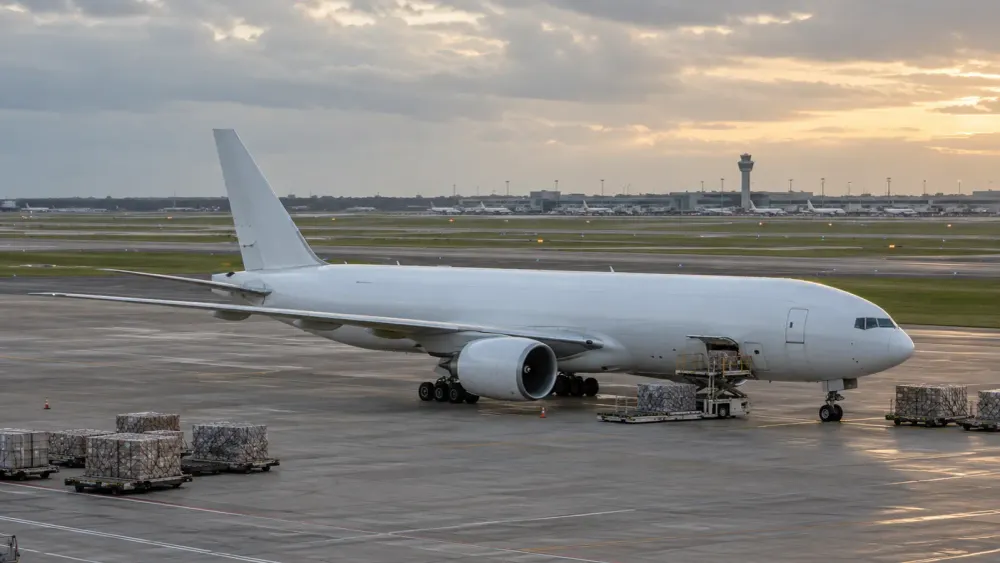
At least five people were killed and five others injured Sunday when a 21 Air Boeing 767 cargo jet operating for Amazon overran a runway at Miami International Airport, struck vehicles beyond the airfield and caught fire, authorities said. Three of the injured were in critical condition. The accident turned one of the country’s busiest international gateways into an emergency scene and forced an immediate halt to arriving and departing flights.
The aircraft, Flight 7598, had arrived from San Juan, Puerto Rico, when it ran past Runway 30 shortly before 2 p.m. Eastern time, according to an FAA statement. Miami-Dade officials said the pilot and copilot were trapped in the wreckage, while at least two people were killed in vehicles on a road used by nearby businesses and warehouse workers. More than 60 rescue units and roughly 200 personnel responded as crews confronted fire and a fuel leak.
The disruption spread quickly through the passenger network. By late Sunday, more than 160 flights had been canceled and nearly 325 delayed, with some arrivals diverted as far as Orlando, the Associated Press reported. Two of Miami’s four runways had reopened by evening, but officials warned travelers to confirm flights with airlines while investigators and recovery crews occupied part of the airport.
What the evidence establishes
The confirmed sequence remains short. The twin-engine freighter landed, continued beyond the usable pavement and crossed the airport boundary before coming to rest near a parking area. Public tracking data identified the aircraft as N1997A and showed it leaving the runway area at a recorded groundspeed of about 112 knots. That figure helps define the energy investigators must explain; it does not, by itself, reveal why the aircraft failed to stop.
Thunderstorms were in the area, and airport observations reported gusty winds around the time of the accident. Those conditions will be examined alongside runway surface information, the jet’s approach and touchdown, braking and reverse-thrust performance, crew actions and any mechanical warnings. None has been established as a cause. Images or videos of the final seconds cannot substitute for synchronized flight-recorder, cockpit, weather, maintenance and airport data.
The National Transportation Safety Board sent a team led by Chair Jennifer Homendy and planned its first media briefing for Monday, according to the agency’s initial update. The FAA is investigating as well. Amazon, 21 Air and Boeing said they were cooperating, while the airport’s immediate priorities remained firefighting, victim recovery, safe runway reopening and the management of stranded passengers.
Why Miami’s disruption travels
Miami International handled 55.3 million passengers in 2025, an average of more than 151,000 per day, according to official airport data. About 45% were international travelers. The airport lists 57 passenger airlines and 190 nonstop destinations, making it a crucial bridge between the United States, Latin America and the Caribbean as well as a large domestic connecting hub.
Closing every runway, even for part of a day, therefore produces more than a local queue. Incoming aircraft may be held, diverted or canceled before departure; crews and airplanes then finish the day in the wrong cities. Travelers can miss onward connections, while limited replacement seats push recovery into subsequent schedules. Cargo restrictions may also matter because Miami is a major freight gateway, although Sunday’s publicly reported cancellation totals chiefly described passenger flights.
Reopening two runways restored some capacity, but it did not instantly restore the timetable. Airlines still had to reposition aircraft and crews, manage duty-time limits, refuel diverted flights and rebook passengers. Travelers with Monday itineraries faced a sensible but unglamorous task: verify the flight directly with the airline before leaving, preserve receipts if disrupted and avoid assuming an airport-wide reopening meant every individual service would operate.
The safety zone beyond a runway
A runway excursion is an aircraft veering off or overrunning the runway surface. The primary physical safeguard beyond a runway end is the runway safety area: a graded, obstacle-reduced zone intended to lower the consequences when an aircraft does not stop where expected. FAA guidance says a standard area can extend 1,000 feet beyond the runway end, but older airports may be constrained by roads, water, buildings or other development.
Where a full safety area cannot fit, some airports install an engineered material arresting system, a bed of crushable material designed to decelerate an overrunning aircraft. The AP reported that Miami did not have such a system at the accident runway. The FAA’s EMAS guidance explains the technology and credits completed beds with stopping aircraft safely, but its absence here does not establish why the overrun happened or prove that a particular installation would have prevented the fatalities.
That distinction matters because stopping performance depends on aircraft weight, speed and path, the point where the aircraft leaves the runway, terrain and the geometry available beyond it. Investigators will reconstruct those conditions before judging whether airport infrastructure met applicable standards and how much protection the overrun area provided. The event may prompt a fresh review of barriers, roads and safety zones, but a policy conclusion drawn before measurements would outrun the evidence.
An older aircraft, not an answer
The jet was a Boeing 767-300 manufactured in 1994, according to the FAA registry. It entered service as a passenger aircraft and was converted to carry freight in 2015. Its registration was current. Passenger-to-freighter conversions are common in air cargo because widebody aircraft can retain useful economic life after leaving passenger fleets, provided operators comply with inspection, maintenance and operating requirements.
Age and conversion history give investigators a roadmap for records to collect; they are not findings of fault. The NTSB will examine the airframe, landing gear, tires, brakes, engines and control systems, then compare physical evidence with maintenance histories and recorder data. It will also scrutinize the operator’s training, procedures and operational decisions. The question is whether a specific condition or action contributed, not whether a three-decade-old airframe looks old on a calendar.
Amazon contracts airlines to fly cargo rather than operating these aircraft with its own crews. A separate Amazon-contracted 767 crashed near Houston in 2019, killing three people, but the NTSB’s final findings attributed that accident to the first officer’s inappropriate response to an inadvertent go-around activation and resulting spatial disorientation, with other crew and hiring factors. That established chain is not evidence about Sunday’s runway overrun.
What investigators must resolve
Flight-data and cockpit-voice recorders, if recoverable, can establish the approach configuration, touchdown point, airspeed, braking commands, thrust reverser deployment, cockpit warnings and crew coordination. Investigators will align those records with air-traffic communications, surveillance tracks, weather observations and runway inspections. Tire marks, debris and ground scars can help calculate the aircraft’s path and changing speed after touchdown.
Officials must also account for the consequences beyond the runway: which vehicles were struck, whether the road or parking area had protective separation, how quickly responders reached the victims and whether fuel or wreckage created further hazards. Those questions belong beside the cockpit investigation because runway safety is designed around both preventing an excursion and limiting harm when one occurs. The deaths of people outside the aircraft make that boundary especially important.
For travelers, the immediate facts are stark but narrower than the speculation: a cargo jet overran a runway, at least five people died, hundreds of flights were disrupted and only part of the airfield had reopened by Sunday evening. The first NTSB briefing may refine the timeline, but a probable cause will take far longer. Until the recorders, wreckage and runway evidence are analyzed together, the responsible conclusion is that the consequences are known and the mechanism is not.