
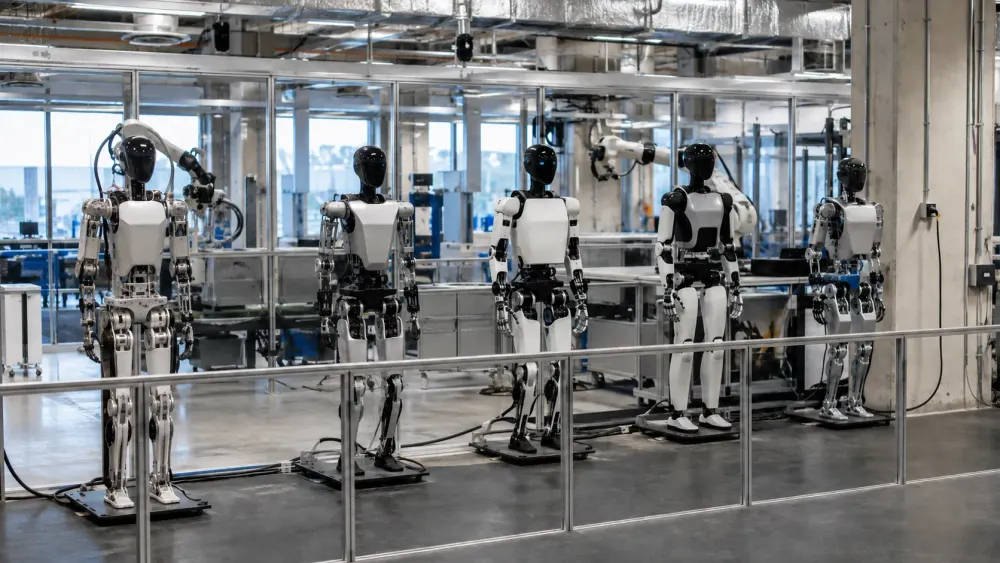
Nvidia is extending its artificial-intelligence platform from data centers into machines that move through the physical world, and China is becoming its largest early proving ground. The company describes robotics, autonomous vehicles and other “physical AI” applications as a business producing about $10 billion in annual revenue, according to a new WSJ report. Chief Executive Jensen Huang says the category could become ten times larger within a decade.
That forecast rests on more than selling one processor. Nvidia is assembling training chips, simulation software, robot foundation models and compact computers that can run inside machines, positioning itself as the shared technology layer beneath products made by many manufacturers. China offers unusual scale for testing that strategy: it has a dense robotics supply chain, aggressive government support and manufacturers shipping humanoid machines faster than competitors elsewhere.
The early numbers are impressive, but they do not yet prove that general-purpose robots can operate reliably or profitably in ordinary factories. A recent Reuters review found that Chinese humanoids still struggle with intelligence, dexterity and reliability, while conventional industrial arms often complete narrow jobs faster and more consistently. Nvidia’s opportunity is therefore large precisely because the central technical problem remains unresolved: turning compelling demonstrations into machines that can repeat useful work for thousands of hours.
Nvidia Is Building a Full Stack
Nvidia’s robotics push follows the same playbook that made its data-center business difficult to displace. Developers can train perception and control systems on the company’s accelerators, create synthetic environments in its simulation software, refine behavior with generated data and then deploy models on an embedded Jetson computer. Each layer is designed to make the next one more valuable, reducing the incentive for customers to replace only the chip while keeping the surrounding software.
The company’s GR00T system illustrates that approach. Nvidia says its next-generation GR00T model can generalize to unfamiliar manipulation tasks better than earlier systems, though those benchmarks are company claims rather than independent proof of factory performance. Its Cosmos 3 model is meant to help machines reason about future physical states and generate training scenarios.
Nvidia does not need to manufacture the finished robot for that architecture to work. It released a reference design combining its computing and software with a humanoid body made by China’s Unitree and dexterous hands from another supplier. The design is explicitly a research platform, not evidence that a general-purpose worker is ready for mass deployment, but it makes Nvidia’s commercial aim clear: become the common operating substrate while partners compete over motors, batteries, hands and complete machines.
China Offers Scale, Suppliers and Subsidies
China’s attraction is not just lower-cost hardware. The country has more than 150 humanoid-robot companies, and the Reuters investigation estimated that Chinese manufacturers accounted for roughly 95% of the approximately 20,000 humanoids shipped globally in 2025. That concentration gives developers access to component makers, contract manufacturing, test sites and a large pool of engineers close enough to iterate on a machine’s mechanics and software together.
Shipment estimates differ because the category is young and definitions vary. Counterpoint data relayed in an industry shipment report put worldwide humanoid deliveries above 22,000 in the first half of 2026, nearly four times the year-earlier level, while Omdia estimated about 18,500 units for the same period. The disagreement is a warning against treating a single total as settled, but both measures show Chinese vendors dominating a rapidly expanding early market.
State spending also shapes demand. Reuters calculated that Chinese government entities spent at least $230 million on humanoid robots and related equipment in the first half of 2026, compared with $62 million a year earlier and $6 million in the first half of 2024. Such purchases can accelerate learning, yet they are not equivalent to private buyers renewing orders because a robot lowered costs.
Investor enthusiasm has moved even faster. Shares of Chinese robot maker Unitree surged on their market debut after the company raised about $904 million, according to an AP account, even though many machines across the industry remain concentrated in research, entertainment and controlled demonstrations. That financing can fund better hardware and larger production runs, but it can also obscure the difference between shipment growth and durable commercial adoption.
The Revenue Is Real, but Definitions Matter
The reported $10 billion figure should not be read as annual sales of humanoid-robot chips. The Wall Street Journal’s description covers a broad “physical AI” category that includes robotics, autonomous vehicles and related infrastructure, while Nvidia’s formal reporting groups products differently. For fiscal 2026, the company’s financial results listed automotive and robotics revenue of $2.3 billion, up strongly but still close to 1% of total annual revenue.
The comparison matters because Nvidia remains dependent on data-center demand. The company reported $215.9 billion in fiscal 2026 revenue, and the Journal calculated $303 billion across the four quarters through July. A $10 billion physical-AI business is meaningful, but still small beside the capital flowing into generative-model infrastructure.
For investors, Nvidia’s full-stack strategy creates several possible revenue streams before general-purpose humanoids become common. Automakers can use its computers for assisted-driving systems; warehouses can run perception models on edge devices; robot developers can rent data-center capacity for training; and simulation tools can serve customers that never buy a humanoid. That diversity reduces reliance on a single breakthrough, while making the category’s exact size harder to audit from public segment disclosures.
Export Controls Leave a Fragile Lane
The China opportunity also carries political risk. Washington restricts exports of leading data-center accelerators and in January moved selected advanced products, including Nvidia’s H200, to case-by-case license review under specified security conditions, according to the Commerce Department’s BIS rule. Those controls do not automatically prohibit every embedded robotics computer or software package, leaving Nvidia a narrower channel to serve physical-machine customers.
That distinction may not remain stable. Robots combine perception, navigation and foundation models, so policymakers could decide some edge systems have military or surveillance uses even when sold for civilian factories. Beijing is also pushing domestic computing and robotics supply chains, pressuring customers to reduce dependence on American technology.
Nvidia must therefore balance two competing goals. Deep integration with Chinese robot makers supplies data, volume and rapid hardware iteration, but it also exposes the company to new licensing rules and potential substitution. A design win is less durable if a customer fears losing access to future chips, updates or development tools after it has built a product around them.
Commercial Proof Still Trails the Hype
The decisive test is not whether a humanoid can complete a rehearsed task. Buyers need predictable uptime, safe behavior, recovery from errors and a cost below that of workers or simpler automation. Reuters found that many machines still require teleoperation or fail unpredictably when surroundings change.
Humanoid form can be useful because existing buildings, tools and workflows were designed for people. Yet the same body adds balance problems, many joints and more components that can fail; in a fixed production cell, a conventional arm or wheeled platform may remain cheaper and more dependable. The strongest near-term market may therefore be machines that use parts of the humanoid stack—vision, reasoning, simulation and dexterous manipulation—without reproducing a person’s entire body.
Nvidia has positioned itself to benefit whichever machine architecture wins. Its challenge is showing that the platform creates repeatable customer value, not merely more prototypes, procurement awards or spectacular funding rounds. Over the next several years, the most revealing measures will be repeat orders from private operators, hours worked without intervention, deployment outside controlled environments and revenue that becomes visible in audited segments.
China gives Nvidia the fastest available laboratory for that experiment, while export policy makes it one of the least predictable. If manufacturers convert shipment volume into dependable labor, the company’s stack could become for robots what its computing platform became for AI training. If reliability and economics continue to lag, physical AI may still grow into a substantial business—but the promised tenfold expansion will have arrived through cars, industrial systems and specialized machines rather than a sudden army of humanoid workers.