Fourteen of 18 patients evaluated three years after receiving an experimental retinal implant improved by at least two lines on an eye chart, according to new data presented Sunday at the American Academy of Ophthalmology’s annual meeting. The same 14 patients improved by at least three lines, and average device-assisted vision reached roughly 20/120, compared with about 20/460 when the study began.
The findings suggest that partial central vision produced by the PRIMA system can persist for three years in some people with geographic atrophy, an advanced form of age-related macular degeneration. That matters because the implant attempts something available medicines do not: replace a small part of sight already lost, rather than slow further retinal damage. But the evidence remains preliminary. The trial had no randomized control group, only 18 of the original 38 participants were included in the three-year efficacy analysis, and the follow-up has been disclosed as a conference report rather than a complete peer-reviewed paper.
PRIMA received a European CE mark in July, allowing commercial use in 30 countries, but it is not approved in the United States. For American patients and regulators, the new follow-up is best understood as an encouraging durability signal, not proof that the implant will work broadly, remain safe indefinitely or deliver the kind of vision needed for driving and other visually demanding tasks.
How the implant bypasses damaged photoreceptors
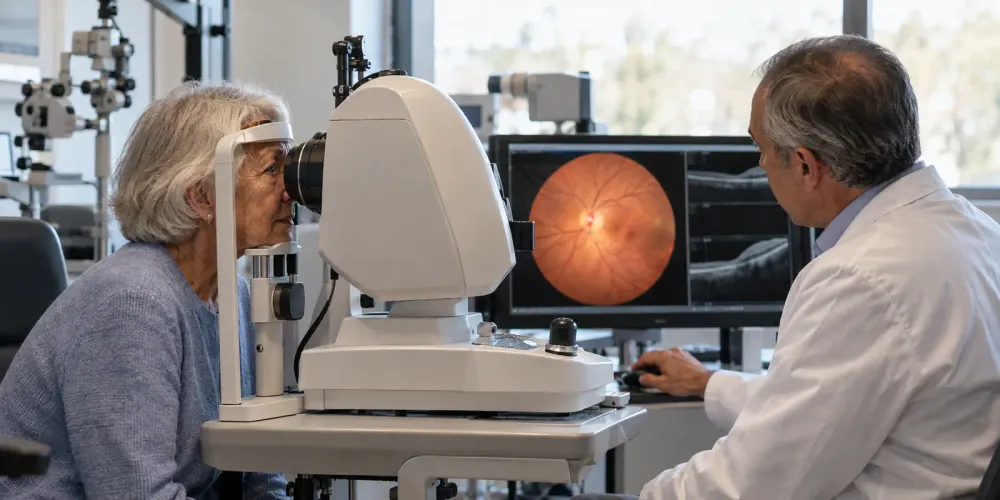
Geographic atrophy destroys photoreceptors in the macula, the central portion of the retina used for reading, recognizing faces and seeing fine detail. The surrounding retinal circuitry can remain partly functional even after those light-sensing cells die. PRIMA tries to exploit that surviving network with a two-millimeter photovoltaic chip placed beneath the retina and a pair of camera-equipped glasses.
The glasses capture a scene, process it and project a near-infrared pattern onto the implant. Hundreds of microscopic pixels convert that light into electrical stimulation, which activates nearby retinal neurons and sends signals toward the brain. The approach is described in the registered trial record and in the first-year study report. Because the system replaces only a small central patch of input, it does not recreate normal sight. Users must also complete months of rehabilitation to learn how to interpret the new signal and operate magnification features in the glasses.
The technology is designed to add an artificial central image without erasing a patient’s remaining peripheral vision. That distinction is clinically important: age-related macular degeneration usually impairs straight-ahead detail while leaving some side vision intact. The Eye Institute estimates that 11 million Americans have some form of age-related macular degeneration, though only a subset have advanced geographic atrophy severe enough to resemble the study population.
The three-year signal and the missing participants
PRIMAvera was a prospective, open-label, single-group study conducted at 17 centers in five European countries. All 38 enrolled participants received the implant. At one year, 32 remained available for the main evaluation; 26 of those 32 achieved at least a two-line improvement, according to the peer-reviewed report. The average gain was about five eye-chart lines, and 27 participants could recognize letters, numbers or words with the system.
The new three-year results cover a much smaller group. Twenty-seven participants were evaluable for safety and 18 for efficacy. Among those 18, the nearly six-line average gain was slightly larger than the first-year improvement, while natural vision measured with the device turned off was reported as essentially stable in the implanted eye. Vision in untreated fellow eyes continued to decline, a pattern consistent with progressive disease but not a substitute for a randomly assigned comparison group.
Attrition is the central interpretive problem. The academy’s summary does not explain why 20 of the original 38 participants were absent from the three-year efficacy set. If people who benefited less, had complications or found the system difficult to use were disproportionately unavailable, the remaining patients would make durability appear stronger than it was across the original cohort. Conversely, some missing assessments may have reasons unrelated to treatment. Without a participant-level accounting and prespecified statistical handling of missing outcomes, readers cannot determine how much either possibility influenced the result.
Safety remains tied to surgery
The initial implantation requires retinal surgery, so the relevant risk is not limited to the chip’s electronics. The first-year paper reported that serious eye-related adverse events occurred mainly soon after surgery and that most resolved within two months. Earlier feasibility work following a smaller cohort for four years also found sustained prosthetic acuity but documented a case in which the implant was placed incorrectly in the choroid, underscoring the procedure’s technical demands in the follow-up study.
From months 13 through 36 in PRIMAvera, three patients each experienced one serious eye-related adverse event, according to the new report. That total is too small to establish reliable event rates, particularly with only 27 participants available for long-term safety evaluation. Rare complications often emerge only after a device is used in far larger and more diverse populations, and surgical performance in specialized trial centers may not predict results in routine practice.
The system’s practical burden is also part of its safety-and-benefit profile. Patients need surgery, external glasses, image processing and structured visual rehabilitation. The restored image is monochrome, limited in resolution and confined to a narrow central field. Independent reporting on early users found that reading could become possible again but remained laborious, while facial recognition and mobility gains varied. A detailed patient account published in July likewise described meaningful function without suggesting a return to ordinary vision.
Restoration differs from slowing disease
Two drugs already approved in the United States, pegcetacoplan and avacincaptad pegol, inhibit parts of the complement immune pathway and can slow the expansion of geographic atrophy lesions. Their official FDA labeling does not claim that they restore vision that has disappeared. They require repeated injections into the eye and carry risks that include infection, retinal detachment and conversion to wet age-related macular degeneration.
PRIMA addresses a later consequence of disease rather than the underlying degenerative process. In principle, that makes the implant and disease-slowing drugs complementary rather than competing approaches: one could preserve remaining tissue while the other supplies a new signal where photoreceptors are gone. The trial did not test that combined strategy, however, and it cannot answer whether earlier implantation would improve results or expose people with more natural vision to an unfavorable surgical tradeoff.
The first-year study was funded by Science Corporation, which acquired the technology and now manufactures it, along with support from the Moorfields National Institute for Health and Care Research Biomedical Research Centre. Company involvement is expected in a device-development trial, but it makes independent replication, transparent long-term reporting and postmarket surveillance especially important. Science’s European launch announcement said reimbursement applications and clinical-site activation were underway; separate reporting confirmed the July authorization but noted that access would still depend on national payment decisions.
What regulators and patients still need to know
The three-year result strengthens one part of the evidence chain: among a selected group who returned for testing, the prosthetic acuity gain did not fade after the first year. It does not yet establish the proportion of all implanted patients who will retain a useful benefit, how frequently serious complications occur outside expert centers, or whether restored chart vision translates into durable improvements in independence, injury risk, mental health and quality of life.
A stronger U.S. evidence package would include complete follow-up for the original cohort, standardized functional outcomes, detailed reasons for missing visits and assessment by masked examiners. A comparator may be difficult in a surgical device trial, but prospective benchmarks and sensitivity analyses could reduce uncertainty. The United Kingdom’s research summary shows that PRIMAvera was designed to assess both visual function and functional vision; publishing the full three-year results for both domains would reveal whether the eye-chart gains consistently changed daily life.
For now, the implant represents a genuine advance in form vision and an unresolved test of scalability. The newest data indicate that partial sight can endure for years in some recipients, while the shrinking analyzable cohort prevents a confident estimate of how often that will happen. The next decisive evidence will come not from a larger headline number, but from complete long-term accounting, independent replication and careful monitoring as European use moves beyond the trial setting.