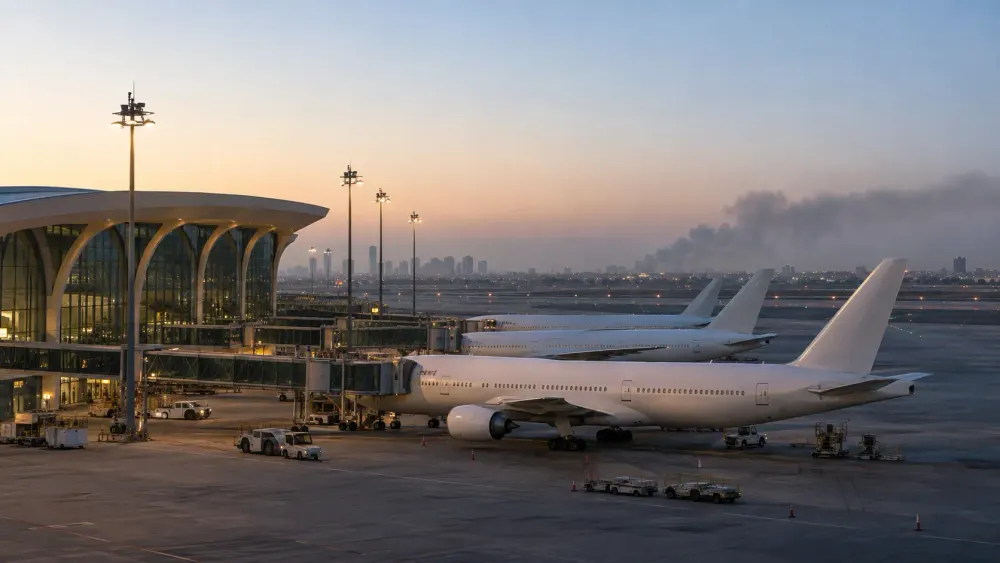
A fire beside Riyadh’s main international airport and a claimed Houthi missile-and-drone attack pushed King Khalid International Airport to the highest disruption level tracked by a major flight-monitoring service on Saturday, adding a new aviation choke point to an already unstable Middle East travel network.
Saudi authorities said they intercepted a ballistic missile aimed toward the capital, while witnesses saw a large plume of black smoke near the airport. The Houthis said they had targeted “sensitive sites” in Riyadh, but Saudi officials did not publicly connect the airport-area fire to a specific projectile. No casualties were reported in the capital, and civil defense later issued an all-clear.
An airport fire amid a wider attack
The incident unfolded as air-raid alerts sounded in Riyadh. Video and photographs reviewed by Reuters showed flames behind fuel tanks and dense smoke near King Khalid International Airport. The Saudi-led coalition said it had destroyed a missile headed for Riyadh and stopped other attacks elsewhere in the kingdom.
The Associated Press reported that residents heard an explosion before seeing smoke near the airport. Saudi Arabia said the attempted strike was the first on Riyadh since the latest regional escalation began in July. The Houthis also claimed attacks on oil facilities in Yanbu, claims that were not independently verified.
What remains uncertain is important. Saudi authorities did not disclose the cause of the fire, the extent of any damage or whether airport fuel supplies were affected. The available reporting therefore supports two confirmed facts—a missile interception and a fire near the airport—but not a definitive causal link between them.
Flights face more than a momentary delay
For travelers, the operational signal was immediate. FlightRadar24 placed the airport at its maximum disruption index, indicating “major problems,” according to the Guardian. The airport is Riyadh’s principal international gateway and a transfer point for domestic and long-haul itineraries, so even a short interruption can ripple through later departures and connecting journeys.
An all-clear does not instantly restore an airline schedule. Aircraft may be out of position, crews can approach duty-time limits, gates and arrival slots can become congested, and additional security inspections may slow the restart. Those effects can persist after the immediate threat has passed, particularly when airlines are already routing around other regional hazards.
The Journal described the blaze as involving a fuel depot at the airport and said the apparent target was jet-fuel storage. Saudi officials had not publicly confirmed that account by late Saturday. Travelers should treat the distinction as unresolved rather than assume either that the airport’s fuel system was disabled or that normal operations were fully restored.
Regional risk extends beyond Riyadh
The disruption came as the United States renewed a broader security warning for the Middle East. A Sept. 19 security alert from the U.S. Mission in Saudi Arabia cited regional tensions and urged heightened vigilance. The State Department also told Americans outside the region to seriously reconsider travel to or through the Middle East because further escalation could produce flight cancellations, airspace closures and other disruptions.
That regional message is broader than a single airport notice. Airlines may change routings, schedules or destinations when security assessments shift, even if the traveler’s origin and final destination are outside Saudi Arabia. A connection through Riyadh, Jeddah, Dubai, Doha, Abu Dhabi or another hub can therefore be affected by decisions made elsewhere in the network.
The warning also should not be confused with proof that every airport in the region is disrupted. Conditions vary by country, carrier and hour. Its practical meaning is that travelers face a higher probability of abrupt operational changes and should verify each segment independently.
Claims and confirmed facts remain separate
The Houthis’ statement establishes that the group claimed responsibility for an attack on Riyadh; it does not by itself establish what struck or ignited near the airport. Saudi confirmation of an interception similarly does not explain every piece of debris or every fire reported during the alert. With military operations still unfolding, both sides have incentives to shape the public account.
Independent reporting narrows the gap but does not eliminate it. Multiple news organizations documented the smoke, the warnings and the disruption, while Saudi officials confirmed the interception and later all-clear. None of those facts establishes a complete damage assessment. A cautious account should therefore avoid declaring the airport closed, destroyed or fully normal without a formal operational statement.
What travelers can verify now
Passengers booked through Riyadh should first check the operating airline’s app or website, because airlines control rebooking and can update a flight before airport displays do. They can also consult the airport’s official flight board, while recognizing that status fields may change repeatedly during recovery.
Travelers with separate tickets face greater exposure because a delayed first carrier may not protect the onward booking. Those with time-sensitive connections should review change policies and identify alternate routings before reaching the airport. Anyone already in Saudi Arabia should follow official civil-defense instructions and local alerts rather than rely on social-media footage whose location or timing may be unclear.
The central travel fact is not that all flights through the Gulf have stopped. It is that an attack alert reached the immediate vicinity of one of the region’s major airports and produced measurable disruption. Until airlines and airport authorities demonstrate a stable operating pattern, itineraries through Riyadh carry a higher risk of delays, missed connections and short-notice schedule changes.