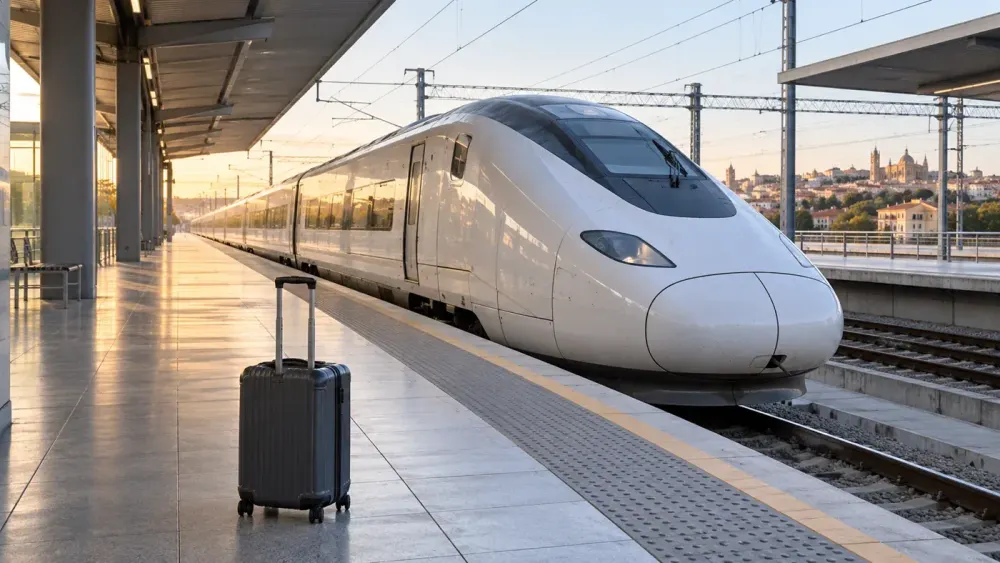
Ouigo’s entire Spanish train schedule is cancelled for Monday, Nov. 2, adding a second nationwide shutdown at the low-cost operator to disruption already affecting the high-speed corridor between Madrid and Andalusia.
The cancellation was announced Oct. 29 after a court suspended the minimum-service order for a drivers’ strike. Monday is the second of two full cancellation days, following Oct. 30. The company’s estimate of 40 trains and nearly 20,000 affected passengers covers both days together, according to EFE reporting; it is not a count of people stranded Monday.
For visitors moving between Spanish cities, the immediate problem is two overlapping disruptions with different causes and remedies. The Ouigo strike affects that company’s network, while the separate infrastructure closure following the Oct. 28 Urda accident restricts high-speed travel south of Madrid across operators. A ticket on another company therefore is not automatically a workable substitute for an Andalusian journey.
Why the minimum-service plan fell away
Spain’s Transport Ministry initially required roughly 72% of Ouigo services to operate during the strike. The National Court provisionally suspended that order, leaving the operator unable to guarantee which trains would run. Europa Press reported that Ouigo then cancelled all services on the two strike days, saying it wanted to avoid additional confusion at stations.
The interim court action concerned the justification for restricting the right to strike, rather than an order declaring trains unsafe. EFE reported that the court questioned the lack of route-specific reasoning and consideration of competing operators. The drivers’ union, Semaf, has alleged excessive working hours, inadequate rest and failures to comply with the collective agreement. Those are the union’s allegations, not independently established findings about every cancelled service.
The southern corridor has a separate problem
The Madrid–Andalusia infrastructure closure compounds the strike’s effects, but should not be confused with it. Renfe said its proposed alternative transport plan could not begin before Nov. 3 because of a required 96-hour notice period for changes to staff schedules. The company said it would inform passengers of the final routes, timetable and start date once the operation was defined.
That statement sets an earliest possible date, not a guaranteed restart of high-speed trains or a promise that a replacement itinerary will match the original journey. Renfe attributed the delay to Semaf’s insistence on the notice period. Passengers need the final operator notice for their own booking, particularly where a journey includes a connection, an airport transfer or a fixed departure elsewhere.
A bus offer comes with defined limits
Ouigo has published a separate Movelia arrangement for customers whose trains were cancelled because of the southern infrastructure closure. Eligible passengers can purchase a qualifying bus journey through the designated Movelia channel and receive reimbursement. The offer covers specified city pairs involving Madrid, Córdoba, Málaga, Seville, Zaragoza and Barcelona; it is not a blanket reimbursement offer for every alternative journey on the Ouigo network.
The published conditions cover qualifying travel from Oct. 28 through Nov. 9, or until the affected line resumes service, whichever occurs first. Customers must use the same email address as the cancelled Ouigo reservation. The stated window for this commercial offer does not establish when the railway will reopen. It also means travellers should check eligibility before assuming that any independently purchased coach ticket falls within the arrangement.
Refunds and rerouting are different choices
For the strike cancellations, Ouigo told the news agencies that customers could change their ticket free of charge or request a full refund, with additional compensation of up to 200% of the fare. The maximum should not be treated as a guaranteed payment in every case. Separately, Spain’s consumer centre explains that cancelled rail passengers have rights to reimbursement or alternative transport, alongside assistance where applicable.
The European Commission’s passenger guidance says that when a cancellation would delay arrival by more than an hour, travellers can choose reimbursement or comparable rerouting. If no rerouting options are communicated within 100 minutes of scheduled departure, necessary, appropriate and reasonable costs of alternative public transport by rail, coach or bus can be reimbursable. That is not an unrestricted entitlement to book any replacement at any price.
Assistance can include meals and refreshments proportionate to the wait and, where an overnight stay becomes necessary and accommodation is physically available, a hotel and transport between the hotel and station. Spain’s consumer guidance also says vouchers cannot be imposed instead of the traveller’s voluntary acceptance. These protections address the immediate consequences of disruption, separately from any additional compensation offered by the operator.
Assistance and delay compensation also have separate conditions, and accepting a refund affects the remaining choices. Keeping cancellation notices, booking details and replacement-travel receipts provides the record needed to pursue the appropriate remedy. Monday’s central disruption is confirmed in the published cancellation plan; the unresolved questions are the final alternative arrangements for each journey and the timing of restored southern high-speed service.