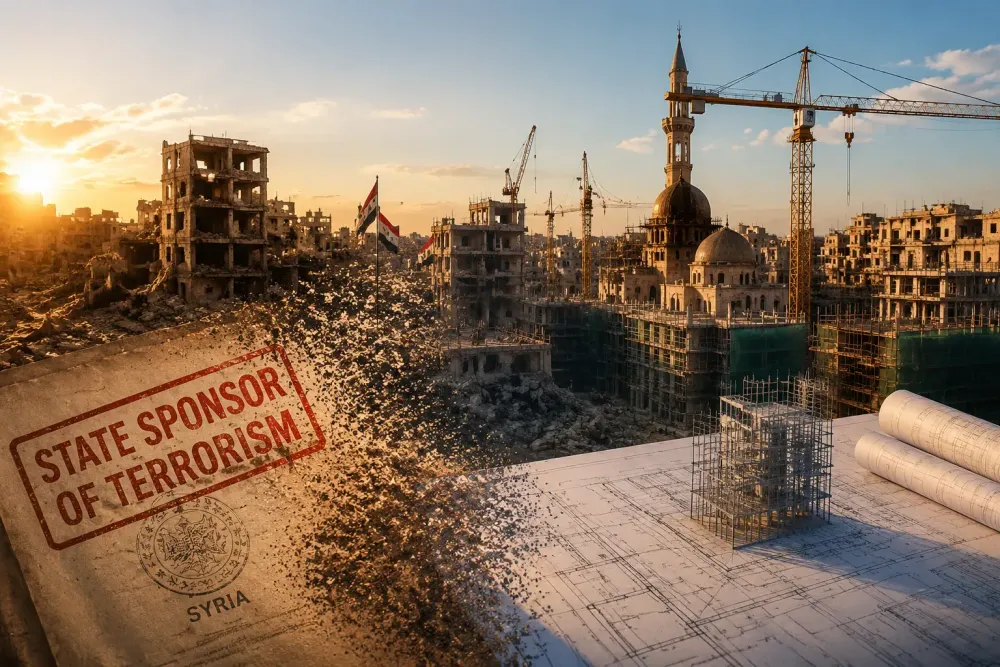
After nearly 47 years on the U.S. list of State Sponsors of Terrorism, Syria was formally removed on August 24, eliminating a designation that restricted American assistance, defense exports and financial transactions just as the country faces an estimated $216 billion reconstruction bill. The decision took effect after a mandatory 45-day congressional review and represents a major reversal in U.S. policy toward Damascus following the fall of Bashar al-Assad's government and the emergence of President Ahmed al-Sharaa's administration.
Secretary of State Marco Rubio said the action recognized what Washington considers positive steps by Syria to distance itself from international terrorism. The State Department simultaneously removed Hay'at Tahrir al-Sham, formerly known as the Nusrah Front, from the U.S. Specially Designated Global Terrorist framework. The Treasury Department also removed HTS from its blocked-persons list, extending a broader sanctions-relief process that began before Monday's announcement.
For Syria, the policy change addresses an obstacle that government officials have repeatedly described as critical to restoring normal banking, trade and investment. But delisting is not the same as financing reconstruction. The World Bank estimates that rebuilding damaged physical assets could cost about $216 billion, roughly ten times Syria's estimated 2024 gross domestic product. Removing one major legal barrier can reduce transaction risk, but it cannot by itself create the capital, institutions, security or commercial confidence required to rebuild an economy damaged by more than a decade of war.
A designation dating to 1979 carried consequences beyond symbolism
Syria had been on the U.S. terrorism-sponsor list since December 1979, effectively from the beginning of the modern designation system. Such a listing is not merely diplomatic language. It triggers statutory restrictions involving foreign assistance, defense exports and sales, controls over certain dual-use items, and financial constraints that can make banks and multinational firms unwilling to process transactions even where a particular payment might otherwise be lawful.
The August 24 removal therefore changes the legal architecture around Syria. Reuters reported that Damascus viewed the terrorism designation as the last major obstacle to reconnecting with the global financial system after other U.S. and European restrictions had been eased. The administration argues that the change will encourage investment and reinforce incentives for Syria's new government to remain separated from terrorist networks.
That rationale also explains the simultaneous action on HTS. Al-Sharaa once led the organization, whose lineage included the Nusrah Front and earlier ties to al-Qaeda. Washington had already revoked HTS's Foreign Terrorist Organization designation in 2025. The latest action removes an additional financial designation, reflecting an assessment that the current Syrian government should not remain legally treated as if it were the former insurgent movement.
The decision remains a policy judgment, not proof that Syria's political transition is complete or irreversible. Terrorism designations are based on legal and intelligence assessments, while investment decisions also incorporate governance, contract enforcement, corruption, security and reputational risk. Banks can remain conservative even after formal sanctions are removed because anti-money-laundering obligations and internal risk controls are broader than any single sanctions list.
The reconstruction arithmetic is far larger than Syria's domestic economy
The economic scale helps explain why access to foreign capital matters. The World Bank estimates direct physical damage to infrastructure and buildings at about $108 billion. Infrastructure accounts for roughly $52 billion of that damage, residential structures $33 billion and non-residential buildings $23 billion. Rebuilding is more expensive than replacing the value of what was destroyed, which is why the Bank's central reconstruction estimate reaches $216 billion.
That estimate is subject to uncertainty and does not capture every economic loss. The Bank calculates that nominal GDP fell from $67.5 billion in 2011 to about $21.4 billion in 2024, while real output contracted by roughly 53% between 2010 and 2022. The estimated rebuilding requirement is therefore about ten times annual economic output at the end of the conflict period covered by the assessment.
Fiscal capacity is also constrained. A 2026 World Bank project noted that government revenue had fallen from close to 20% of GDP before the conflict to less than 5%, limiting Damascus's ability to finance basic services and capital investment through domestic taxation. That is an institutional problem as much as a financing problem: a government cannot sustainably borrow or spend at reconstruction scale without functioning budgeting, procurement, revenue collection and auditing systems.
The reconstruction total also illustrates why sanctions relief is economically meaningful without being economically sufficient. A country with a roughly $21 billion economy cannot plausibly self-finance a $216 billion rebuilding program on a short timetable. External investors, development banks, Gulf states, European institutions and private lenders would have to provide substantial capital. The terrorism designation made that harder; its removal does not guarantee those investors will come.
Sanctions relief can reopen channels, but banks may move more slowly than policy
One of the most consequential effects could be in financial intermediation. Even when sanctions contain humanitarian exceptions, banks often avoid jurisdictions where compliance costs and penalties are high. That phenomenon, sometimes described as overcompliance or de-risking, can block otherwise permitted transactions because the expected revenue from serving a market does not justify the legal and operational burden.
The Treasury had already begun easing restrictions before Monday. Earlier U.S. relief authorized transactions supporting electricity, energy, water, sanitation and certain governance functions while preserving blocks on designated individuals and entities. The new terrorism-sponsor rescission removes another layer of restrictions and may make correspondent banking relationships easier to establish.
The practical test will be whether commercial institutions treat the legal change as enough to re-enter. Reuters reported growing interest from international financial companies, but interest is not the same as executed lending, insured investment or durable correspondent-bank access. Institutions will evaluate Syria's customer-identification systems, sanctions screening, beneficial-ownership transparency and ability to prevent funds from reaching still-designated actors.
That distinction matters for reconstruction. Large infrastructure projects require payment systems, trade finance, insurance, letters of credit and predictable currency conversion. A bridge or power plant cannot be financed merely because a sanctions notice has changed; contractors must be able to import equipment, pay employees, repatriate profits and resolve disputes. In that sense, the State Department decision removes friction from the financial plumbing, but it does not build the plumbing by itself.
Security and governance remain part of the investment equation
The World Bank's current country assessment describes a recovery that is visible but fragile. It estimates that Syria regained control of a much larger share of national oil production in early 2026, inflation eased sharply from 2024 levels, and economic activity strengthened as sanctions were relaxed. At the same time, the Bank cites violence, banking constraints, high living costs and regional conflict as continuing risks.
Those factors can overwhelm the benefit of sanctions relief if they deteriorate. Infrastructure investors generally require long time horizons, while security shocks can destroy assets or interrupt cash flows. Legal predictability also matters because many reconstruction projects involve land ownership, displaced populations, public procurement and concessions granted by a government whose institutions are themselves being rebuilt.
Human conditions add urgency. The United Nations Development Programme reported in 2025 that poverty had reached roughly 90% and estimated cumulative economic losses from the conflict at about $800 billion. Its assessment argued that restoring market access and substantially higher growth would be necessary to prevent recovery from stretching across generations.
The U.S. policy therefore operates on two levels. Strategically, Washington is rewarding the new Syrian government for behavior it wants to reinforce. Economically, it is removing a legal classification that made normalization with the global financial system unusually difficult. Whether either objective succeeds will depend on Syrian governance and regional stability as much as on sanctions law.
Delisting changes the constraint, not the size of the task
The August 24 decision is consequential because it closes a 47-year chapter in U.S.-Syrian relations and removes a formal barrier that had unusually broad financial consequences. It may help banks, investors and development institutions distinguish the current government from the Assad-era state that originally accumulated decades of sanctions and terrorism designations.
But the reconstruction numbers impose discipline on what can reasonably be inferred. A $216 billion rebuilding requirement against an economy of roughly $21 billion means Syria needs external capital at a scale far beyond ordinary foreign investment. The country also needs functioning public institutions, bank compliance systems, contract enforcement and security conditions capable of sustaining projects over many years.
Removing Syria from the terrorism-sponsor list therefore establishes that U.S. policy has changed. It does not establish that international capital will arrive quickly, that remaining sanctions and compliance concerns will cease to matter, or that reconstruction will accelerate on a specific timetable. The next measurable evidence will be less about diplomatic announcements and more about actual bank connections, committed investment, completed infrastructure and whether economic growth becomes large enough to narrow a rebuilding gap that is currently measured in hundreds of billions of dollars.