
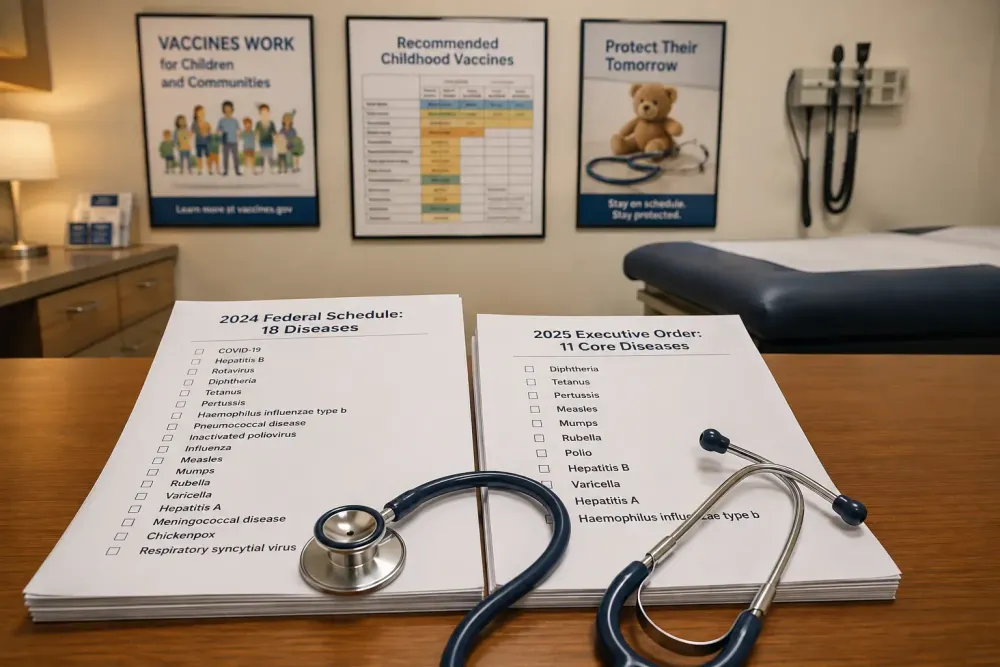
The White House has reduced the number of diseases included in its core childhood vaccination baseline from 18 in the 2024 federal schedule to 11, while directing federal agencies to favor separate measles, mumps and rubella shots once such products are available. The August 10 executive order does not instantly erase existing vaccination recommendations, state school requirements or insurance obligations, but it represents one of the most consequential changes in federal vaccine policy in decades because it changes which immunizations Washington says should be routinely recommended to all children.
The order classifies vaccines against measles, mumps, rubella, diphtheria, tetanus, pertussis, polio, Haemophilus influenzae type B, pneumococcal disease, human papillomavirus and varicella as core recommendations for all children. Other immunizations, including hepatitis A, hepatitis B, influenza, COVID-19, rotavirus and meningococcal vaccines, are shifted toward high-risk or shared clinical decision-making categories under the new framework. The White House also says federal programs should preserve access to vaccines that remain available, an important distinction between changing a recommendation and withdrawing a product.
The immediate policy change is only part of the story. Reporting published August 24 by Reuters described President Donald Trump's frustration with the pace of research into vaccines and autism as a central force behind the order and said Health Secretary Robert F. Kennedy Jr. and allied activists want broader investigations. That places a long-settled scientific question back at the center of U.S. health policy even though large reviews conducted over decades have not found that childhood vaccination or the MMR vaccine causes autism.
The federal recommendation is narrower, but the practical effect depends on implementation
The order changes the federal government's declared vaccination baseline, but American immunization policy is distributed across several institutions. The Centers for Disease Control and Prevention publishes federal schedules; the Food and Drug Administration licenses vaccines; federal and private insurance rules determine much of payment; and states generally decide which vaccinations are required for school attendance. The CDC explicitly notes that school vaccine requirements are matters of state law, not a single federal mandate.
That means the August order is better understood as a directional policy change than an instantaneous nationwide rewrite. It tells federal agencies to advance the new framework "to the fullest extent allowable by law" and advises states and territories to review their own requirements. It also directs the Justice Department to support what the administration considers meritorious legal challenges involving parental authority, religious liberty and exemptions. Those provisions could matter over time even where the federal government lacks direct authority to dictate state school-entry rules.
The White House's own fact sheet says the 2024 federal schedule recommended protection against 18 diseases, compared with 11 in the new core category. The administration argues that the United States recommended more childhood vaccine doses than peer developed countries and that a narrower universal list would better match international practice while preserving individualized decisions for other vaccines.
That comparison is not meaningless, but it does not by itself establish that the previous U.S. schedule was medically excessive. National schedules differ because countries face different disease burdens, financing systems, school-entry rules, vaccine availability, demographics and public-health strategies. A vaccine not universally recommended in one country can still have favorable benefits and risks for children in another. Counting doses is therefore an activity measure, not an outcome measure.
Splitting MMR changes logistics without changing the evidence on autism
The order also says the combined MMR vaccine should eventually be administered as three separate single-disease shots once those products are domestically available, while recommending that childhood immunizations be separated across medical visits "to the maximum extent feasible." That change could have operational consequences even if the underlying antigens remain similar.
Combination vaccines exist partly to reduce the number of injections and visits needed to complete protection. Breaking a combined vaccine into separate appointments can create more opportunities for missed visits, delayed protection and administrative cost. The order does not establish that those effects will occur, and they will depend on product availability and implementation, but the mechanism is straightforward: a schedule requiring more separate encounters places more demands on families and clinical practices than one that permits simultaneous administration.
The scientific question most often attached to MMR is different. The WHO reviewed evidence spanning decades and reported no association between childhood vaccination and autism spectrum disorder. Its evidence review cited three cohort studies involving roughly 1.23 million children that found no association and a 2014 meta-analysis covering about 1.3 million children in cohort studies, along with additional case-control evidence reaching the same conclusion.
The CDC's current MMR guidance likewise states that studies in the United States and other countries have not found a link between MMR and autism. It estimates one dose of MMR is about 93% effective against measles and two doses about 97% effective. Those are effectiveness outcomes, not simply measures of uptake.
The evidence does not mean vaccine safety questions should never be studied. Vaccines, like other medical products, can cause adverse effects, and continued surveillance is a core public-health function. The WHO review, for example, recognizes known associations between MMR-containing vaccines and events such as febrile seizures while distinguishing those documented risks from the unsupported autism claim. The policy dispute is therefore not whether safety monitoring should continue; it is whether federal policy should reopen a causal hypothesis that large bodies of evidence have repeatedly failed to support.
A parallel pediatric schedule has already emerged
The policy shift is unfolding amid an unusual institutional split. The American Academy of Pediatrics published its own 2026 schedule and said it no longer endorses the CDC childhood and adolescent schedule. That divergence means parents, pediatricians, insurers and states may increasingly confront competing recommendations from federal health authorities and major professional medical organizations.
This matters because vaccination programs depend not only on whether a product is licensed, but also on whether clinicians know when to offer it, whether insurers cover it without cost sharing, whether school rules reinforce uptake and whether families regard the recommendations as credible. A schedule can become less effective operationally even when vaccines remain physically available if the surrounding message becomes more difficult to understand.
The administration has tried to address part of that problem by preserving access. An earlier executive order said immunizations appearing in any category of the federal schedule should continue to be covered without cost sharing by private insurance, Medicaid, the Children's Health Insurance Program and the Vaccines for Children Program. Whether those protections remain intact through subsequent agency rulemaking and litigation will be an important implementation test.
For providers, the distinction among "recommended for all," "high risk" and "shared clinical decision-making" can also influence workflow. A universal recommendation can be built into standing orders, electronic reminders and population-quality measures. A conditional recommendation requires more individual assessment, discussion and documentation. That may be appropriate when benefits vary substantially by risk group, but it also changes the amount of clinical work required to reach the same patient.
The measurable question is what happens to disease prevention
The most important evidence will eventually come from outcomes rather than the political dispute surrounding the order. If vaccination rates for diseases moved out of the universal category decline, public-health agencies will need to determine whether infection, hospitalization or outbreak rates change. If uptake remains high through individualized decisions, the practical effect may be smaller than critics fear. If state requirements remain largely unchanged, the federal shift may initially have more influence on messaging than on school-entry coverage.
Measles illustrates why the distinction matters. The disease is highly contagious, and the benefit of vaccination is not limited to the vaccinated individual because high community immunity reduces the chance that transmission chains become sustained. The CDC continues to publish weekly surveillance on measles cases, and it cautions that provisional counts can change as state and local reports are reconciled.
The administration's position is that a narrower core schedule can preserve access while improving parental choice and public trust. Critics, including pediatric organizations, argue that changing recommendations without stronger evidence of improved health outcomes risks increasing confusion and reducing protection. Both claims are testable over time, but they are not equivalent to evidence that the policy has already succeeded or failed.
The central numerical change is clear: the White House has moved from an 18-disease federal baseline to 11 diseases routinely recommended for all children. What that number does not establish is whether children will ultimately receive fewer vaccines, whether state requirements will change, whether disease incidence will rise, or whether public confidence will improve. Those outcomes will depend on the next layer of agency action, state law, insurance policy, clinical practice and family behavior, and they will be the measures by which the policy's health effects can actually be judged.