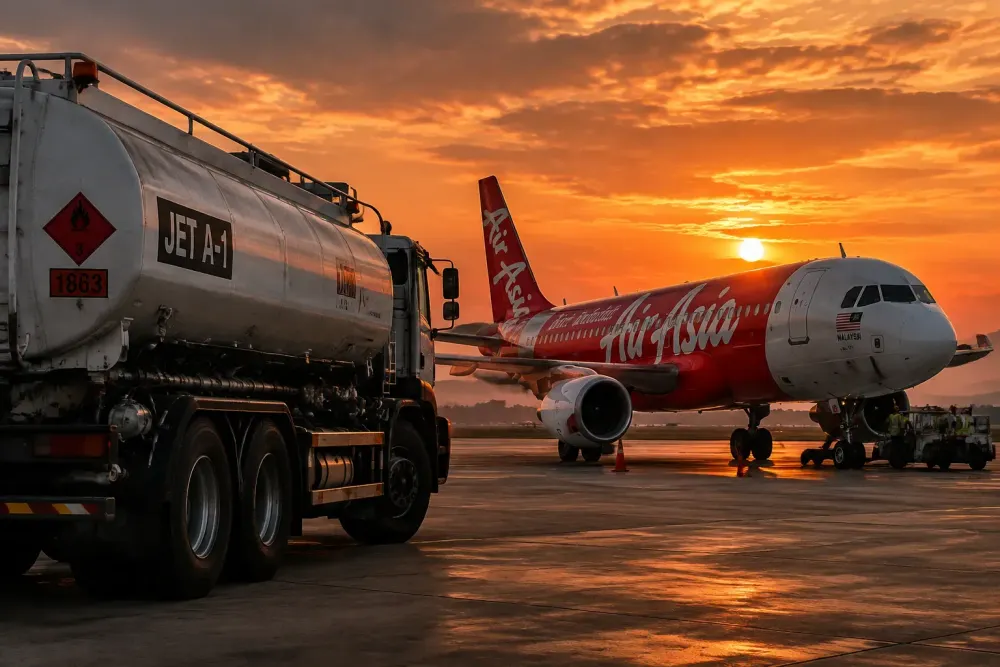
Average jet fuel prices of about $183 a barrel helped push AirAsia Group to an RM830.5 million second-quarter loss even after the carrier raised unit revenue 11% and recovered an estimated 70% of its higher fuel burden through fares, surcharges and cost cuts. The results illustrate a broader problem across Southeast Asia's low-cost airline sector: passenger demand remains substantial, but fuel inflation, weaker regional currencies and price-sensitive travelers have limited how much of the cost increase airlines can pass through.
AirAsia reported RM5.1 billion in second-quarter revenue, down only 1% from a year earlier despite an 11% reduction in capacity. Its results show revenue per available seat kilometer rising 11%, while non-fuel unit costs fell 7%. Those are normally favorable indicators for a low-cost carrier. Yet fuel expense increased 58%, EBITDA fell 56% and the group recorded a net loss of RM830.5 million, including RM331 million of foreign-exchange losses.
The pattern is not limited to one airline. Reuters reported August 24 that AirAsia, Singapore Airlines' low-cost unit Scoot and the Philippines' Cebu Pacific all remain under pressure after the Middle East conflict drove fuel costs sharply higher. The operating challenge is now shifting from emergency fuel shock to a second-stage question: how long can airlines maintain higher fares and thinner schedules without weakening the travel demand on which their business models depend?
Low-cost carriers have less room to absorb an energy shock
Fuel is a major airline expense regardless of business model, but low-cost carriers have structural reasons to feel price spikes quickly. Their economics depend on high aircraft utilization, dense seating, disciplined non-fuel costs and a large share of travelers choosing primarily on price. That creates strong operating leverage when fuel is stable and planes are full, but it reduces the ability to protect margins by simply adding large fare increases.
AirAsia's quarter shows the mechanism. The group increased revenue per seat kilometer by 11% and cut non-fuel unit costs, yet those improvements could not fully offset a 58% jump in fuel expense. Management said dynamic pricing, fuel surcharges and lower non-fuel costs recovered about 70% of the incremental fuel burden. In other words, unusually aggressive commercial and cost measures still left roughly 30% of the shock unrecovered.
Currency movements compound the problem because jet fuel, aircraft leases, maintenance agreements and debt are often priced in U.S. dollars. When regional currencies weaken, a carrier can face higher local-currency costs even if the dollar price of a particular input stops rising. Cebu Pacific described the second quarter as its most difficult post-pandemic period, according to Reuters, in part because of higher fuel and an approximately 8% weakening of the Philippine peso.
Full-service airlines have more tools available to soften that pressure. Premium cabins, corporate contracts, cargo operations and large loyalty programs can produce higher-margin revenue that is less directly dependent on the cheapest fare. Budget airlines deliberately operate with fewer of those buffers. Their advantage is simplicity; in a commodity shock, that same simplicity can become a constraint.
Airlines are raising fares, but the pass-through is incomplete
Thai AirAsia offers one of the clearest examples of how far carriers have pushed pricing. Its parent, Asia Aviation, said average fares rose 27% year over year in the second quarter while seat capacity fell 13%. Ticket revenue still increased 6%, and the airline carried 4.03 million passengers with a 78% load factor.
Those numbers show that demand did not disappear when prices increased. But the cost side moved even faster. The company said average jet fuel prices reached $183 a barrel, up 124% from a year earlier, pushing total fuel expense 43% higher. Thai AirAsia reported a core operating loss of 2.09 billion baht and a net loss of 2.33 billion baht. Its filing says the higher fares covered only about half of the fuel-price inflation.
Scoot faced a similar margin squeeze through a different operating strategy. Reuters reported that its passenger unit costs rose 21.7% in the three months through June, while its operating loss widened to S$32 million from S$17 million a year earlier. That occurred even though demand remained strong, fares increased and the airline benefited from fuel hedging through parent Singapore Airlines.
At group level, Singapore Airlines carried a record 10.9 million passengers during the quarter, yet still posted its first quarterly net loss since 2022. Reuters reported that net fuel costs jumped 78.5% to S$2.25 billion, overwhelming record quarterly revenue of S$5.71 billion and contributing to a S$76 million group loss. Demand and revenue were therefore strong; profitability was the missing outcome.
That distinction is important for travelers. High passenger counts do not mean airline economics are healthy, and an airline loss does not necessarily mean demand is weak. In this case, the primary pressure is the gap between what it costs to operate each seat and how much of that increase the market will accept in higher fares.
Capacity cuts are becoming the second lever
When fares cannot absorb the entire shock, airlines can also reduce flying. AirAsia plans to cut third-quarter seat capacity by roughly 20% to 25% from a year earlier, return 25 older aircraft to lessors during 2026 and suspend the Sydney-Kuala Lumpur route in October as part of a broader network reset. Management says it expects to restore capacity toward pre-war levels during the fourth-quarter holiday period if fuel conditions and bookings support the move.
Capacity discipline can improve airline economics because fewer seats reduce the temptation to discount heavily to fill aircraft. It can also push average fares higher for travelers if demand remains stable. The tradeoff is that aggressive reductions can weaken network utility, reduce schedule choice and surrender market share to competitors.
AirAsia's strategy is therefore deliberately seasonal. The company characterizes the third quarter as the region's softest travel period and plans to restore capacity when year-end demand strengthens. That approach attempts to protect cash during weaker months while preserving the option to expand when holiday traffic produces better yields.
The uncertainty is whether competitors make the same decision. If many airlines restore narrowbody capacity simultaneously, the region could move from a shortage problem to an oversupply problem on some routes. Reuters cited analysts warning that intra-Asian markets could face excess capacity as single-aisle aircraft return faster than long-haul widebodies. In that scenario, airlines may again be forced to trade fare for load factor.
Travelers may see fewer bargains even if fuel prices ease
The consumer effect is unlikely to track oil prices day by day. Airlines sell seats months in advance, hedge parts of their fuel exposure and adjust fares based on demand as well as cost. AirAsia said part of its second-quarter difficulty came from seats sold before the fuel spike, which delayed its ability to pass the shock through to travelers.
The reverse can also occur. If fuel prices decline, airlines may retain elevated fares for a period if demand remains strong or if they are trying to rebuild margins lost earlier in the year. AirAsia has said improved unit economics should emerge as fuel normalizes against a higher fare base. That would help earnings before it necessarily produces large fare reductions.
Travelers may therefore encounter a mixed market: higher prices on routes where carriers have cut capacity, promotional fares where competitors are rebuilding schedules, and continued volatility on markets exposed to currency swings or geopolitical disruption. The lowest advertised fare remains only one part of the total consumer cost, particularly when budget carriers rely on ancillary charges for bags, seats and other services.
The broader industry has already demonstrated that strong demand can coexist with weak profitability. That combination gives airlines an incentive to preserve pricing discipline rather than chase passenger volume at almost any fare.
The recovery depends on margins, not simply passenger counts
The second-quarter numbers show why "travel recovery" is an incomplete description of the market. AirAsia held revenue roughly flat while flying 11% less capacity. Thai AirAsia carried more than four million passengers despite a 27% fare increase. Singapore Airlines and Scoot together helped the group carry a record 10.9 million passengers. Those are meaningful measures of demand and operational activity.
They did not produce strong bottom-line outcomes because fuel moved faster than pricing power. AirAsia lost RM830.5 million, Thai AirAsia recorded a multibillion-baht core loss, Scoot's operating deficit widened, and the Singapore Airlines group fell into a quarterly net loss despite record revenue.
The next phase will be determined by whether fuel prices remain below the second-quarter peak, whether currencies stabilize and whether airlines can keep enough of their fare increases without suppressing bookings. A fourth-quarter rebound is plausible because year-end travel demand is seasonally stronger, but it is not yet established by the evidence.
For Southeast Asia's budget carriers, the defining number is no longer simply how many passengers return to the skies. It is how much of a $183-a-barrel fuel shock can be recovered without undermining the low-price proposition that made the model successful in the first place.