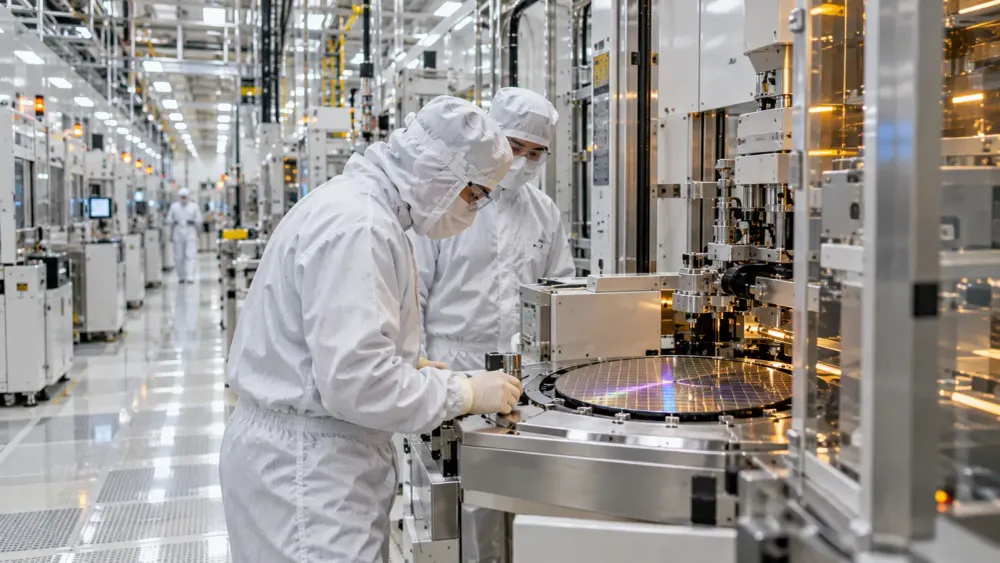
Taiwan Semiconductor Manufacturing Co. is heading into its third-quarter earnings report with expectations for another record profit, as demand for the advanced chips and packaging used in artificial-intelligence systems continues to outpace the broader semiconductor market.
Analysts expect TSMC to report net income of about NT$746.3 billion, or roughly $23.4 billion, for the July-through-September quarter, according to a 16-analyst estimate compiled by LSEG and reported Monday by Reuters. That would represent a 65% increase from a year earlier and a sixth consecutive quarter of record earnings. The estimate remains a forecast, not a reported result; TSMC is scheduled to release its full numbers Thursday.
Revenue already points to a record quarter
The profit estimate follows revenue data that leave little doubt about the strength of demand. TSMC’s October 8 SEC filing said September revenue reached NT$511.86 billion, up 54.6% from September 2025. Revenue for the first nine months of 2026 totaled NT$3.90 trillion, an increase of 41.1% from the comparable period last year.
Adding the company’s July, August and September figures produces third-quarter revenue of about NT$1.49 trillion, 50% above the year-earlier quarter and ahead of market estimates. Reuters separately calculated the same quarterly total from TSMC’s monthly disclosures. September revenue was 0.6% below August, however, a reminder that even rapid annual growth does not eliminate ordinary month-to-month variability.
The result also exceeded the upper end of TSMC’s prior dollar-based guidance. On its official results page, the company lists third-quarter revenue guidance of $44.6 billion to $45.8 billion, a gross-margin range of 65% to 67% and an operating-margin range of 56% to 58%. The final reported profit will depend on currency movements, product mix, utilization and costs, so the revenue record alone cannot confirm the analysts’ earnings estimate.
AI accelerators are reshaping the chip cycle
TSMC’s position is unusual because it manufactures processors designed by many of the companies competing in AI, high-performance computing and consumer electronics. The company does not disclose customer-specific revenue in its monthly reports, but it is a major supplier to Nvidia and Apple. That gives its results significance well beyond one company: they offer a measure of how quickly spending on AI infrastructure is translating into orders for the most advanced manufacturing processes.
TSMC’s second-quarter report provides the clearest official baseline. Revenue rose 36% and net income increased 77.4% from a year earlier. Chips made with processes of 7 nanometers or more advanced accounted for 77% of wafer revenue, including 30% from 3-nanometer technology and 3% from the newly ramping 2-nanometer process. Management said it expected continued strong demand for leading-edge technology in the third quarter.
Advanced packaging is another constraint. AI accelerators often combine multiple computing and memory components in complex packages, making packaging capacity nearly as important as wafer production. Reuters reported that demand remains strong for TSMC’s chip-on-wafer-on-substrate technology, known as CoWoS. A record profit would therefore reflect both leading-edge fabrication and the company’s ability to expand the packaging systems needed to turn individual dies into deployable AI processors.
Arizona expansion raises the U.S. stakes
The earnings surge is financing a much larger manufacturing footprint. TSMC says its planned investment in Arizona has expanded to $265 billion. The company’s Arizona plan includes six logic-chip factories, two advanced-packaging facilities and a research center, with additional plants intended for 2-nanometer and smaller technologies. Its first Phoenix factory began high-volume production in late 2024, while the second is targeted to start volume production in the second half of 2027.
The expansion is strategically important because the United States currently relies heavily on Taiwan for leading-edge chips. Associated Press reported in July that TSMC added $100 billion to its U.S. commitment while raising its 2026 revenue outlook and capital-spending plan. The Arizona investment does not remove supply-chain concentration overnight: factories take years to build, qualify and scale, and TSMC continues to operate its most extensive manufacturing base in Taiwan. It does, however, create a second major production cluster for advanced chips and packaging.
What Thursday’s report must clarify
Investors will focus on three questions when TSMC reports. The first is whether the 65% profit-growth estimate proves accurate. The second is whether management raises its full-year revenue outlook after the third-quarter sales beat. The third is how quickly the company can expand 2-nanometer and CoWoS capacity without eroding margins through higher construction, labor and equipment costs.
The available evidence is strong on revenue because TSMC has already filed the monthly numbers, but less certain on profit and future demand. Analyst estimates can change, and orders placed during an AI buildout do not guarantee that customers will earn attractive returns on their infrastructure. Currency shifts and the timing of customer deliveries can also move quarterly margins even when underlying demand remains firm. For now, the manufacturing data show that spending has not slowed at the foundry level. Thursday’s earnings will test whether that volume growth is continuing to translate into record profitability.