Last updated: August 16, 2026
Quick Answer
The Centers for Disease Control and Prevention confirmed 2,566 measles cases in the United States as of August 13, 2026, the highest annual total in more than 35 years. US measles cases surge to 35-year high in August 2026 largely because childhood vaccination coverage has slipped below the level needed to stop transmission, not because the virus itself has changed. The CDC reports 38 separate outbreaks, cases in 47 jurisdictions, and zero deaths so far this year.
Key Takeaways
- The CDC counted 2,566 confirmed cases as of August 13, 2026, up from 2,465 on August 6 and 2,318 on July 23.
- Reuters reported on August 14 that the 2026 total is the largest since the 1989-1991 resurgence, making this the worst measles year in over three decades.
- 94% of confirmed cases are outbreak-associated, and the CDC has logged 38 distinct outbreaks across 47 jurisdictions.
- Seven states, South Carolina, Utah, Arizona, Texas, Florida, Virginia, and Pennsylvania, carry the heaviest burden. Utah alone passed 516 cases.
- Two doses of MMR vaccine are about 97% effective; there is no evidence of a vaccine-resistant strain.
- Measles spreads through the air and stays infectious in a room for up to two hours after an infected person leaves.
- Infected people are contagious from four days before the rash appears until four days after.
- No deaths have been recorded in the 2026 US outbreak as of August 13, according to CDC data.
How Many Measles Cases Are in the US Right Now?
As of August 13, 2026, the CDC confirmed 2,566 measles cases nationwide. That figure was published in the agency's weekly surveillance update and reported by Reuters on August 14.
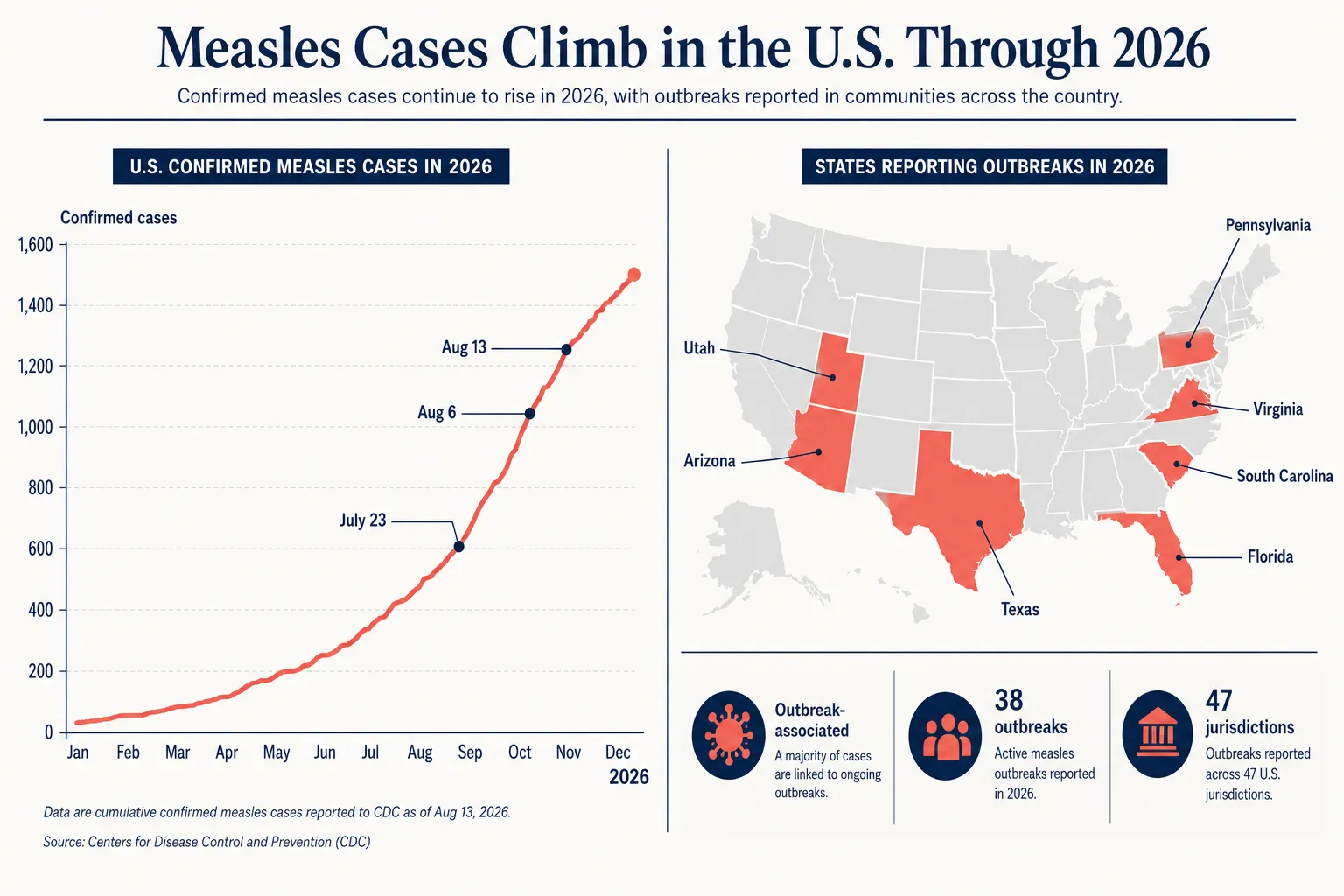
The trajectory matters as much as the total. The count moved from 2,318 in late July to 2,465 on August 6 to 2,566 on August 13, an increase of 101 cases in a single week. An outbreak that was flattening would show shrinking weekly increments. This one is not.
| Reporting date (2026) | Confirmed cases | Weekly change |
|---|---|---|
| July 23 | 2,318 | , |
| August 6 | 2,465 | , |
| August 13 | 2,566 | +101 |
For context, the United States recorded 2,289 cases in all of 2025. The 2026 count passed that mark in July, with more than five months left on the calendar.
What Caused the Measles Outbreak in 2026?
Falling vaccination coverage is the primary driver. Amy Winter, an epidemiologist at the University of Georgia, told Scientific American that the surge is "100 percent a reflection of the recent declines in vaccination rates."
Measles requires roughly 95% two-dose coverage in a community to block sustained transmission. When coverage in a school district, county, or religious community drops into the 80s, a single imported case can seed dozens more. The mechanism is arithmetic, not mystery.
Three factors combine:
- Post-2020 gaps in routine childhood immunization. Kindergarten MMR coverage declined in many states, and pockets of very low coverage cluster geographically.
- International importation. Measles remains endemic in parts of Europe, Africa, and Asia. Unvaccinated travelers return infected and expose under-vaccinated communities.
- Clustering. National averages hide local risk. A state at 92% coverage can contain a county at 78%.
Dr. William Moss of the Johns Hopkins Bloomberg School of Public Health said in early July that "this year, we've seen an even sharper increase in measles cases," warning the country would "easily surpass the 2025 number of cases" if the trend held. It did.
Where Are Measles Cases Concentrated in the US? Measles Outbreak by State, August 2026
Seven states account for the large majority of the national total. Reuters reported the heaviest case loads in South Carolina, Utah, Arizona, Texas, Florida, Virginia, and Pennsylvania. Analysis in late July found those seven states represented more than 84% of all US cases, with South Carolina and Utah together making up roughly half.
Late-summer hotspots have shifted. CIDRAP reported on August 7 that Pennsylvania added 57 cases in a single week, reaching 226 for the year, while Utah climbed to 516 cases. New outbreaks emerged in Arizona, Delaware, and Wyoming in late July, even as some earlier clusters wound down.
- Utah: 516 cases (largest single-state total)
- Pennsylvania: 226 cases as of early August, fastest weekly growth
- South Carolina: among the two largest contributors nationally
- 47 jurisdictions total have reported at least one case
The decision rule for travelers and parents: check your county-level MMR coverage, not your state average. A vacation to a low-coverage county in a high-coverage state still carries exposure risk.
Measles Symptoms: What Should I Look For?
Measles starts like a bad respiratory illness and only later produces its signature rash. The first signs are high fever (often above 104°F), cough, runny nose, and red watery eyes, appearing 7 to 14 days after exposure.
The sequence:
- Days 1-4: Fever, cough, runny nose, conjunctivitis.
- Days 2-3: Koplik spots, tiny white dots inside the cheeks. These are close to diagnostic and often missed.
- Days 3-5: Flat red rash begins at the hairline and face, then spreads down the neck, trunk, arms, and legs.
- Days 5-8: Fever breaks, rash fades in the order it appeared.
Common mistake: treating the early phase as a routine cold and sitting in a crowded waiting room. Anyone with fever plus possible measles exposure should call the clinic first so staff can arrange isolated entry.
Measles vs Chickenpox: How to Tell the Difference
Measles produces a flat, blotchy rash that starts on the face and moves downward; chickenpox produces itchy, fluid-filled blisters that appear in waves across the trunk first. Measles brings much higher fever and a prominent cough.
| Feature | Measles | Chickenpox |
|---|---|---|
| Rash type | Flat, blotchy, merging red patches | Raised blisters that crust over |
| Where it starts | Hairline and face, spreads down | Chest, back, face, scattered |
| Itching | Mild | Intense |
| Cough and red eyes | Prominent | Usually absent |
| Fever | Often above 104°F | Low to moderate |
| Mouth signs | Koplik spots inside cheeks | Occasional mouth blisters |
If blisters appear in distinct crops at different healing stages, chickenpox is likelier. If the rash is flat and preceded by three days of high fever and hacking cough, treat it as suspected measles and call a clinician.
Can Vaccinated People Still Get Measles, and Does the Vaccine Work Against the Current Strain?
Yes, breakthrough infections happen, but they are uncommon and usually milder. Two doses of MMR are roughly 97% effective against measles; one dose is about 93% effective. There is no evidence that the 2026 US outbreak involves a strain that escapes vaccine protection.
That distinction drives everything. The virus has not outrun the vaccine, coverage has fallen below the threshold that keeps outbreaks from taking hold. Genotypes circulating in the US remain the same lineages the MMR vaccine has controlled for decades.
Breakthrough cases in vaccinated people tend to involve shorter illness, lower fever, and less onward transmission. In outbreak reporting through 2026, the overwhelming majority of confirmed cases have occurred in people who were unvaccinated or whose status was unknown.
Edge case: adults vaccinated with a single dose in the 1960s, 1980s, or those vaccinated before 1968 with an inactivated product, may want a documented second dose before travel to a hotspot.
Measles Vaccine Side Effects: What to Expect
Most MMR side effects are mild and resolve within a few days: soreness at the injection site, low-grade fever, and sometimes a faint temporary rash 7 to 12 days after the shot.
- Common: arm soreness, mild fever, brief rash, temporary joint stiffness in adult women.
- Uncommon: febrile seizure, more likely with the combined MMRV formulation in toddlers than with separate MMR and varicella shots.
- Rare: temporary low platelet count; serious allergic reaction, on the order of one per million doses.
The MMR vaccine is a live attenuated vaccine and is not recommended during pregnancy or for people with severe immunosuppression. Those individuals depend on community coverage, which is precisely why local vaccination rates protect people who cannot be vaccinated themselves.
How Long Is the Measles Contagious Period, and What to Do If Exposed
A person with measles is contagious from four days before the rash appears through four days after it appears. The virus lingers in the air and on surfaces for up to two hours after the infected person leaves a room.
If exposed, act inside 72 hours:
- Confirm your status. Two documented MMR doses, or a lab-confirmed prior infection, means very low risk.
- Unvaccinated and within 72 hours? A post-exposure MMR dose can prevent or reduce illness.
- Within 6 days, and high-risk? Immunoglobulin may be an option for infants, pregnant people, and immunocompromised patients.
- Call ahead before any clinic visit. Do not walk into a waiting room.
- Self-monitor for 21 days. Watch for fever, cough, red eyes, then rash.
Who Is Most at Risk for Complications, and What Are the Treatment Options?
Children under 5, adults over 20, pregnant people, and anyone immunocompromised face the highest risk of severe measles. There is no antiviral cure, treatment is supportive care, with vitamin A given to hospitalized children under medical supervision.
Complications include ear infections, diarrhea, pneumonia (the leading cause of measles death in children), encephalitis, pregnancy loss and preterm birth, and subacute sclerosing panencephalitis, a fatal brain condition that can emerge years later. Recovery for uncomplicated measles typically takes 10 to 14 days from first symptom, with cough sometimes lingering longer.
The CDC's data page lists zero deaths in 2026 as of August 13, despite the record case count.
How Are Schools and Colleges Affected by the Measles Outbreak?
Schools and colleges function as amplifiers because they concentrate large groups indoors, and campus health offices in affected states have issued exposure notices and excluded unvaccinated students from classes during quarantine periods. With 94% of cases outbreak-associated, transmission is happening in linked settings rather than through scattered unrelated infections.
Standard public health response in an affected school:
- Exclusion of susceptible students for 21 days after the last exposure.
- Rapid record review to identify students without two documented doses.
- Pop-up vaccination clinics for students and staff.
- Notification of parents in exposed classrooms and shared spaces.
With the August, September return to campus arriving as the count climbs, districts in Utah, Pennsylvania, and South Carolina face the tightest timelines.
FAQ
How many measles cases are in the US in 2026? The CDC confirmed 2,566 cases as of August 13, 2026, the highest annual US total in more than 35 years.
Why do US measles cases surge to a 35-year high in August 2026? Declining two-dose MMR coverage in specific communities, combined with international importation, allowed 38 separate outbreaks to take hold across 47 jurisdictions.
Has anyone died in the 2026 US measles outbreak? CDC data listed zero measles deaths in the US for 2026 as of August 13, despite the record case count.
Is the measles vaccine still effective in 2026? Yes. Two MMR doses are about 97% effective, and no vaccine-escaping strain has been identified in the current outbreak.
Which state has the most measles cases? Utah, with 516 cases, held the largest single-state total, with South Carolina close behind and Pennsylvania growing fastest in early August.
How long after exposure do measles symptoms start? Typically 7 to 14 days, beginning with fever, cough, runny nose, and red eyes before the rash.
Can adults get an MMR booster? Adults without documented immunity can receive MMR. Those with only one dose may get a second, especially before travel or work in healthcare.
How long does measles recovery take? Uncomplicated cases resolve in about 10 to 14 days, though cough and fatigue can persist longer. Hospitalization is more common in young children.
Conclusion
The 2026 measles total of 2,566 confirmed cases is not a plateau, it grew by 101 cases in the week ending August 13, and the CDC counts 38 active outbreaks in 47 jurisdictions. The epidemiological consensus is that this is a coverage problem with a known fix.
Practical next steps:
- Pull your family's immunization records and confirm two documented MMR doses per person.
- Check county-level coverage before travel to Utah, South Carolina, Pennsylvania, Arizona, Texas, Florida, or Virginia.
- Schedule catch-up doses now, ahead of the school year, since full protection takes about two weeks after the second dose.
- Call ahead, never walk in, if fever and rash appear after a possible exposure.
- Track the CDC's weekly update, which posts revised case counts each Wednesday.
Tags: measles outbreak 2026, CDC measles cases, MMR vaccine, measles symptoms, vaccination rates, public health, Utah measles, Pennsylvania measles, measles vs chickenpox, measles contagious period, herd immunity, healthcare