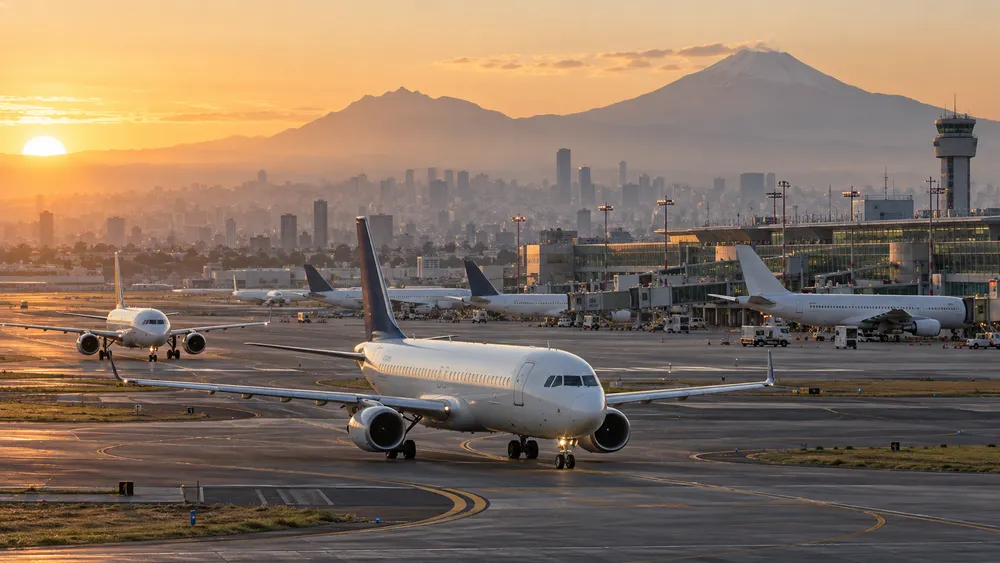
The U.S. Department of Transportation has lifted a freeze that prevented Mexican airlines from opening new routes to the United States from Mexico City’s two major airports. The decision reopens opportunities for future passenger service from Benito Juárez International Airport and Felipe Ángeles International Airport after a year-long bilateral aviation dispute.
The change does not immediately create new flights. Airlines must propose schedules, secure airport slots, obtain safety and economic authority and decide whether a route is commercially viable. The department also retained some oversight requirements, including schedule filings and prior approval for certain large-aircraft charter operations.
Why the restrictions were imposed
Washington froze growth by Mexican carriers in October 2025 after accusing Mexico of failing to comply with the countries’ 2015 air transport agreement. U.S. officials objected to Mexico’s decision to take slots from U.S. passenger airlines at Benito Juárez and to require cargo operators to move to the more distant Felipe Ángeles airport.
The Transportation Department said those measures restricted access for U.S. carriers and changed competitive conditions without adequate transparency. Its October 2025 action canceled or blocked 13 current or planned Mexican routes and froze further expansion from Benito Juárez. The department also maintained separate charter and schedule-filing requirements as leverage for corrective action.
Mexico argued that moving cargo flights and managing passenger slots were necessary to reduce congestion at Benito Juárez while developing Felipe Ángeles as a second gateway for the capital region. The dispute therefore involved more than individual routes: it concerned whether Mexico’s airport policy treated U.S. airlines consistently with the bilateral agreement.
What changed
Mexico took steps that Washington said addressed some of its concerns, leading the department to lift the growth freeze on October 16. Reuters reported that Mexican airlines can again seek new U.S. flights from both Mexico City airports. Mexican carriers Aeroméxico and Viva welcomed the decision, saying it would improve connectivity between the countries.
Two related U.S. orders remain in effect, according to Reuters. Mexican airlines still must file schedules for U.S. services, and carriers using large aircraft for certain charter flights need advance authorization. The government said it would continue monitoring Mexico’s compliance, making the decision a partial normalization rather than a complete end to scrutiny.
The 2015 air transport agreement was designed to expand access between any city in Mexico and any city in the United States, subject to each country’s laws and safety rules. When it entered into force in 2016, U.S. officials said greater route flexibility would promote competition, tourism, manufacturing and cargo trade.
What travelers may see
The first consumer effect is likely to be airline planning rather than immediate fare changes. Carriers can evaluate routes that were canceled or delayed under the freeze and may add frequencies where demand supports them. Competition on a specific city pair can put downward pressure on fares, but airport charges, fuel costs, aircraft availability and slot constraints will also shape prices.
Felipe Ángeles may gain more U.S. service because the airport has room to grow, though its distance from central Mexico City remains a consideration for passengers. Benito Juárez offers established connections and easier access for many travelers but continues to face capacity limits. Airlines may use both airports to balance demand, operating costs and connecting traffic.
Aviation trade publication Aviacionline reported that the lifted order had affected planned services from Mexican carriers to cities including Austin, Chicago, Dallas-Fort Worth, Denver, Houston, Los Angeles, Miami, New York and Orlando. Airlines have not committed to restoring every route, and network decisions can change with demand.
Safety oversight is separate
The dispute concerned market access and treaty compliance, not a new finding that Mexican airlines were unsafe. The Federal Aviation Administration restored Mexico to Category 1 under its International Aviation Safety Assessment program in 2023, allowing Mexican carriers to add U.S. service and renew code sharing after a previous downgrade.
Even with Category 1 status, each airline and aircraft operation must meet applicable U.S. requirements. Route authority from the Transportation Department does not replace FAA operational approvals, security reviews or airport procedures. Travelers should therefore distinguish the lifting of an economic restriction from the certification work required before a flight begins.
The original bilateral framework emphasized precisely that combination: broader commercial access with continuing safety and security obligations. A 2015 joint U.S. statement said the agreement would let airlines respond to growing demand while protecting standards and encouraging competition.
What comes next
The durability of the reopening depends on continued cooperation over slots, cargo operations and airport capacity. If U.S. officials conclude that Mexico has again disadvantaged American carriers, the remaining filing requirements give Washington information and leverage. Mexico, meanwhile, wants flexibility to manage congestion and support its newer airport.
For travelers, the practical advice is to watch airline schedules rather than assume every previously canceled route will return. New service announcements, launch dates and fares will come from the carriers after they complete regulatory and commercial reviews. The October 16 decision removes a major federal barrier, but it begins a route-planning process rather than completing one.
The result is a cautious reopening of one of the world’s busiest cross-border air markets. More flights may follow, especially from the two Mexico City airports, but the remaining U.S. orders show that the aviation dispute has been reduced, not fully resolved.