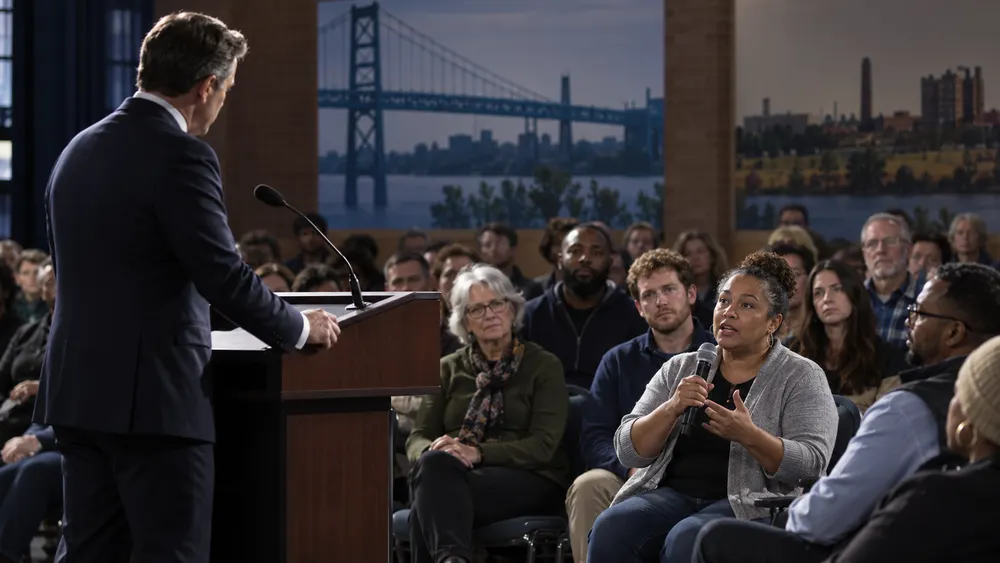
Vice President JD Vance used a nationally televised town hall to defend the Trump administration’s record, but the questions from Michigan voters exposed the issues Republicans must answer in the final weeks before the midterm election: the cost of living, the war with Iran, immigration enforcement, data-center development and ethical conduct inside the administration.
The hour-long CBS program, recorded with voters in Michigan and aired Saturday, gave Vance more room than a campaign speech to explain policy. It also forced him to respond to people describing direct consequences of government decisions. The full town hall is the primary record; the Associated Press account independently documented the exchanges and their political context.
Iran questions moved from strategy to accountability
The sharpest moment came from Joey Amor, whose wife, Master Sgt. Nicole Amor, was one of six U.S. soldiers killed in an Iranian drone strike in Kuwait on March 1, the day after the war began. Amor asked about the failures that left the troops vulnerable and how leaders would be held accountable. Vance said it was the first time he had heard the specific account, acknowledged that mistakes had been made in troop placement and said procedures had changed.
That answer matters because it shifted the discussion from the administration’s stated objective to the operational decisions behind it. Vance has previously described the administration’s diplomatic position in an interview with Reuters: Iran must make a meaningful reduction in nuclear-enrichment capacity for the conflict to end. Reuters also reported that Tehran rejects Washington’s terms and that a provisional agreement reached in June failed. The town hall did not resolve those strategic gaps; it added a demand for an account of how the war has been conducted.
Vance’s statement that information sometimes does not reach senior officials is not itself evidence of why the Kuwait strike succeeded or what remedial steps were taken. Those questions require military records and a formal review. His willingness to speak with Amor after the program was a commitment to follow up, not a substitute for public findings.
Affordability remains the immediate electoral pressure
Voters also pressed Vance on gasoline prices and the broader economy. In CBS’s account, he said repairing the economy would take more than 18 months and argued that new investment would pay off after factories were built and workers hired. That is a different emphasis from President Trump’s more categorical praise of the economy, and it reflects the difficulty of asking voters to credit future benefits while they face current costs.
Vance attributed elevated fuel prices partly to the Middle East conflict and earlier reductions in refining capacity. The first connection is broadly plausible because war around major production and shipping routes can raise oil-market risk. The second is a policy argument that depends on the time period, refinery utilization and product demand. The town hall format allowed the claim to be made, but not fully tested.
A Michigan resident also challenged data-center development after describing constant noise near her home. Vance said data centers can bring jobs and tax revenue but should not raise household utility bills or impose unreasonable local burdens. That response recognized a conflict increasingly visible in communities asked to host power-intensive infrastructure: national leaders want AI investment, while residents want enforceable limits on noise, water use, grid costs and land impacts.
Immigration and rhetoric required a narrower defense
On immigration, Vance defended the administration’s enforcement goals while acknowledging that mistakes can occur. The administration’s own October 8 presentation shows how prominently it is emphasizing visa fraud. At the town hall, however, voters asked not only about enforcement totals but about treatment, proportionality and the language used to describe immigrants.
Vance also revisited earlier comments about H-1B workers, saying his criticism was aimed at companies that use the program to reduce labor costs rather than at immigrants themselves. That distinction is politically important, but implementation is the better test: rules governing wages, eligibility, investigations and due process determine whether policy targets abuse without treating lawful workers as presumptively suspect.
A midterm message under examination
The setting amplified the political significance. Michigan is holding a competitive Senate race, and voters there can influence control of the chamber. Vance also acknowledged that he has not decided whether to seek the presidency in 2028. His answers therefore carried two audiences: voters evaluating the administration now and Republicans evaluating a possible future nominee.
The town hall did not produce a new policy platform. It did something more revealing for the closing stage of a campaign: it placed administration claims beside specific voter experiences. Vance’s strongest responses accepted that economic change takes time and that data centers and enforcement can cause real harms. His weakest moments came when questions demanded facts he did not have at hand. The political test is whether the administration supplies those facts and follows through before voters decide how much confidence to place in its promises.