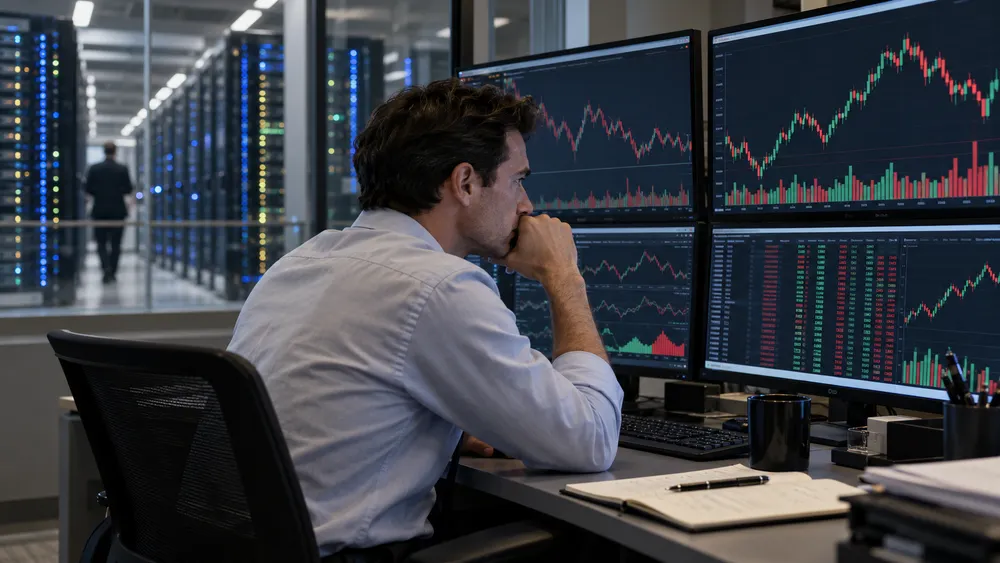
Wall Street is heading into a consequential earnings week after an AI-centered selloff knocked the S&P 500 and Nasdaq lower. The question is no longer whether large technology companies will keep spending on artificial intelligence; their own filings show that they will. Investors now want evidence that the new data centers, chips and software can generate cash fast enough to justify the scale and financing cost of the build-out.
Reuters reported that the S&P 500 recorded its steepest weekly decline since June as AI-linked shares weakened, while the Philadelphia semiconductor index fell sharply through October. The Associated Press separately found that the Nasdaq dropped 2.1% on Friday and posted its worst week since June. Those moves do not establish that an AI investment cycle is ending, but they show that markets are applying a higher burden of proof.
Market breadth also complicates a simple bubble narrative. AP reported that slightly more than half of S&P 500 stocks declined Friday, while nearly the entire technology sector fell. That concentration suggests investors were reassessing the most AI-sensitive valuations rather than abandoning equities indiscriminately. Whether the weakness spreads will depend partly on the earnings and guidance now arriving.
Disclosed spending is enormous
Meta provides a clear measure of the capital at stake. In its second-quarter results, the company projected 2026 capital expenditures, including principal payments on finance leases, of $130 billion to $145 billion. Its quarterly filing showed $31.08 billion of capital expenditures in the three months ended June 30, with much of the increase tied to servers, data centers and network infrastructure. The coming report will be read not just for revenue and earnings, but for any change in that range and management’s explanation of returns.
Tesla is making a different but still substantial wager. The company’s June-quarter filing said it expected more than $25 billion in 2026 capital expenditures, driven by AI initiatives, compute infrastructure, data centers, manufacturing and an expanding fleet of company-operated AI-enabled assets. Because that spending spans both physical production and software-intensive projects, investors will need to separate ordinary expansion from the portion meant to support future AI revenue.
The two companies are not direct substitutes, and their spending plans should not be combined into a single industry estimate. Meta primarily monetizes advertising and digital services; Tesla depends heavily on vehicle, energy and related operations. What links them is the timing mismatch: capital is being committed now, while some of the hoped-for revenue and productivity gains may arrive later or remain uncertain.
Earnings must answer three questions
First, investors will look for utilization. New computing capacity creates value only if it supports products customers use or lowers the cost of delivering existing services. Measures such as revenue growth, operating margins, free cash flow and depreciation trends can help test management claims, though no single quarter will settle the issue.
Second, the market will examine financing. Higher interest rates raise the hurdle for long-duration projects and make heavily indebted suppliers more vulnerable. Even cash-rich technology companies are affected because capital tied up in servers and facilities cannot simultaneously be returned to shareholders or deployed elsewhere. The risk is larger for smaller cloud and infrastructure providers that depend on borrowing or concentrated customer contracts.
Third, guidance will matter as much as the reported quarter. A company can beat near-term earnings expectations while increasing future spending faster than analysts anticipated. Conversely, a lower capital forecast could support cash flow but raise questions about demand. Investors are therefore likely to focus on the relationship between spending, contracted capacity and measurable revenue rather than treating a larger budget as automatically bullish.
The IMF adds a stability warning
The concern extends beyond individual stocks. At its October meetings, the International Monetary Fund warned that an AI-related correction could follow if investment expectations or projected profits disappoint. The IMF’s financial-stability briefing identified optimistic earnings assumptions and strong investment plans as a potential trigger. Its published report summary said a reassessment of AI prospects could reduce investment, push equities lower and tighten financial conditions internationally.
That is a risk scenario, not a forecast that collapse is imminent. The same investment boom can raise productivity, expand digital capacity and produce durable earnings. The policy and market challenge is that the benefits may be uneven and slow, while financing obligations and asset-price losses can surface quickly.
A reset, not yet a verdict
The recent selloff should be read as a repricing of uncertainty rather than proof that AI demand has disappeared. Major companies continue to disclose large budgets, and suppliers still report strong interest in compute capacity. But the trade is maturing: broad enthusiasm is giving way to company-by-company scrutiny of cash generation, customer demand and balance-sheet resilience.
This week’s results will not provide a final answer on the AI cycle. They can, however, narrow the gap between ambition and evidence. If revenue growth and margins keep pace with spending, the market may view the pullback as temporary. If guidance points to rising capital needs without clearer returns, the pressure on technology valuations and highly leveraged infrastructure firms is likely to persist.