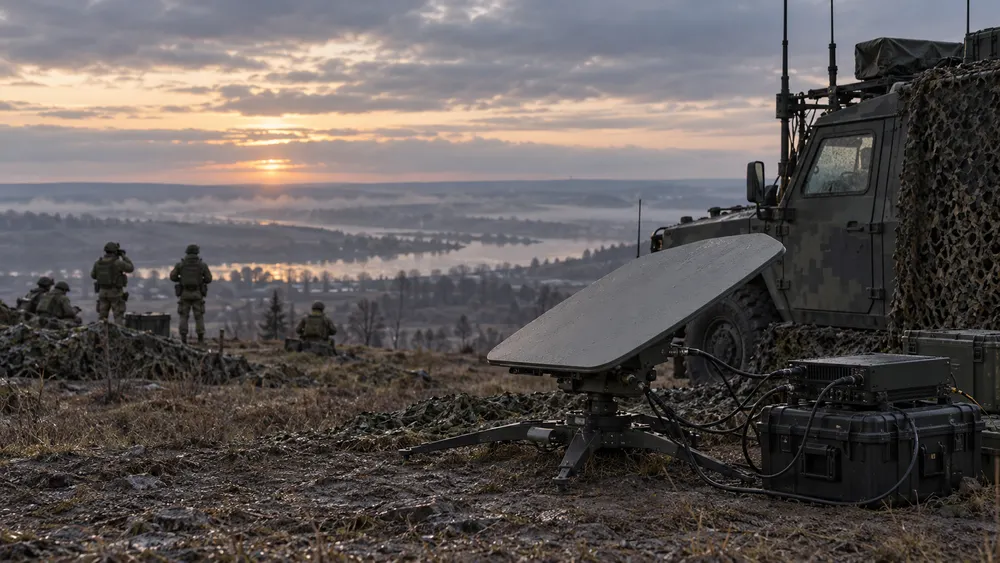
A sudden speed limit on Ukraine’s Starshield satellite service disrupted drone missions and battlefield communications this week, exposing the military and policy risks of relying on a commercial network controlled through U.S. government arrangements. Ukraine says partial service has returned, but a 160-kilometer-per-hour limit remains and negotiations are continuing.
The restriction cuts connectivity when a Starshield terminal moves faster than roughly 100 miles per hour. That threshold matters because Ukraine mounts terminals on drones used for reconnaissance, strikes and interception of faster Russian unmanned aircraft. Communications can slow or drop as the platform accelerates, complicating control at the moment a mission becomes most demanding.
What changed
Ukraine detected the new limit without advance notice, according to government and military officials interviewed by the Associated Press. Presidential adviser Serhii Beskrestnov said Kyiv was speaking with SpaceX and the Pentagon about removing it. The commercial Starlink service and the government-oriented Starshield service share technical roots, but Starshield is designed for national-security customers and operates under U.S. government arrangements.
Reuters reported that soldiers in the Donbas region experienced slower connections between artillery units and command posts, along with interference affecting surveillance and drone operations. Those reports do not establish the full geographic scope of the limitation, and service quality can vary for technical reasons. Still, Ukraine’s public statements confirm that an operational restriction was imposed.
Ukrainian President Volodymyr Zelenskyy raised the problem during meetings in Brussels. After talks with NATO Secretary General Mark Rutte, his office said the Starlink limitations added to challenges facing air defense as Russia increased missile and drone attacks. The official account linked the communications issue to Ukraine’s need for interceptors, aircraft ammunition and more resilient defensive systems.
Responsibility remains disputed
The origin of the order is contested. Reuters reported, citing unnamed U.S. and Western officials, that the direction came from inside the White House and was communicated to Defense Department leaders. President Donald Trump said Friday that he did not believe either he or SpaceX chief executive Elon Musk was responsible for Ukraine’s loss of access, according to a separate Reuters account.
The White House and Pentagon had not issued a detailed on-record explanation of the restriction at the time of publication. Musk said publicly that the U.S. government controls decisions about Starshield’s use in Ukraine. Those conflicting statements leave unanswered whether the limit reflected policy, contract administration, security concerns or a technical change.
That uncertainty is itself an operational problem. Military planners need to know which capabilities will be available, under what conditions and how quickly limits can change. A network can be technically reliable yet strategically fragile if mission parameters depend on decisions made outside the supported force’s chain of command.
A known dependence on commercial space
The Pentagon has acknowledged for years that it contracts for satellite communications supporting Ukraine. In a 2023 press briefing, the department confirmed a Starlink contract intended to ensure that Ukrainian forces had needed communications infrastructure. Starshield subsequently expanded the role of commercial low-Earth-orbit networks in military operations.
The arrangement offers major advantages. Large constellations provide broad coverage, relatively low latency and many satellites, making the network harder to disable than a small number of traditional spacecraft. Terminals can be moved quickly and connected without building extensive terrestrial infrastructure. Those features have supported Ukrainian command, medical, logistics and drone operations under attack.
But commercial dependence creates governance questions that military-owned systems handle differently. A private provider maintains the underlying constellation, the U.S. government administers national-security access and an allied military uses the service in combat. Contract terms, geographic boundaries and permitted missions can become strategic levers.
The Government Accountability Office warned in a 2025 review that the Defense Department needed better reporting and coordination as it increased reliance on commercial satellite communications. GAO found that the department’s new approach was complex and that Congress needed clearer information on implementation, interoperability and progress. The Starshield episode gives those management concerns immediate battlefield relevance.
Operational lessons
Ukraine is seeking alternatives, but no replacement can be fielded instantly at the same scale. Other commercial constellations may add redundancy, and Europe can invest in sovereign networks, yet terminals, ground infrastructure, security standards and capacity all take time. A backup that cannot support moving platforms or battlefield encryption is not equivalent to Starshield.
Military planners can reduce risk by using multiple communications paths, pre-negotiating service conditions and maintaining the ability to switch networks. Contracts should define who can impose operational limits, how quickly allies must be notified and what dispute process applies during combat. Forces also need training that assumes degraded bandwidth rather than uninterrupted service.
The European Council’s October conclusions renewed support for Ukraine and emphasized European defense capacity. Satellite communications should be part of that discussion alongside ammunition, air defense and intelligence because connectivity now links sensors, commanders and weapons.
The immediate question is whether the speed cap will be lifted. The larger lesson is already clear: commercial space networks can provide extraordinary military capability, but access rules are part of the weapon system. Resilience depends not only on satellites in orbit, but also on contracts, political decisions and alternatives available when policy changes without warning.