
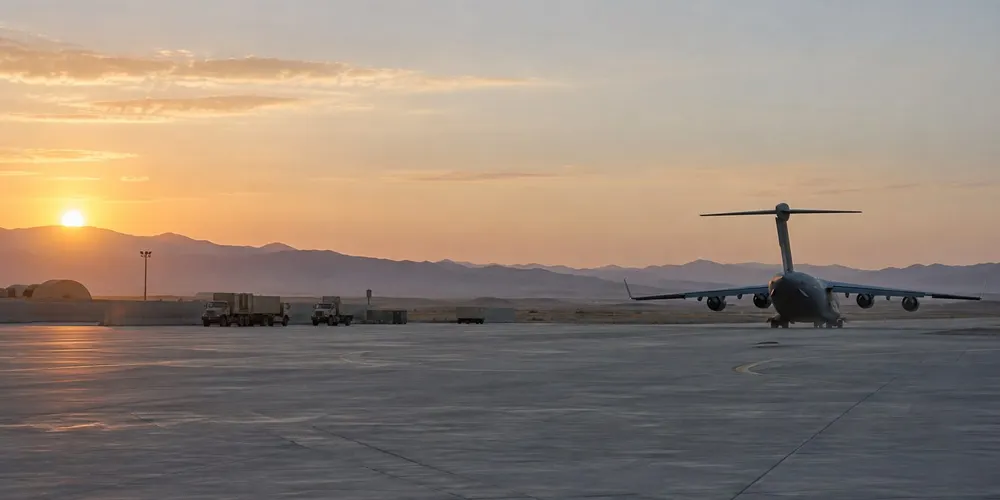
A 12-year U.S.-led military mission in Iraq ended Wednesday as the last American troops and equipment left Erbil Air Base, shifting primary responsibility for the country’s security to Iraqi forces while the wider campaign against the Islamic State continues from neighboring states.
U.S. Central Command said the departure completed the Iraq phase of Operation Inherent Resolve, which began in 2014 after Islamic State fighters captured large parts of Iraq and Syria. The official CENTCOM account said Erbil had hosted most of the roughly 1,500 American and coalition personnel still supporting counter-ISIS operations. The Pentagon described the exit as an orderly transition to a bilateral U.S.-Iraq defense relationship, not the end of security cooperation.
The withdrawal is a consequential endpoint for the United States, but it is narrower than a complete regional disengagement. The coalition task force remains operational from Jordan, and Washington says it will continue targeted training and intelligence support for Iraqi partners. The result is a smaller, more remote American role that reduces exposure inside Iraq while preserving some capacity to respond if Islamic State again develops into a larger threat.
A planned withdrawal reaches its final stage
The exit follows a two-phase transition negotiated by Washington and Baghdad in 2024. Under that transition plan, coalition operations in federal Iraq would wind down first, followed by the remaining mission in the semiautonomous Kurdish region. American personnel departed major bases in central and western Iraq before the final movement from Erbil.
The U.S. mission had already changed substantially before Wednesday. American forces returned to Iraq at Baghdad’s invitation in 2014 after having left in 2011, and helped Iraqi and Kurdish forces dismantle the Islamic State’s territorial caliphate. By the final phase, the mission centered on advising, intelligence and enabling support rather than large-scale ground combat. The Defense Department’s formal statement said the coalition had defeated ISIS as an organized military threat, while avoiding the broader claim that the group had been eliminated.
The counter-ISIS campaign moves outside Iraq
The operational distinction matters. Islamic State no longer controls cities or broad territory in Iraq, but it retains dispersed cells capable of attacks and recruitment. CENTCOM said the coalition headquarters has moved to Jordan and will continue counter-ISIS work in Syria with partner forces. That leaves Iraqi security institutions to manage threats inside Iraq while the United States supplies narrower support from outside the country.
Independent accounts broadly confirm the handoff while emphasizing its risks. The Associated Press reported particular concern in Iraq’s Kurdish region, where officials have warned that removing U.S. air defenses could leave them more exposed to drones and missiles. Reuters also reported fears that a security vacuum could strengthen both Islamic State remnants and armed groups aligned with Iran.
Those concerns do not prove that either threat will expand. Iraqi forces are substantially more capable than they were when units collapsed before the Islamic State offensive in 2014, and the coalition says they can operate independently. The real test will be whether Iraqi institutions can sustain intelligence collection, air defense, logistics and command coordination without an American force physically present at Erbil.
Militias become Baghdad’s central test
The withdrawal also removes a longstanding justification used by Iran-aligned militias for retaining weapons outside state control. Iraqi Prime Minister Ali al-Zaidi has pledged that government forces will continue fighting Islamic State and that non-state groups will eventually disarm. Yet the AP reported that the original September 30 disarmament deadline has slipped to June 2027, while several powerful factions have rejected or conditioned the demand.
That gap is central to the post-withdrawal order. Baghdad gains fuller control over the formal security mission, but it does not automatically gain authority over every armed organization operating in the country. Tehran and allied groups have celebrated the American departure as a strategic victory, while Kurdish officials and some Iraqi analysts worry that those factions will become more influential. The withdrawal therefore transfers not only security responsibility but also political accountability to Iraq’s government.
A military endpoint, not a clean break
The formal end of the mission also closes a chapter that began long before Operation Inherent Resolve. The United States invaded Iraq in 2003, withdrew combat forces in 2011 and returned three years later after the Islamic State’s advance. Wednesday’s announcement ends the renewed troop presence rather than erasing the diplomatic, financial and security ties built over more than two decades.
Coalition partners are making the same distinction. Britain’s defense ministry said its forces had departed as the mission concluded, but described the next phase as continued bilateral cooperation with Iraq. That framing mirrors Washington’s position: combat-era coalition structures are ending inside Iraq, while training, intelligence and regional counterterrorism mechanisms remain.
What the withdrawal will measure
The immediate facts are clear: American forces have left Iraqi territory, Erbil Air Base has been handed over, and the coalition’s Iraq-based mission has ended. What is not yet established is whether the new arrangement can contain Islamic State cells, deter attacks on the Kurdish region and help Baghdad bring militias under state authority.
Those outcomes will emerge over months rather than days. A stable transition would validate the Pentagon’s judgment that Iraqi forces can manage the threat with limited external support. Renewed militant activity or expanding militia power would show that the physical U.S. presence had been performing functions that remote assistance cannot readily replace. For the United States, Wednesday’s withdrawal is a concrete end to one mission and the beginning of a less visible test of the security partnership that remains.