Quick Answer
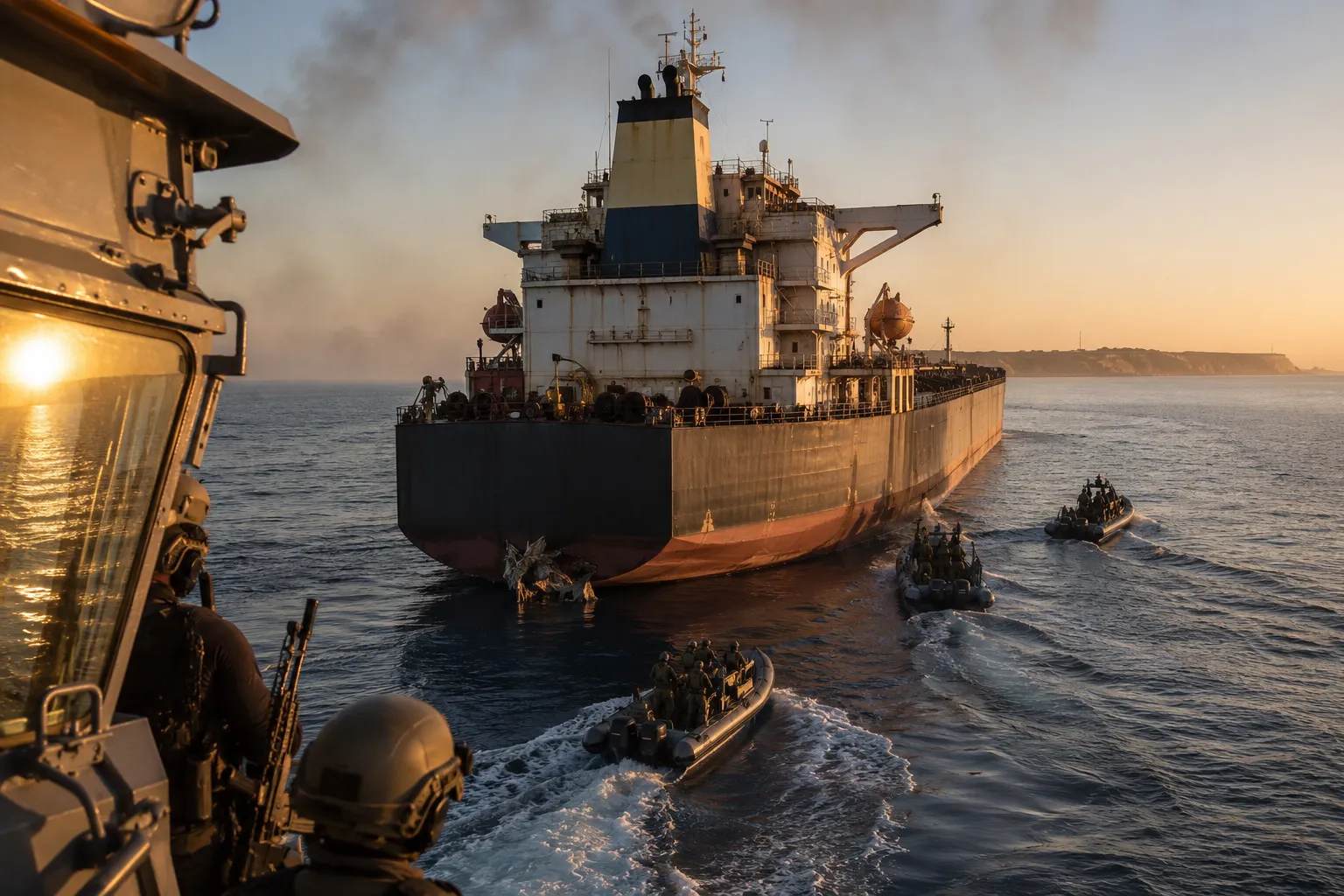
U.S. Central Command has redirected 44 ships, disabled 2, and boarded 2 since the naval blockade of Iranian ports resumed, according to CENTCOM figures reported in early August [2]. The disabling of the M/V Vela Nova, one of the two vessels CENTCOM says it stopped by force rather than by radio warning, marks the point where US Central Command intensifies Iran blockade in August 2026 enforcement from deterrence into direct physical interdiction. The blockade, announced on 14 July 2026 at the direction of the Commander-in-Chief, covers all maritime traffic transiting to or from Iranian ports and coastal areas [1].
Key Takeaways
- CENTCOM announced U.S. forces would resume blockading maritime traffic entering and exiting Iranian ports beginning 14 July 2026 at 4 p.m. ET [1].
- The order applies to vessels "transiting to or from Iranian ports and coastal areas," while other regional traffic not violating the blockade continues [1].
- Enforcement totals reported in early August: 44 ships redirected, 2 disabled, 2 boarded [2][9].
- The M/V Vela Nova is among the small number of vessels physically disabled rather than turned away, the clearest signal that US Central Command intensifies Iran blockade in August 2026 through kinetic means.
- The 2026 blockade has run in two phases: 13 April, 18 June, then a pause, then 14 July to present [3].
- CENTCOM struck Iranian air defenses, coastal radar, missile, drone and small-boat capabilities on 12 July to degrade Iran's ability to threaten shipping in the Strait of Hormuz [4].
- By 17 July, CENTCOM had completed a seventh consecutive night of strikes while "fully enforcing a naval blockade against Iranian ports" [8].
- Strike operations reached a 13th night, hitting military logistics and underground weapons storage [5].
- A trilateral defense pact signed in Mecca and a possible Hormuz arrangement were under discussion by 8 August [7].
- Blockades are legally distinct from sanctions: one is a physical military cordon, the other is a financial and legal restriction.
What is US Central Command doing in Iran in August 2026?
CENTCOM is running two linked operations at once: a naval cordon around Iranian ports and a sustained air campaign against Iranian military targets. The command stated plainly on 17 July that it was "fully enforcing a naval blockade against Iranian ports" while completing its seventh consecutive night of strikes [8].
The strike target sets have been specific rather than general. On 12 July, CENTCOM reported a new wave against Iranian air defenses, coastal radar sites, missile and drone capabilities, and small boats, describing the purpose as degrading Iran's ability to attack international shipping in the Strait of Hormuz [4]. The 17 July wave hit surveillance sites, military logistics infrastructure, underground weapons storage and maritime capabilities [8]. By the 13th night, strikes on Iranian military targets were still ongoing [5].
At sea, the arithmetic tells the story. Of the vessels CENTCOM has engaged, the overwhelming majority, 44, were simply redirected [2][9]. Only two were disabled. The M/V Vela Nova falling into that second category is what separates August's posture from July's.
What caused the Iran blockade in August 2026, and why now?
The blockade resumed on 14 July 2026 by presidential direction after a pause in an earlier phase collapsed [1][3]. The stated military rationale is protecting international shipping in the Strait of Hormuz from Iranian missile, drone and small-boat attack [4].
The timeline is the mechanism:
| Date | Development |
|---|---|
| 13 April 2026 | First blockade phase begins [3] |
| 18 June 2026 | First phase suspended under a temporary arrangement [3] |
| 12 July 2026 | CENTCOM strikes Iranian air defenses, coastal radar, missiles, drones, small boats [4] |
| 14 July 2026, 4 p.m. ET | Blockade formally resumes by order of the Commander-in-Chief [1] |
| 17 July 2026 | Seventh consecutive night of strikes; blockade "fully enforced" [8] |
| Early August 2026 | 44 ships redirected, 2 disabled, 2 boarded [2] |
| 8 August 2026 | Trilateral Mecca defense pact signed; Hormuz deal under discussion [7] |
The pattern is escalation by increments, not a single trigger. Each round of strikes narrowed Iran's ability to contest the cordon, and each narrowing made physical interdiction, boarding, disabling, operationally cheaper for U.S. forces.
How does a naval blockade actually work?
A naval blockade is a physical military cordon. Warships, aircraft and surveillance assets establish a declared zone, warn approaching vessels by radio, and escalate through interception, boarding, seizure, or disabling if a ship refuses to turn back.
The escalation ladder used off Iran, based on CENTCOM's own reported numbers [2]:
- Notice. A public declaration naming the covered area, here, "vessels transiting to or from Iranian ports and coastal areas" [1].
- Query and warning. Radio contact; the master is told to alter course.
- Redirection. The vessel complies and diverts. This accounted for 44 of the engagements [2][9].
- Boarding. A visit-and-search team goes aboard. Two vessels [2].
- Disabling. Propulsion or steering is rendered inoperable. Two vessels, including the M/V Vela Nova [2].
Decision rule for shipowners: if a vessel's charter routes it to Bandar Abbas, Bushehr or any Iranian coastal terminal, it is inside the declared scope [1]. Traffic transiting regional waters without violating the blockade continues [1], the cordon is port-specific, not a closure of the Gulf.
Common mistake: assuming a blockade only targets weapons. A declared blockade covers traffic to and from the blockaded coast regardless of cargo, which is why crude carriers, general cargo ships and tankers all appear in the redirection count.
What's the difference between a blockade and sanctions?
Sanctions are legal and financial restrictions enforced through courts, banks, insurers and designations. A blockade is enforced by warships. Sanctions punish a transaction after the fact; a blockade physically prevents the voyage.
- Enforcer: Treasury and regulators versus CENTCOM warships and aircraft [1].
- Mechanism: asset freezes, secondary designations, insurance withdrawal versus interception, boarding, disabling [2].
- Evasion route: sanctions can be worked around by shadow fleets, ship-to-ship transfers and falsified manifests. A blockade closes the water, so a shadow tanker still has to sail past a destroyer.
- Speed: sanctions take months to bite. The Vela Nova case shows a blockade takes hours.
Iran has operated under U.S. sanctions for decades. The 2026 blockade is a different instrument applied on top of that framework [3].
Has the U.S. blockaded Iran before, and how is this one different?
The U.S. has conducted escorting, mine-clearing and tanker-protection operations in the Gulf in earlier decades, but a declared naval blockade of Iranian ports is the exception, not the pattern. The 2026 operation is documented as a distinct, two-phase event [3].
What makes the current phase different:
- It is declared and public. CENTCOM issued a formal notice with a start time [1].
- It is paired with a nightly strike campaign. Enforcement is preceded by the destruction of the coastal radars, missiles and small boats that would otherwise contest it [4][8][5].
- It has been suspended and restarted. The 18 June pause, then the 14 July resumption, shows the blockade functioning as a negotiating lever [3].
- It now includes disabling. Redirection dominates the numbers, but the M/V Vela Nova establishes that refusal carries a physical cost [2].
How will the Iran blockade affect oil prices, and which countries are involved?
Iran is a significant crude exporter and the blockade closes its ports, so the direct effect is on Iranian barrels reaching market and on risk premiums for all Gulf shipping. Freight rates and war-risk insurance for Hormuz transits respond faster than crude benchmarks.
Parties visible in the reporting:
- United States: CENTCOM commands the blockade and the strike campaign [1][4].
- Iran: the blockaded state, and the target of strikes on air defense, missile, drone and maritime assets [4][8].
- Gulf and regional states: a trilateral defense pact was signed in Mecca as a Hormuz arrangement was under discussion on 8 August, per Al Jazeera [7].
- Flag and owner states of affected merchant ships: the 44 redirected, 2 boarded and 2 disabled vessels represent commercial interests across multiple registries [2][9].
Edge case worth watching: CENTCOM says traffic not violating the blockade continues through regional waters [1]. If that holds, the Strait stays open for non-Iranian trade and the price effect stays tied to Iranian supply rather than to a full closure.
What can Iran import and export during the blockade, and what are the humanitarian concerns?
The declared scope covers maritime traffic to and from Iranian ports and coastal areas [1], which means seaborne crude exports and seaborne imports are the primary casualties. Land borders, air routes and overland trade are not part of the naval cordon.
Humanitarian pressure points that follow from any port blockade:
- Food and pharmaceutical imports that normally arrive by sea, and whether exemptions or inspection corridors exist.
- Fuel and refined product flows into inland distribution.
- Seafarer safety aboard redirected, boarded and disabled vessels, the M/V Vela Nova's crew being the clearest example of civilians inside a military operation.
- Insurance withdrawal, which can halt even permitted cargo because no underwriter will cover the voyage.
CENTCOM's published notice frames the measure around shipping to and from Iranian ports and does not resolve these questions [1].
What's Iran's response to the U.S. blockade, and how long do blockades usually last?
Iran's response has been military rather than compliant: CENTCOM's stated reason for striking coastal radar, missile, drone and small-boat sites was to degrade Iran's ability to attack international shipping in the Strait of Hormuz [4]. Thirteen nights of strikes indicate the target set has not been exhausted [5].
Blockades end when one of three things happens: the blockading force achieves its aim, the cost of enforcement exceeds the benefit, or a negotiated arrangement replaces it.
Duration has no standard. The 2026 case is instructive on its own terms: phase one ran 13 April to 18 June, about nine weeks, before a temporary arrangement suspended it [3]. Phase two began 14 July and is ongoing [3]. The 18 June suspension shows how quickly a cordon can lift when diplomacy advances, and the 14 July restart shows how quickly it returns when diplomacy stalls. The Mecca pact and the Hormuz talks reported on 8 August are the variables most likely to determine phase two's end date [7].
FAQ
When did the current Iran blockade start? The second phase began 14 July 2026 at 4 p.m. ET, announced by CENTCOM at the Commander-in-Chief's direction [1].
How many ships has CENTCOM stopped? CENTCOM reported 44 ships redirected, 2 disabled and 2 boarded since the blockade of Iranian ports began [2][9].
What happened to the M/V Vela Nova? It is one of the two vessels CENTCOM says it disabled rather than merely redirected, marking the shift to physical interdiction in August 2026 [2].
Is the Strait of Hormuz closed? No. CENTCOM states traffic through regional waters that does not violate the blockade continues; the cordon targets Iranian ports and coastal areas [1].
Is a blockade the same as sanctions? No. Sanctions are financial and legal; a blockade is a physical military cordon enforced by warships.
How many nights of strikes has CENTCOM conducted? CENTCOM publicly reported a seventh consecutive night on 17 July and a 13th night in a later release [8][5].
Was there an earlier blockade in 2026? Yes. A first phase ran 13 April to 18 June 2026 before being suspended under a temporary arrangement [3].
What are the strikes targeting? Air defenses, coastal radar, missile and drone capabilities, small boats, surveillance sites, military logistics and underground weapons storage [4][8].
Conclusion
The numbers define the moment. Forty-four redirections show a blockade working mostly by warning; two disabled ships, the M/V Vela Nova among them, show what happens when warning fails [2]. That ratio is the single most useful gauge of whether US Central Command intensifies Iran blockade in August 2026 further, or whether the Mecca defense pact and the Hormuz talks reported on 8 August pull the operation back toward the 18 June pattern [7][3].
Practical next steps for readers tracking this:
- Monitor CENTCOM public releases for the redirected/boarded/disabled counts, the ratio, not the total, signals escalation [1][2].
- Watch whether nightly strike releases continue past the 13th-night mark or stop [5].
- Follow the Hormuz negotiation track; the 18 June suspension proves a deal can lift the cordon quickly [3][7].
- For shipping and energy exposure, treat war-risk insurance quotes for Gulf transits as the earliest price signal.
References
[1] Us Forces To Resume Naval Blockade Against Iran - https://www.centcom.mil/MEDIA/PUBLIC-RELEASES/Article/4542098/us-forces-to-resume-naval-blockade-against-iran/ [2] Us Centcom Says It Redirected 44 Ships Disabled 2 Boarded 2 - https://www.middleeasteye.net/live-blog/live-blog-update/us-centcom-says-it-redirected-44-ships-disabled-2-boarded-2 [3] 2026 United States Naval Blockade Of Iran - https://en.wikipedia.org/wiki/2026_United_States_naval_blockade_of_Iran [4] Centcom Completes Another Wave Of Strikes Against Iran - https://www.centcom.mil/MEDIA/PUBLIC-RELEASES/Article/4541002/centcom-completes-another-wave-of-strikes-against-iran/ [5] Us Concludes 13th Night Of Strikes On Iranian Military Targets - https://www.centcom.mil/MEDIA/PUBLIC-RELEASES/Article/4554310/us-concludes-13th-night-of-strikes-on-iranian-military-targets/ [6] Iran War Trump - https://www.cnn.com/2026/08/04/world/live-news/iran-war-trump [7] Iran War Live Trilateral Mecca Defence Pact Signed As Hormuz Deal Looms - https://www.aljazeera.com/news/liveblog/2026/8/8/iran-war-live-trilateral-mecca-defence-pact-signed-as-hormuz-deal-looms [8] Centcom Finishes Latest Wave Of Strikes Against Iran - https://www.centcom.mil/MEDIA/PUBLIC-RELEASES/Article/4549624/centcom-finishes-latest-wave-of-strikes-against-iran/ [9] 17cnlls Centcom Reroutes Ships Since Start Iranian Ports - https://www.wam.ae/en/article/17cnlls-centcom-reroutes-ships-since-start-iranian-ports [10] CENTCOM - https://x.com/CENTCOM/status/2084317815847178361
Tags: Iran blockade, US Central Command, CENTCOM, M/V Vela Nova, Strait of Hormuz, naval blockade, oil prices, Iran sanctions, maritime security, Middle East policy, Hormuz deal, US Navy