
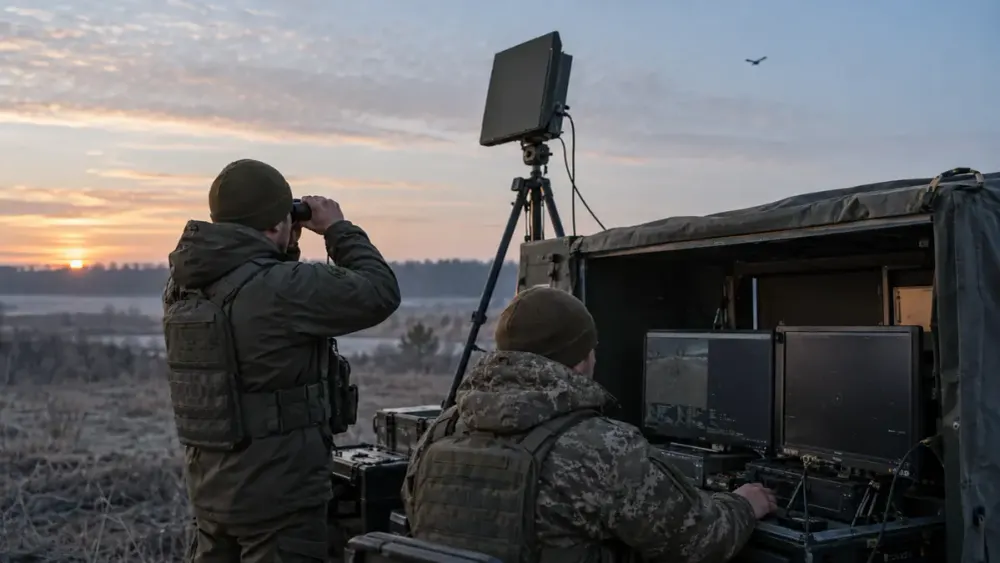
Ukraine said a newly developed interceptor successfully struck a jet-powered Shahed drone in testing on Tuesday, offering the first public sign that Kyiv may be closing a dangerous gap in its defenses against Russia’s faster generation of attack drones.
President Volodymyr Zelenskyy disclosed the result in an official address, saying the Ukrainian system still needed technical work, particularly on its controls. He did not identify the weapon, its manufacturer, cost, range or intended production date. The single reported hit has not been independently verified and does not establish that the interceptor is ready for sustained combat.
The test matters because Russia has sharply expanded its use of jet-powered drones that can fly more than twice as fast as the piston-engine Shahed designs Ukraine learned to counter relatively cheaply. Ukraine’s military also said it downed or suppressed 187 airborne targets overnight, while Zelenskyy put the interception rate for Russian drones at 93%, according to Reuters. Those figures are Ukrainian claims and do not show how the new system performed beyond the reported test.
Russia’s Faster Drones Changed the Air-Defense Problem
Russia increased its use of jet-powered drones roughly sixfold during the summer, from about 450 in June to 2,850 in August, Ukrainian military data reviewed by Reuters showed. The weapons flew between 240 and 500 kilometers per hour, compared with less than 200 kilometers per hour for a typical propeller-driven Shahed. Ukrainian defense intelligence estimated Russian production at about 3,000 jet drones a month.
Speed shortens the time available to detect, track and engage a target. Ukraine’s inexpensive interceptor drones, which can cost less than $2,000, became an important answer to mass attacks by slower Shaheds, but many cannot catch the jet variants from behind. Some Russian models can also be guided during flight and resist electronic jamming, allowing operators to change routes or altitude as defenders react.
Kyiv and its surrounding region accounted for nearly one-fifth of the faster drones documented in the Ukrainian data, while Odesa and its port infrastructure were also heavily targeted. Ukrainian Air Force officials said jet models made up more than 70% of the drones in some raids. Concentrating high-speed weapons on those areas forces defenders to protect political leadership, civilian neighborhoods, power systems and export routes at the same time.
A Successful Hit Is Only the First Threshold
The latest result follows an unsuccessful July exercise in which several interceptor prototypes were difficult to control above 400 kilometers per hour and crashed. That history makes Zelenskyy’s acknowledgment of remaining control problems important. A weapon that can hit once under test conditions must still acquire targets reliably at night, operate amid electronic interference, avoid friendly aircraft and function in sufficient numbers during a large raid.
Ukraine has trained more than 1,000 interceptor-drone crews and has said more than 60 companies are pursuing answers to jet-powered threats. Developers are examining faster drones, low-cost guided missiles and head-on interception, which requires highly accurate prediction of an incoming drone’s path. Ukraine’s president said fighter jets and helicopters were still being used heavily to protect cities, a costly and sometimes hazardous substitute for a mature ground-based solution.
Economics and Production Will Determine the Outcome
The central military problem is not simply whether Ukraine can destroy a jet drone, but whether it can do so at a sustainable exchange rate. Using scarce, sophisticated air-defense missiles against mass-produced drones can preserve a target while depleting weapons needed for ballistic and cruise missiles. European militaries are therefore pursuing larger inventories of lower-cost interceptors, an industrial shift detailed in a separate analysis.
Kyiv is combining domestic development with foreign assistance. NATO says its members pledged €70 billion in military equipment, assistance and training for Ukraine in 2026, while allies and partners have financed more than $6 billion of U.S. equipment through the Prioritised Ukraine Requirements List. The alliance’s summary identifies air-defense ammunition as part of deliveries already underway. Expensive systems remain essential against ballistic missiles, but a cheaper layer is needed to keep them from being consumed by drones.
Critical Infrastructure Is Driving the Procurement Push
Ukraine’s leadership is tying the interceptor effort to protection of railways, energy facilities, border crossings and other logistical assets. After a national command meeting Tuesday, Zelenskyy’s office said the government would expand electronic-warfare capabilities and increase purchases of protective systems for infrastructure, according to the official statement. Rail and port networks are military targets because they move troops and equipment, but they also sustain civilian travel and exports.
The new interceptor should therefore be judged by repeatable results rather than the novelty of its propulsion or guidance. The next meaningful evidence would include multiple engagements against maneuvering targets, a disclosed unit cost, production commitments and successful integration with Ukraine’s sensors and command network. Tuesday’s reported hit shows technical progress against a threat that expanded rapidly this summer; it does not yet show that Ukraine can manufacture and field the system at the scale Russia’s campaign demands.