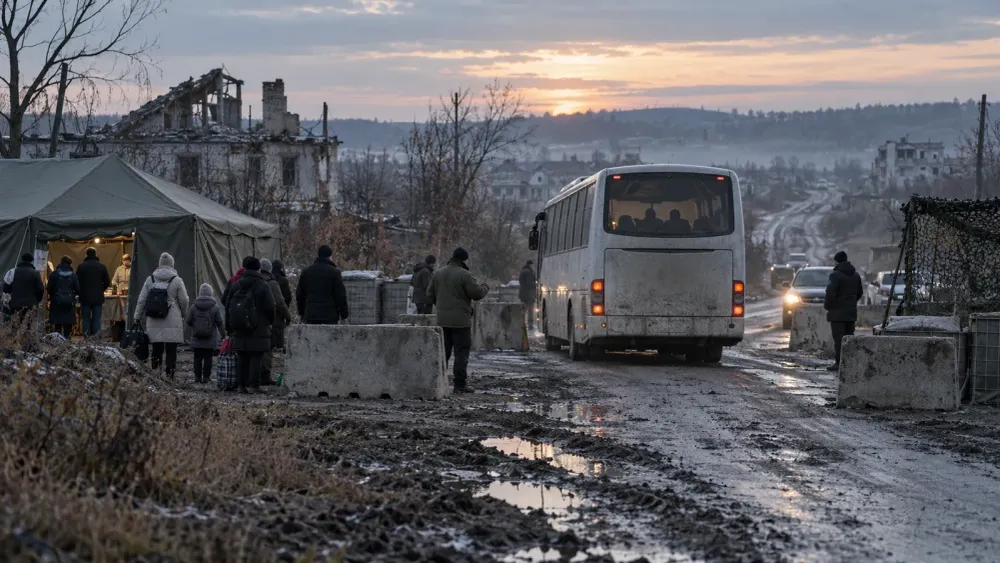
Civilians evacuated from Russian-occupied Oleshky reached Ukrainian-held territory on Saturday after a long journey through occupied Crimea, Russia and Belarus, completing the central phase of a rare localized ceasefire in southern Ukraine. The arrivals turned an agreement on paper into a functioning humanitarian corridor across one of the war’s most dangerous front-line areas.
The operation is limited in geography and purpose. It does not stop fighting elsewhere, and it does not establish a broader peace process. Its significance lies in something narrower but still consequential: Russian and Ukrainian officials coordinated a pause, demined roads, delivered supplies and moved civilians across opposing lines without a reported breakdown in the arrangement.
The Associated Press and Reuters reported that evacuees crossed the Belarus-Ukraine border in the Chernihiv region on Saturday. The Financial Times separately reported that the group reached Ukrainian territory after leaving Oleshky the previous day.
A corridor across hostile territory
Oleshky sits on the Russian-held side of the Dnipro River in the Kherson region, only a few miles from the front. Residents who chose to return to Ukrainian-controlled territory could not travel directly west across the battle line. Instead, buses carried them through occupied Crimea to Anapa in southern Russia, followed by flights to Belarus and a final bus crossing into northern Ukraine. Reuters and AP both documented the route, while Ukrainian officials withheld some operational details to protect people who remained behind and preserve the possibility of future missions.
The group included elderly residents, people using wheelchairs or stretchers, children and families traveling with pets. Aid workers, ambulances and reception teams met them after the border crossing. Ukrainian human rights commissioner Dmytro Lubinets said the youngest evacuee was just over one year old and the oldest was 94, figures also reported by AP and Reuters.
What the ceasefire accomplished
The pause began early Tuesday and was scheduled to last through Sunday evening. During that period, the sides stopped military action around Oleshky, cleared mines from access roads, brought in food and medicine and organized departures. The White House announced the agreement on Oct. 23, saying first lady Melania Trump had worked with Russian and Ukrainian representatives to define the terms, timing and technical procedures.
Ukraine’s ombudsman said Friday that organizers had assembled 25 buses with 750 seats and ambulances for people with limited mobility. The office said residents could leave for their preferred destination or remain in Oleshky and receive supplies. AP reported that about 2,000 people were believed to be in the city when the truce began, while Reuters cited an estimate of roughly 1,700. The difference reflects the absence of a formal population count under occupation.
Conditions that made the mission urgent
Accounts from evacuees described severe food shortages, extensive drone activity and movement constrained by mines. Reuters interviewed residents who said they had lost significant weight or eaten grass and squash to survive. AP separately reported that staples had largely disappeared by spring and that residents feared drones and landmines. Those accounts cannot establish conditions in every household, but together they support the official assessment that the remaining population faced an acute humanitarian emergency.
Oleshky had about 24,000 residents before Russia’s full-scale invasion in 2022. Russian forces occupied the city early in the war, and the destruction of the Kakhovka Dam in 2023 compounded the damage through catastrophic flooding. By this month, utilities and normal supply routes were severely disrupted. The White House and both news agencies described the remaining population as disproportionately older and in need of food, clean water and medical care.
A model with strict limits
Both sides have indicated that the mechanism may be used again. Russia’s human rights commissioner, Yana Lantratova, said regular humanitarian missions had been agreed, according to AP and Reuters. Lubinets said the Oleshky arrangement could become a basis for responding to other severe humanitarian crises, although he did not confirm the same forward commitment described by Lantratova.
That gap matters. A successful evacuation demonstrates that tightly bounded coordination is possible, but it does not prove that either government is prepared to expand a ceasefire or accept political compromises. The mission required an outside intermediary, detailed logistics and a route of more than 1,000 miles because the direct crossing remained too dangerous. It also left some residents in Oleshky and sent others to Russian-held territory, preserving difficult questions about consent, screening and long-term protection.
Fighting continues beyond Oleshky
The local truce did not reduce military operations across the wider war. Reuters reported continuing drone attacks by both sides, while AP described strikes and casualties away from Kherson. In a Friday presidential address, Volodymyr Zelenskyy said Ukrainian forces were helping the Oleshky mission even as Russian attacks continued against energy infrastructure and cities elsewhere.
For military planners, the corridor shows the value of precise boundaries, synchronized timing, demining and monitoring when adversaries agree on a civilian objective. For diplomacy, the result is more modest: a rare proof that limited arrangements can survive several days amid an active war. Whether that cooperation can be repeated will depend on conditions far more fragile than the successful arrival of one group of evacuees.