
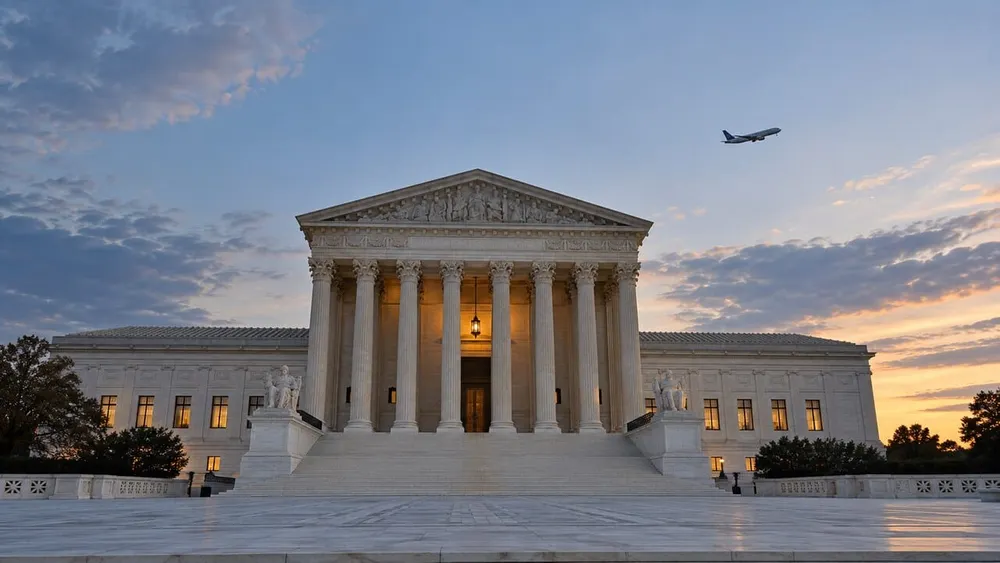
The Supreme Court on Tuesday allowed the Trump administration to resume fast deportations to countries other than a migrant’s own while the justices review the policy’s legality, immediately lifting lower-court safeguards in a program that rights groups say has sent more than 25,000 people to 29 nations.
The court’s official docket shows that the justices granted the Department of Homeland Security’s emergency stay, treated the application as a petition for review and agreed to hear the case in December. The three liberal justices would have denied the stay, producing an apparent 6-3 division on whether the policy should operate while the litigation continues.
The unsigned order does not decide whether the removals are lawful. It pauses a February judgment from U.S. District Judge Brian Murphy in Massachusetts and leaves the policy in place until the Supreme Court sends down its eventual judgment. That distinction is consequential: Reuters and the Associated Press both reported that removals can restart before the justices resolve the underlying statutory and constitutional questions.
The ruling changes operations immediately
Third-country removals apply when the government seeks to deport a person to a nation other than the one named in the original removal proceedings. The administration says the tool is necessary when a person’s home country will not accept the return or when U.S. law prevents removal there because of a risk of persecution or torture. In its emergency filing, the Justice Department called the program essential for removing people with final deportation orders, including some with serious criminal convictions.
The practical effect is broader than that description. The policy permits removal without advance notice when the receiving government has supplied diplomatic assurances that it will not persecute or torture the person. When such assurances are absent, authorities provide notice, but the individual must raise a fear claim before the government conducts a safety assessment. The Financial Times reported that the administration argued the lower-court restrictions disrupted flights, negotiations and agreements with receiving countries.
The government told the courts that the First Circuit’s ruling forced it to cancel a flight carrying about 70 people to Burundi, Rwanda and the Central African Republic. With the stay now in place, that legal barrier has been removed, although the administration has not publicly identified when a flight will depart or which individuals will be placed on it.
Lower courts required a meaningful chance to object
Judge Murphy ruled in February that the policy violated federal immigration procedures and Fifth Amendment due-process protections because people could be sent to unfamiliar countries without a meaningful opportunity to raise country-specific fears. A unanimous three-judge panel of the U.S. Court of Appeals for the First Circuit largely upheld that conclusion on Sept. 18, finding that the statute could not be read to deny protection to people given no meaningful notice of their destination.
The appellate ruling preserved the central requirement that people be able to contest a third-country destination, while reversing a separate part of Murphy’s judgment concerning the sequence in which the government must consider possible destinations. A Washington Post account said the Supreme Court majority gave no explanation for suspending those protections; Justices Sonia Sotomayor, Elena Kagan and Ketanji Brown Jackson noted only that they would have denied the government’s request.
The litigation is D.V.D. v. Department of Homeland Security, a national class action brought for people with final removal orders who may face third-country deportation. The plaintiffs argue that some class members had already been protected from return to their home countries because of risks there, yet could be transferred elsewhere without enough time to seek legal relief.
The numbers are large but remain externally compiled
More than 25,000 people have been sent to 29 third countries since the policy began, according to tallies cited by several news organizations and rights groups, with most transferred to Mexico. That is not presented as a comprehensive government audit. An ACLU review published this month documented more than 23,000 cases and described agreements involving countries in Latin America and Africa; subsequent reporting placed the total above 25,000.
The administration says receiving countries provide credible assurances against persecution or torture. Plaintiffs say those promises have not prevented abuse, detention, disappearance or onward transfer to countries from which the United States had already granted protection. Those allegations remain contested, but the risk is not abstract. The program has included removals to South Sudan, where the State Department maintains a Level 4 “Do Not Travel” advisory because of armed conflict, crime, kidnapping, landmines and health threats.
December arguments will reach beyond this policy
The Supreme Court directed the parties to address four sets of questions. The justices will consider whether the district court had jurisdiction; whether federal law allowed classwide declaratory relief and vacatur under the Administrative Procedure Act; whether the removal guidance violates immigration statutes, due process or protections implementing the Convention Against Torture; and any additional questions the government believes necessary to resolve the case.
That scope means the final decision could determine both the legality of the deportation process and how broadly lower courts may remedy unlawful federal policies. The case therefore joins immigration enforcement with a larger judicial dispute over nationwide or classwide relief against executive action.
For now, the administration has the operational authority it sought, while the ultimate legality of the program remains unsettled. The next concrete developments will be the Supreme Court’s briefing schedule, any renewed deportation flights and the December argument. Until final judgment, Tuesday’s order governs the immediate reality: lower-court protections are suspended, but the policy has not received a final endorsement on the merits.