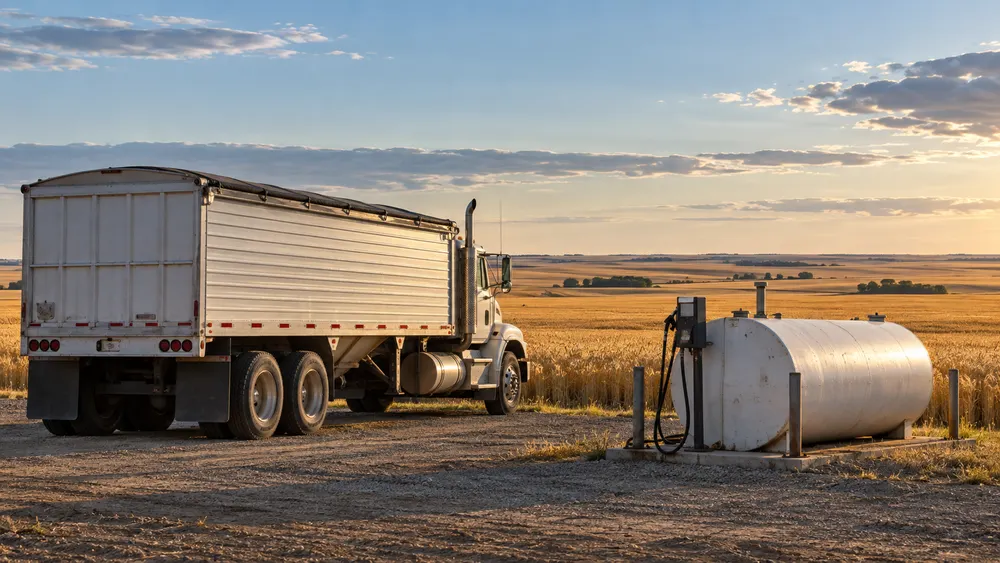
North Dakota farmers and ranchers may immediately use red-dyed diesel in licensed highway vehicles for specified agricultural work under a state emergency order issued Tuesday by Gov. Kelly Armstrong. The temporary authorization runs through Nov. 30 and is intended to ease harvest-season costs during a diesel supply and price emergency.
The order expands state-permitted use beyond tractors and other off-road equipment. It covers licensed vehicles used to haul grain, livestock, feed, seed, fertilizer, equipment and other agricultural inputs or products. The governor’s office also included vehicles connected to storing and processing agricultural products.
What the state action changes
North Dakota normally taxes clear on-road diesel at 23 cents per gallon and dyed diesel at 4 cents per gallon. The state Tax Commissioner’s fuel-rate guide documents that distinction. For covered agricultural highway uses, the emergency action therefore creates a 19-cent-per-gallon state tax difference.
At 1,000 gallons, that state-tax difference amounts to $190. The actual benefit to an operation will depend on fuel availability, the volume used in qualifying vehicles and how suppliers handle sales under the temporary rules. The order does not extend to general commercial trucking or personal vehicles.
Armstrong declared the emergency because of conditions affecting diesel supply and availability. The move comes amid broader national pressure on fuel markets: Reuters reported that U.S. diesel recently reached a record $6.53 per gallon as global supply disruptions and low inventories pushed multiple states to adopt tax, fuel-specification or transportation waivers.
Federal rules still matter
The governor’s announcement specifically says the order does not change the federal diesel excise tax of 24.4 cents per gallon. That limitation is important because state permission does not itself rewrite federal rules.
IRS Publication 510 generally treats dyed fuel placed in a registered highway vehicle for taxable use as subject to the 24.4-cent backup tax. The same publication says fuel used off the farm on a highway—including to transport livestock, feed, crops or equipment—is not considered “on a farm for farming purposes” for the federal exemption. It also describes federal penalties for knowingly using dyed fuel for a taxable purpose.
The North Dakota release does not announce a federal waiver. Producers, fuel dealers and vehicle operators should therefore confirm federal tax and reporting treatment with the IRS or a qualified tax professional before putting dyed diesel into a licensed highway vehicle. They should also retain purchase and use records identifying the vehicle, agricultural purpose, gallons and dates.
For qualifying operations, the state relief is available now and expires after Nov. 30 unless extended. The immediate value is a lower North Dakota levy during the remainder of harvest; the principal compliance risk is assuming the state order also removes federal obligations when it does not.