
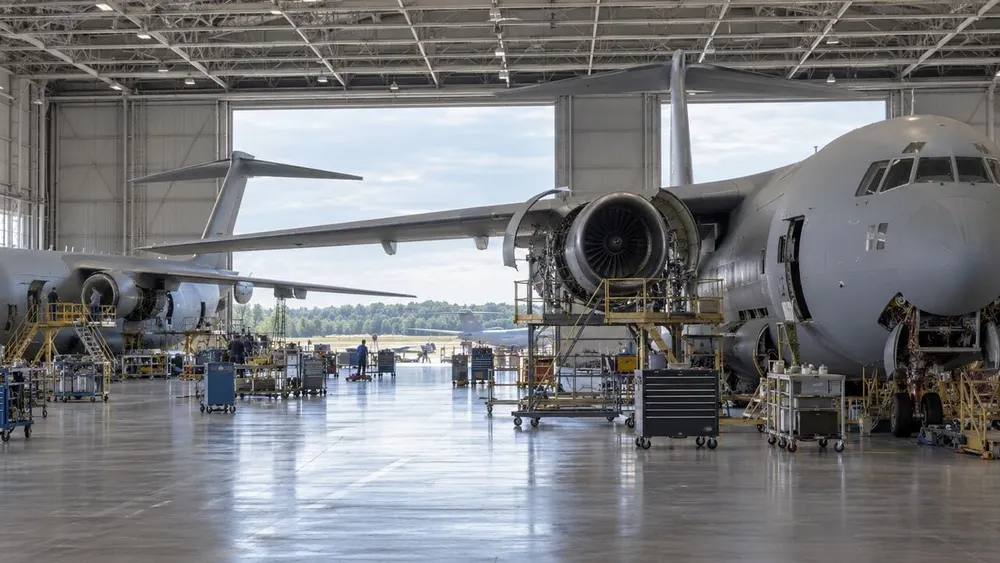
North Carolina and the U.S. Navy have opened a major aircraft-maintenance complex at the state-owned Global TransPark in Kinston, a project expected to create more than 400 skilled jobs and generate an estimated $140 million in annual economic activity. The ribbon-cutting marks the shift of Fleet Readiness Center East work into a permanent Kinston complex following years of state investment and a temporary operating period at the site.
The facility covers more than 700,000 square feet across roughly 75 acres and connects directly to Global TransPark’s 11,500-foot runway. According to the Navy’s project account, the complex will support depot-level maintenance, repair and overhaul for Navy and Marine Corps C/KC-130 aircraft and the Air Force HH-60W combat-rescue helicopter.
That workload is broader than the short inspection cycles and minor repairs previously handled at the Kinston site. The Navy said the new footprint allows full-scale overhaul work intended to extend aircraft service life and improve availability. It also makes Fleet Readiness Center East the designated depot repair point for the HH-60W, with an unscheduled repair already completed before full operations begin.
A state-financed expansion
The project rests on a substantial public commitment. North Carolina lawmakers authorized a $350 million loan in 2023 for Global TransPark site improvements. An April agreement gave the Navy a 10-year lease and established a $15 million annual contract that takes effect when Fleet Readiness Center East fully occupies its 65-acre leased area.
For eastern North Carolina, the practical measure of success will be whether the projected positions arrive and remain filled. The Navy identified likely occupations including aircraft mechanics, sheet-metal artisans, avionics technicians, quality-assurance specialists and aerospace engineers. It said Fleet Readiness Center East is working with Lenoir Community College and Craven Community College to develop the regional training pipeline needed for those jobs.
The expansion also diversifies activity at the 2,500-acre Global TransPark, which combines airport, rail and highway access and includes a foreign-trade zone. State officials said the site’s infrastructure has also attracted an aviation training academy, an engineering firm supporting new aerospace tenants and Airbus-related operations.
The complex has direct operating consequences beyond the job count. Navy officials said aircraft can move from landing to active maintenance without the additional ground transfers required at a disconnected industrial site. The new hangars also consolidate tooling, technical data and specialized workspaces for three aircraft families, allowing the depot to take on deeper repairs and longer maintenance cycles in Kinston.
The state’s April announcement said temporary operations at Global TransPark showed Fleet Readiness Center East could work more efficiently there, helping support the permanent expansion. The agreement also ties the project’s financial structure to occupancy: the annual Navy payment begins when the agency fully occupies the leased space, making the facility’s ramp-up important to both the state and the federal customer.
Fleet Readiness Center East remains a major regional employer in its own right. NAVAIR reported that the organization has nearly 4,000 civilian, military and contract workers and annual revenue exceeding $860 million. The Kinston complex is therefore both an industrial-development project and an expansion of an existing federal maintenance operation, rather than a stand-alone manufacturing announcement.