
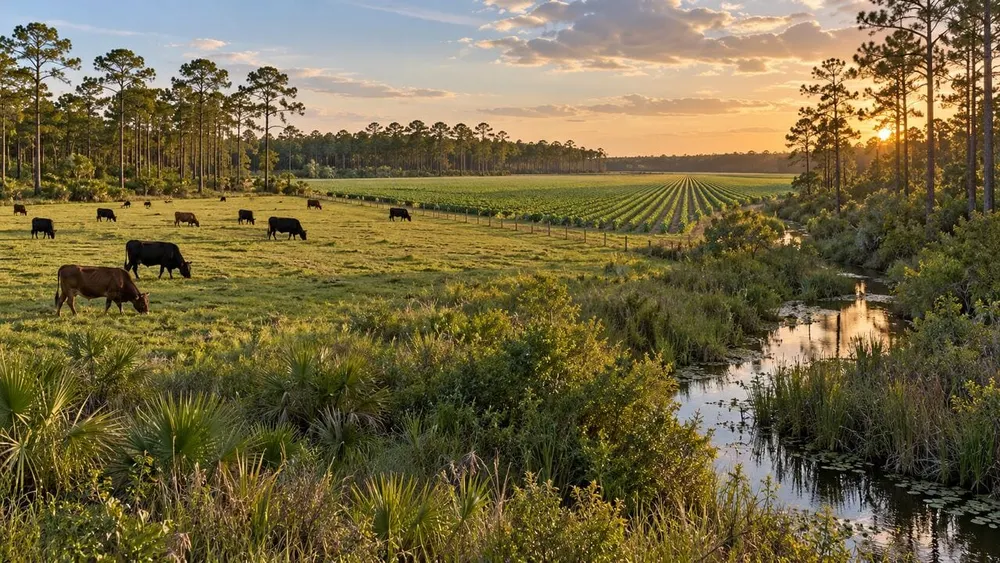
Florida has permanently restricted development on about 1,076 acres of working farmland in Putnam and Polk counties through three conservation easements valued at a combined $7.355 million. The Florida Department of Agriculture and Consumer Services announced the completed transactions Friday, saying the land will remain privately operated for timber, cattle, pasture and crop production.
The largest transaction covers the 916-acre G-3 Ranch Addition in Polk County. Florida paid for a $6.45 million easement, including $500,000 supplied by Polk County. The property includes pasture, row crops and pine forest, with former citrus acreage being converted to strawberries and watermelons. Creeks on the land drain toward the Peace River and Charlotte Harbor.
A second Polk County agreement protects a roughly 75-acre cow-and-calf ranch owned by David and Elizabeth Hunt. That easement is valued at $745,000, with Polk County contributing $250,000. The property contains pasture and wetlands along a stream between Gator Lake and Lake Pembroke. In Putnam County, the state secured a $160,000 easement over the approximately 85-acre Young Family Farm, a timber tract containing sandhill habitat, lakes and stream floodplain forest.
The transactions do not convert the farms into public parks or transfer ownership to the state. Under the department’s Rural and Family Lands Protection Program, Florida purchases development rights while owners keep farming, ranching or managing timber. The restrictions remain in place permanently, limiting future subdivision or conversion while allowing continued agricultural production and keeping the property on local tax rolls.
Projects are reviewed by a technical team, formally ranked by a selection committee and ultimately approved by the governor and Cabinet. The program can give priority to proposals that bring matching public or private money after ranking, making Polk County’s combined $750,000 contribution relevant to the two local acquisitions. Eligibility also considers agricultural viability, development pressure, water resources, wildlife habitat and sustainable land management.
All three properties are enrolled in state agricultural best-management practices and lie within the Florida Ecological Greenways Network or the Florida Wildlife Corridor, according to the department. The Florida Wildlife Corridor Act defines the corridor through statewide conservation priorities and directs agencies to encourage voluntary easements on private land. The law identifies working farms, ranches and forests as compatible habitat that can support rural economies while reducing fragmentation.
For nearby communities, the immediate effect is land-use certainty rather than a change in public access. The properties remain working operations, but the purchased development rights remove future residential or commercial conversion options covered by the easements. The two Polk County agreements also protect parts of the Peace River watershed and improve links within the broader wildlife corridor.
Florida says the program has now preserved more than 247,000 acres since its creation in 2001, including nearly 182,000 acres during Agriculture Commissioner Wilton Simpson’s tenure. The 2026-27 state budget includes $425 million for additional easements. Friday’s closings therefore represent completed protection—not merely proposed purchases—within a substantially larger acquisition pipeline.