
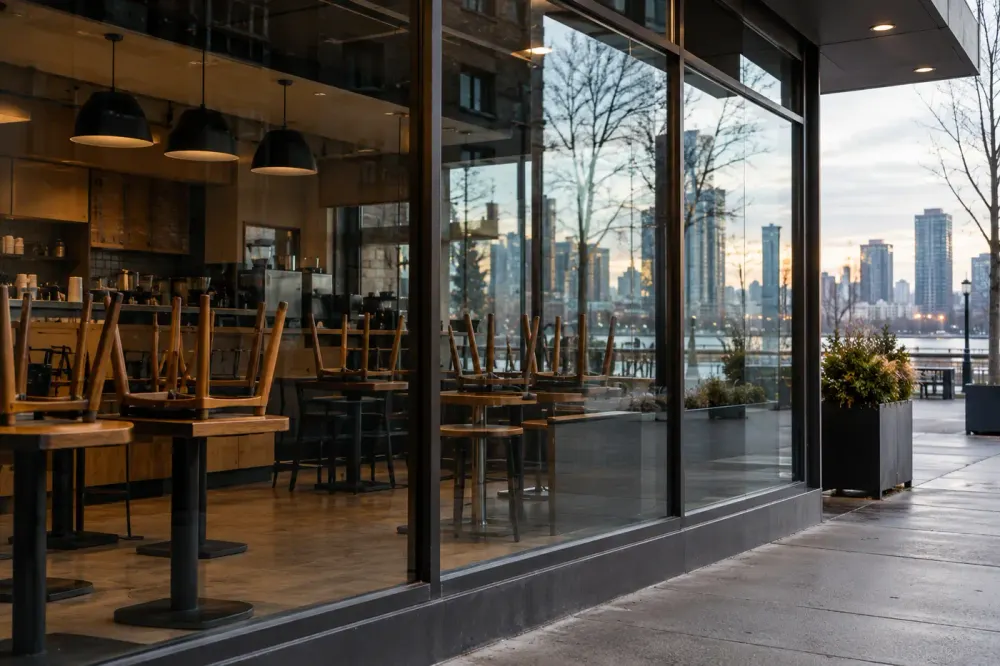
Starbucks said Thursday it will close approximately 250 coffeehouses across North America later this week, a move that will eliminate about 1% of its regional footprint even as the chain says its turnaround has restored strong sales growth.
The decision is the clearest sign yet that Chief Executive Brian Niccol’s “Back to Starbucks” strategy is entering a more selective phase. The company is no longer only adding labor, redesigning cafés and simplifying service. It is also removing locations that management believes cannot meet its financial or customer-experience standards.
A second sweep of the portfolio
Chief Operating Officer Mike Grams told employees that Starbucks had reviewed its North American portfolio and identified stores where it could not consistently deliver the experience it wants or could not see a path to acceptable returns. In the company’s employee letter, Grams said affected workers would be offered transfers where possible and severance when another placement is unavailable.
Starbucks did not release a list of stores, specify how many are in the United States or Canada, or say how many jobs will be affected. That leaves customers and employees with limited visibility until local notifications are completed. The Associated Press reported that the company had 18,371 North American stores at the end of June, making the planned closures significant but modest relative to the total network.
This is the company’s second large closure wave under Niccol. Starbucks closed 627 stores in North America and Europe last September, after deciding that some locations were financially weak or unable to support the more welcoming café environment the turnaround requires.
The financial cost is material
The closures are expected to produce about $300 million in restructuring charges, according to the company’s regulatory disclosure reviewed by Reuters. Roughly $200 million will be cash costs tied to lease exits and employee separation benefits, while approximately $100 million will be noncash charges from impairing or disposing of store assets.
Those expenses follow a separate $400 million restructuring program disclosed in May, when Starbucks eliminated 300 U.S. corporate positions and moved to close underused offices. Reuters reported at the time that the earlier charge included $120 million for severance and $280 million for real-estate impairments. Together, the actions show that the company is willing to absorb substantial near-term costs to reduce overhead and improve the economics of its store base.
Closures arrive as sales recover
The timing distinguishes this round from emergency retrenchment. Starbucks reported 7.9% global comparable-store sales growth in its fiscal third quarter, with U.S. comparable sales rising at the same rate. Revenue fell 1% to $9.3 billion, partly because the company had shifted its China business into a joint venture, while adjusted earnings exceeded analyst expectations. Both Reuters and the Associated Press attributed the improved operating picture to stronger traffic, higher spending per visit and faster service.
Management argues that those gains make weak stores easier to identify. Starbucks says its Green Apron Service model has improved throughput and consistency, while redesigned cafés are producing stronger customer response. Grams said the chain expects to complete 1,500 North American store “uplifts” by the end of September.
That creates a sharper financial test for each location: a store must justify additional labor and renovation spending while also fitting the company’s renewed emphasis on seating, hospitality and beverage craft. Closing stores that cannot clear that threshold may protect margins, but it also risks reducing convenience in neighborhoods where Starbucks has built habitual traffic.
Growth plan gets more selective
The company now expects about 440 net new company-operated and licensed stores globally in fiscal 2026, down from an earlier forecast of 600 to 650. The reduction suggests that closures will offset more of the openings already underway.
That does not amount to a retreat from expansion. At its January Investor Day, Starbucks said it saw room for as many as 5,000 additional U.S. coffeehouses over time and expected to build about 400 net new company-operated U.S. stores in fiscal 2028. It also promoted a smaller café format that costs less to construct while retaining seating, drive-through service and mobile pickup.
The apparent contradiction—closing hundreds of stores while planning thousands more—reflects a portfolio strategy rather than a simple count. Starbucks is trying to replace locations that lack a viable path with newer stores designed around current traffic patterns and lower construction costs. Success will depend on whether those new units generate better returns without simply shifting sales from nearby cafés.
What remains unclear
The company has not provided store-level performance data, so outsiders cannot assess how long the targeted cafés have underperformed or how heavily lease obligations shaped the decision. It also remains unclear how many workers will accept transfers, how far those transfers may require them to travel and whether the closures will affect service capacity at nearby stores.
Investors therefore face two separate questions. The first is whether Starbucks can execute the closures within its projected cost and timing. The second is whether the broader turnaround can preserve July’s sales momentum while absorbing restructuring charges and continued spending on labor and renovations.
The 250 closures are small compared with Starbucks’ continental scale, but they make the strategy more concrete. A turnaround sold as a return to the neighborhood coffeehouse is now also a test of which neighborhoods and which store formats can support that promise profitably.