
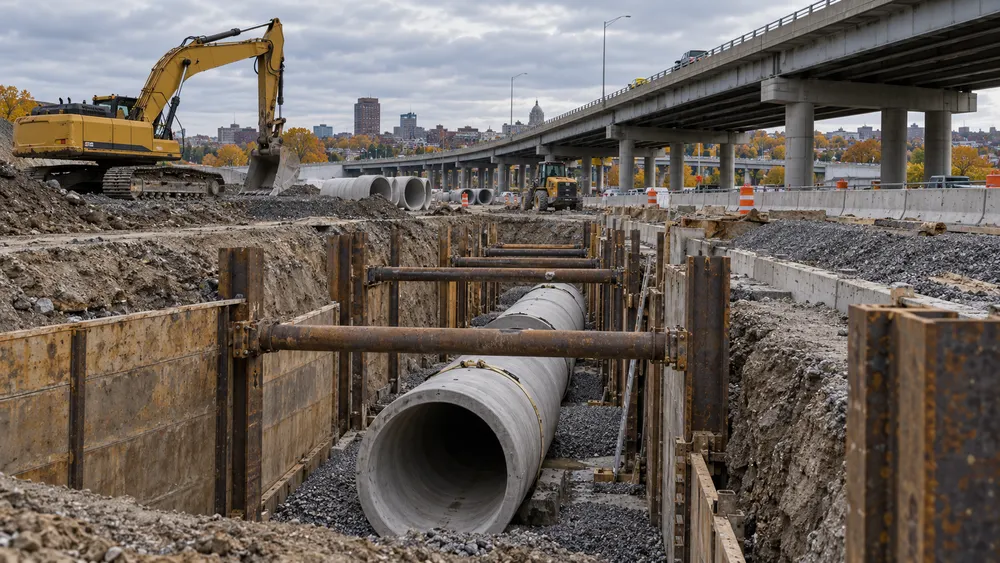
New York has awarded a $143.5 million construction contract for a mile-long stormwater trunkline beneath downtown Syracuse, pairing the drainage work with a federal decision that formally shifts the Interstate 81 designation onto the city’s eastern bypass.
The state announcement says the Federal Highway Administration approved redesignating I-481 as the new I-81 and converting the existing downtown route into Business Loop 81. Motorists will not see an immediate numbering change; the state Department of Transportation is developing a transition plan.
A pipeline beneath six streets
Contract 6a will build an eight-by-ten-foot trunkline beneath sections of Almond Street, East Water Street, State Street, Erie Boulevard, Salina Street and Herald Place. The route was selected to limit disruption to downtown businesses while collecting runoff from reconstructed roads and bridges.
The contract also covers five local streets totaling 2.5 lane miles. The project scope includes sidewalks and shared-use paths, eight replacement traffic signals, lighting, signs, striping and trees. Excavations will reach depths of up to 25 feet.
The drainage system is designed to separate stormwater from sewage, reducing overflows that can reach Onondaga Creek and Onondaga Lake while improving wastewater treatment. It extends work already included in other I-81 contracts, including a half-mile drainage line along Erie Boulevard East and sewer segments south of downtown.
Route change advances the Community Grid
The federal redesignation is a prerequisite for moving through traffic away from the elevated downtown highway. Existing I-481 will carry the I-81 name, while the current route between the northern and southern interchanges becomes Business Loop 81. That clears the way for eventual removal of the 1.4-mile viaduct and construction of the street-level Community Grid.
The state’s project overview says about 100,000 vehicles use the Syracuse I-81 corridor each day. It describes the viaduct as deteriorated, below current engineering standards and associated with high crash rates. The chosen Community Grid plan was estimated at $2.25 billion and a six-year construction period when the environmental review was completed.
Federal approval followed the project’s formal environmental process. The Department of Transportation maintains the decision record and responses to public comments, which set the legal and planning foundation for the route conversion and construction program.
What the milestone does—and does not—mean
The award moves a major piece of Phase Two into construction, but it does not mean the viaduct is coming down immediately. Contract 6a is one of nine planned contracts, and utility work, traffic staging and other roadway projects must proceed before the full downtown conversion is complete.
The practical tests will be whether the trunkline reduces flooding and combined-sewer overflows, whether street reconstruction improves walking and cycling connections, and whether the state manages disruption for residents and businesses. The route redesignation settles an important administrative step; construction performance will determine the public benefit.