
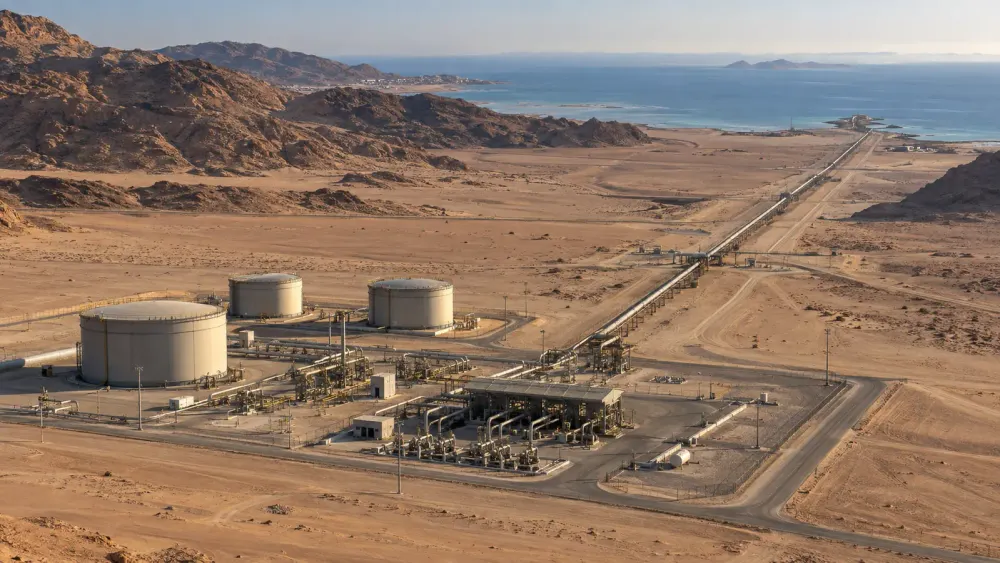
Saudi Arabia’s East-West Pipeline could remain mostly out of service for three to five weeks, a newly reported repair estimate that threatens as much as 4 million barrels of daily oil flow through the kingdom’s principal bypass around the Strait of Hormuz. The duration, reported Monday by AP and broadly consistent with a separate Reuters estimate, converts what Saudi officials initially described as a temporary shutdown into a potentially monthlong constraint on a route carrying roughly 4% of world supply.
The estimate is not an official Saudi repair schedule. AP attributed it to two regional officials briefed on the damage who were not authorized to speak publicly; one said the line may operate partially during repairs. Saudi Aramco and the kingdom’s government communications office had not publicly confirmed the timetable by early Monday afternoon Eastern time. Reuters separately reported Sunday that industry sources offered a range extending to five or six weeks, while allowing that partial pumping could resume sooner. The overlap between those independent reports establishes that the damage is being treated as a multiweek problem, but the precise outage and throughput remain uncertain.
That distinction matters. When the pipeline was struck last week, Saudi authorities confirmed a shutdown but did not disclose its expected duration. TAQ’s earlier report focused on the attack and the route’s capacity. The new repair window materially changes the economic stakes: inventories can cover exports only briefly, replacement routes are costlier and less secure, and a sustained interruption would force refiners to compete for a smaller pool of suitable crude.
A bypass becomes a bottleneck
The 745-mile pipeline carries crude from Saudi Arabia’s eastern oil fields across the peninsula to Yanbu on the Red Sea. It became indispensable after the Iran war sharply reduced traffic through the Strait of Hormuz. Saudi officials said drones launched from Iraq hit the line in the Riyadh and Medina regions; the government has not publicly identified the attacker. The official account, summarized in the initial confirmation, said there were injuries and that damage was being assessed.
AP reported that repairs include work at a major pumping facility. The line had moved a weekly average of 2.6 million to 4 million barrels a day since late August, according to a Monday Rystad Energy note cited by the news organization. Complete loss of that flow would not automatically remove the same quantity from world production: some barrels can be drawn from storage, redirected through other ports or moved later. But each workaround has limits, and Saudi Arabia cannot indefinitely export oil that cannot reach a functioning terminal.
Traders and Saudi customers told Reuters that Yanbu held enough oil to maintain exports for only five to seven days if the pipeline did not restart. Storage at Egyptian ports could provide several additional days. Those estimates are not official inventory disclosures, and the tanks were not believed to be full. They nevertheless explain why the repair window is consequential now rather than weeks from now: a three-to-five-week project is far longer than the reported buffer.
Refiners in Asia were already preparing for delays before the longer repair estimate emerged. Several buyers had received no firm allocation guidance from Aramco, while at least one had been told a loading would be delayed, according to refinery sources. The sour crude normally supplied by Saudi Arabia cannot always be replaced barrel for barrel because refineries are configured for particular grades. Buyers may turn to Iraq or the United Arab Emirates, driving up both crude differentials and freight costs.
A shock inside an existing shortage
The outage is landing in a market that had little spare logistical capacity. The International Energy Agency’s September report estimated that global oil production fell by 1.6 million barrels a day in August and projected a 5.7-million-barrel daily decline for 2026. More than 10 million barrels a day of Gulf production remained shut in because of security risks, while observed inventories had fallen by 507 million barrels since the war began.
Saudi supply itself fell to about 6 million barrels a day in August, the lowest level in more than three decades and down from nearly 10 million a year earlier. The kingdom told OPEC it produced 6.238 million barrels a day, while the IEA measured supply at 5.97 million. The figures differ because “supply” includes exports from storage and domestic use as well as production, but both show a severe contraction before the latest pipeline damage.
U.S. government data show why losing the overland route reverberates well beyond Saudi Arabia. The Energy Information Administration recorded average second-quarter flows of just 4.9 million barrels a day through Hormuz, down from 21.6 million in late 2025, while Bab el-Mandeb flows rose to 8.1 million barrels a day. The agency’s chokepoint data capture the wartime shift: barrels that once exited directly into the Arabian Sea increasingly traveled west, then through the Red Sea.
That fallback is also under pressure. Houthi forces have seized Greater and Lesser Hanish, islands roughly 100 miles north of Bab el-Mandeb, after taking Mayun and the port of Mocha last week. Government and Houthi officials confirmed Monday’s island seizures to AP. Control of an island does not amount to control of international shipping, but the advances increase the rebels’ ability to threaten vessels moving between the Red Sea and the Gulf of Aden.
Direct pressure on U.S. prices
The United States is a major oil producer, but crude and refined-product prices are set in global markets. A lost Saudi barrel raises the marginal cost faced by refiners and consumers regardless of where the replacement barrel originates. The EIA’s current outlook already assumed that Middle East flows would remain constrained through the fourth quarter, with 5.7 million barrels a day of production shut in during that period. It also warned that changing conflict conditions would produce more short-term price volatility than its baseline forecast.
Monday’s markets reflected that transmission. Brent crude traded near $108.83 a barrel, up about 4%, while the benchmark 10-year Treasury yield touched 5% for the first time since 2023. Traders placed a roughly 90% probability on a Federal Reserve rate increase this week, according to a market update. Oil is not the only force moving bonds or rate expectations, but higher fuel costs reinforce inflation at a moment when policymakers are deciding whether to tighten credit.
The IEA said U.S. diesel prices exceeded the equivalent of $200 a barrel in early September, nearly double their prewar level. Diesel sits deep in the cost structure of the U.S. economy: trucking, farming, construction and backup power all depend on it. A prolonged Saudi disruption could therefore reach consumers through freight and food costs even if gasoline prices do not move in lockstep.
What remains unconfirmed
No Saudi authority has yet specified which pipeline components were damaged, how much capacity might return first or whether customer contracts will be reduced. Aramco had not declared force majeure, a contractual step companies sometimes use when extraordinary events prevent deliveries. There is also no public evidence that all 2.6 million to 4 million barrels a day will remain offline for the full repair period. The most defensible conclusion is narrower: multiple independent reports now point to weeks of constrained operation, with partial service possible.
The attack’s attribution also remains incomplete. Saudi Arabia said the drones came from Iraqi territory, where Iran-backed armed groups operate, but it has not named a responsible organization. Iraq condemned attacks on the kingdom. Claims by combatants elsewhere in the conflict do not establish who ordered or executed this strike, and the repair estimate does not resolve that question.
The next verifiable markers will be Aramco’s allocation notices, confirmed tanker loadings at Yanbu and any official estimate of restored throughput. A partial restart would reduce the immediate supply risk; a prolonged full shutdown would force a larger reordering of global crude flows. Until those facts arrive, the three-to-five-week estimate is best read as a warning about the scale of the damage, not a guarantee that every barrel will be absent for a month.
What has changed is the horizon. The East-West Pipeline is no longer merely a temporarily closed asset after a one-day attack. It is a damaged strategic corridor facing a repair period measured in weeks, while the maritime routes on both sides of the Arabian Peninsula are constrained. That combination makes the outage a direct risk to global supply, U.S. fuel costs and the inflation outlook.