
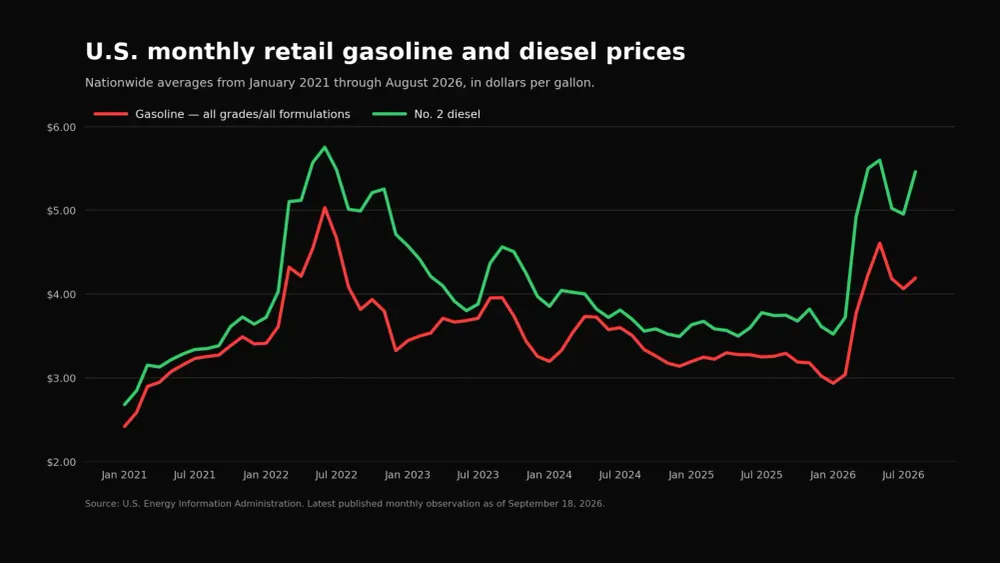
The nationwide retail price of on-highway diesel reached $6.285 a gallon on September 14, while the average for all grades of gasoline climbed to $4.455, according to the latest EIA data. Those figures include taxes and represent increases of 68.6 cents for diesel and 24.8 cents for gasoline in two weeks.
Regular gasoline averaged $4.319 a gallon in the same survey. The broader all-grade measure—used in the accompanying chart so the historical series remains consistent—includes regular, midgrade and premium fuel. EIA's completed monthly averages for August were $4.192 for gasoline and $5.462 for diesel, compared with $3.258 and $3.744, respectively, one year earlier.
The increases are related but not identical. Both fuels are absorbing a higher crude-oil cost created by disrupted global supply. Diesel is also confronting a more acute shortage of the refined product itself, leaving trucking fleets, farmers, construction companies and consumers exposed to a price premium that cannot be explained by crude oil alone.
Crude oil returned as the common pressure
Crude oil is the largest variable component in the retail price of gasoline and diesel. Its recent rise began upstream, before fuel reached a refinery or service station. Brent crude averaged $91 a barrel in August, up $7 from July, according to EIA's September market outlook.
EIA estimates that global petroleum inventories declined by approximately 400 million barrels during 2026 through August. The agency calculates that inventories fell at an average rate of 3.9 million barrels per day in the second quarter and projects further declines of 3 million barrels per day in the third quarter and 1.7 million in the fourth.
That drawdown reflects a market in which consumption is exceeding immediately available production and supply. It also removes the inventory cushion that ordinarily absorbs a disruption without producing an equally sharp price response. When stored barrels are scarce, buyers compete more aggressively for current production, raising crude prices and the wholesale cost refiners pay.
U.S. production has not collapsed. EIA projects domestic crude output to average 13.8 million barrels per day in 2026, above 13.7 million in 2025. But oil is priced in a global market. Additional U.S. barrels can moderate the effect of an international shortage without fully isolating American motorists from it.
Middle East disruptions reduced available supply
The immediate geopolitical pressure is concentrated around two major shipping corridors. EIA reported that crude-production shut-ins averaged 6.7 million barrels per day in August, up from 5 million in July, as exports through the Strait of Hormuz and the Bab el-Mandeb remained constrained and variable.
The agency attributed part of the disruption to renewed restrictions on Iranian oil exports after attacks on tankers in the Strait of Hormuz. The Treasury Department separately imposed maritime sanctions in July on firms and vessels it said were connected to an Iranian insurance and shipping system operating around the strait.
Saudi export movements through the Red Sea were also disrupted. EIA said August shipments from the Saudi port of Yanbu were approximately half their July level. Producers and traders have responded with alternative pipelines, longer voyages, cargo transfers between ships and other routing changes, but those workarounds can reduce available volume, increase transportation expenses or delay delivery.
EIA assumes that Middle East flows will gradually improve but remain constrained through the fourth quarter. Under that scenario, the agency forecasts Brent crude near $90 a barrel during the second half of 2026. It also cautions that changing conditions around both waterways could create more short-term volatility than its forecast captures.
Diesel faces a second, tighter market
Diesel's $1.83 premium over the all-grade gasoline average on September 14 reflects conditions in the global distillate market. Diesel, heating oil and jet-fuel-range products compete for related refinery output. Their prices can rise independently of gasoline when distillate production falls or demand increases.
U.S. distillate inventories fell below their five-year range in April. EIA now forecasts stocks will drop below 100 million barrels in September and remain below the 2021–2025 minimum through the end of 2026 and much of 2027. The agency connects the decline to reduced refinery production in the Middle East, Russia and China and to strong U.S. exports into a supply-constrained international market.
Net U.S. distillate exports have been at or near their five-year highs in every month since February. Exports support refinery operations and serve overseas customers, but in a tight market they also link domestic diesel more closely to higher global prices. EIA estimates the diesel crack spread—the difference between the wholesale value of diesel and the crude oil used to produce it—will exceed $2 a gallon from August through November.
Seasonal conditions may reinforce that imbalance. Refineries typically perform maintenance during the fall, temporarily limiting output. At the same time, agricultural diesel use rises during the harvest and heating-oil demand begins increasing ahead of winter. The result is a period in which production can decline as consumption strengthens, with unusually low inventories available to bridge the difference.
Gasoline faces a somewhat different seasonal transition. Demand generally eases after the summer driving period, and the switch from more expensive summer-grade gasoline to winter specifications can reduce production costs. Those factors would ordinarily place downward pressure on gasoline. This year, however, the decline in global crude inventories and the cost of disrupted oil flows are working in the opposite direction.
Retail prices do not change in perfect synchronization with crude oil. Refiners first convert crude into products, wholesalers move those fuels through pipelines and terminals, and service stations price inventories acquired at different times. Changes in crude prices and refinery margins can therefore reach individual pumps at different speeds. Transportation costs, state and local taxes, required fuel formulations and regional supply conditions also produce substantial differences around the national figure.
The EIA readings are statistical estimates rather than a census of every filling station. The agency surveys retail outlets each week and reports prices including taxes. It then calculates monthly and annual figures as simple averages of the available weekly estimates. That distinction matters in a fast-changing market: the August point in the chart describes the completed month, while the September 14 reading provides the more current snapshot cited in this article.
The same distinction explains why a driver's observed price may differ from the national average without contradicting it. Reformulated gasoline, required in designated areas to address air-quality standards, averaged $4.816 across all grades on September 14. Conventional-area gasoline averaged $4.269. Both are components of the $4.455 national all-grade estimate, but neither represents every local market.
The chart places the current rise in context
The monthly record shows that both fuels remain below their June 2022 peaks on a completed-month basis. All-grade gasoline averaged $5.032 in June 2022, while diesel averaged $5.754. By January 2026, those averages had retreated to $2.936 and $3.523 before rising rapidly during the spring and summer.
August 2026 diesel was only 29.2 cents below its June 2022 monthly high. The September 14 weekly reading has already moved above that earlier monthly peak, although weekly and monthly observations measure different periods and should not be treated as direct equivalents. September's final monthly average will not be available until the month's weekly observations are complete.
EIA currently forecasts full-year 2026 averages of $3.84 for gasoline and $5.07 for diesel. Its 2027 forecast declines to $3.35 and $4.40 as Middle East production and trade flows recover, global inventories rebuild and U.S. crude output increases to a projected 14.3 million barrels per day.
That path is conditional, not assured. A faster normalization of shipping and refinery production could pull wholesale and retail prices lower. Continued export constraints, additional refinery outages or a slower inventory recovery could keep crude and diesel margins elevated. For the moment, the evidence indicates that motorists are paying for a global crude shortage, while diesel users are paying for that shortage plus a separate scarcity of distillate fuel.