
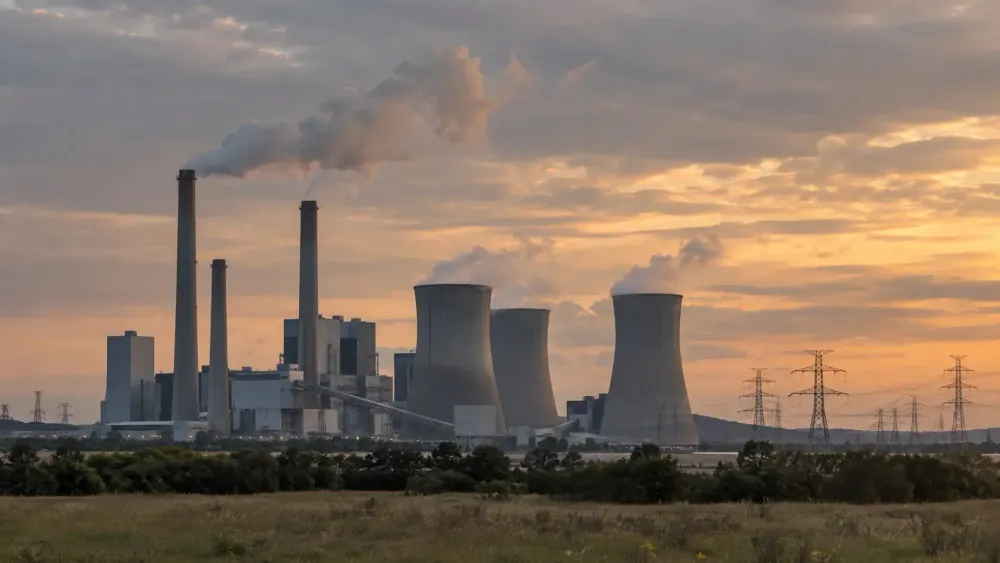
The Environmental Protection Agency on Monday finalized the repeal of federal carbon standards for coal- and natural-gas power plants that the Biden administration had projected would prevent about 1 billion metric tons of greenhouse-gas emissions through 2047. The action removes the central federal limits on carbon pollution from new gas plants and many existing coal plants, shifting power-sector investment decisions back toward a regulatory baseline without those national requirements.
The Associated Press reported that EPA said it was repealing the rules and described the decision as removing more than $300 billion in industry costs. Reuters separately reported that the agency would announce its final rule Monday at a Group of 20 energy-ministers meeting in Houston. Together, those reports move the development beyond the proposed rollback EPA issued in June 2025: the administration now says it has completed the repeal.
The distinction matters. A proposal signals an agency's preferred course but does not itself erase an existing regulation. A final rule, once signed and published according to federal procedures, establishes the agency's legal position and starts the timetable for implementation and court challenges. As of the reporting cutoff, EPA's public rule page still displayed the 2025 proposal rather than the new final text, and the final action was not yet visible on the Federal Register page. The announcement is confirmed; the precise publication date, effective date and any changes made after public comment remained unavailable in the operative document.
What the repeal removes
The 2024 carbon standards applied different requirements according to a plant's fuel, age, operating pattern and expected retirement date. The original final rule set performance standards for new and reconstructed fossil-fuel generators and directed states to write plans for covered existing units. Long-running coal units faced standards built around capturing 90 percent of carbon dioxide, while certain new baseload gas turbines faced a phased standard that also pointed toward carbon capture. Units retiring sooner had less stringent pathways or different compliance dates.
Those provisions were grounded in Section 111 of the Clean Air Act, which directs EPA to identify the best adequately demonstrated system of emission reduction and translate it into performance standards. The Biden EPA said carbon capture, efficiency measures and fuel changes were technically demonstrated and cost-effective when federal tax incentives and lead time were considered. It projected climate and public-health benefits far above compliance costs, although utilities, coal producers and Republican-led states disputed the agency's technology and reliability assumptions.
The Trump administration took the opposite view in its 2025 repeal proposal. Its primary theory said EPA should first determine that greenhouse-gas emissions from fossil-fuel power plants contribute significantly to dangerous air pollution, then concluded that the sector did not cross that threshold when considered against global emissions and the administration's energy priorities. The proposal also offered a narrower alternative that would remove the carbon-capture requirements and emission guidelines without embracing the broader statutory interpretation.
EPA's final rule will reveal which theory the agency selected and how it answered public comments. That choice is consequential because the broad approach would do more than cancel the 2024 compliance program: it would establish an agency interpretation designed to make future Section 111 carbon standards harder to issue. AP reported that EPA also announced a separate proposal aimed at the predicate finding for power plants. That second action is not final and should not be confused with Monday's completed repeal.
Competing cost and reliability claims
EPA Administrator Lee Zeldin has argued that the rollback will preserve dispatchable generation, reduce pressure on electricity prices and give utilities flexibility as data centers, manufacturing and electrification increase demand. Coal-industry groups likewise say the 2024 standards depended on carbon-capture systems that have not been deployed broadly enough at commercial power plants and could accelerate retirements before replacement capacity is ready.
Those are administration and industry claims, not established outcomes. The 2025 proposal's formal impact analysis estimated present-value compliance-cost savings of roughly $19 billion at a 3 percent discount rate, or $9.6 billion at 7 percent, over 2026 through 2047. Reuters reported that Zeldin had described annual savings of about $120 million when the proposal was issued. AP's report of a new, much larger $300 billion-plus figure cannot be reconciled with those earlier estimates until EPA publishes the final regulatory analysis and identifies its assumptions.
The same caution applies to reliability. Removing a regulation may reduce one source of cost and operational constraint, but it does not dictate what utilities will build or retire. Fuel prices, state clean-energy laws, regional capacity markets, tax policy, transmission availability and the economics of newer technologies all shape those decisions. Federal energy data show that the U.S. grid is a changing mix dominated by natural gas alongside coal, nuclear power and rapidly expanding renewable generation. The repeal changes federal constraints around that mix; it does not by itself guarantee lower bills or additional reliable capacity.
The emissions stakes
Power plants remain one of the largest U.S. sources of heat-trapping pollution. EPA's emissions inventory identifies electricity production as a major national contributor, while Reuters put the sector's share at nearly one-quarter of U.S. greenhouse-gas pollution. The 2024 rule's projected reduction—about 1 billion metric tons through 2047—was cumulative, not an estimate of annual emissions or an assertion that every ton would occur immediately.
Environmental and public-health groups say repealing the standards will lock in higher emissions, expose communities to additional conventional air pollution and delay investment in cleaner generation. Their legal objections are also likely to focus on EPA's reasoning. An agency may change policy, but administrative law generally requires it to acknowledge reliance interests, examine the evidence and provide a reasoned explanation for departing from earlier factual findings. Courts will test the final text, not the political language surrounding Monday's announcement.
The Supreme Court's 2022 court opinion in West Virginia v. EPA looms over that litigation. The court held that EPA could not use Section 111 to impose a generation-shifting system of the breadth claimed in the Obama-era Clean Power Plan without clear congressional authorization. The Biden administration responded with plant-level standards based on technologies such as carbon capture and co-firing. Challengers argued that approach still exceeded EPA's authority or relied on insufficiently demonstrated controls; defenders said it fit the statutory framework the court left intact.
Monday's repeal does not produce a final judicial answer to that dispute. It changes which side will be defending the agency action. States and environmental organizations are expected to challenge the rollback, while power companies and state regulators must decide how much weight to give a rule whose durability may remain uncertain for years. Existing state standards and permits also remain in place unless separately changed; EPA's action does not automatically erase them.
What happens next
The immediate document to watch is the signed final rule and its supporting analysis. Those materials should specify whether EPA adopted the broad significance theory, the narrower technology-based alternative or a modified approach; how it calculated the new cost claim; when the repeal takes effect; and how it addressed comments on carbon capture, grid reliability and climate damages. Publication will also establish the procedural starting point for petitions seeking judicial review.
Utilities will then reassess compliance plans made under the 2024 standards, but capital decisions may not reverse quickly. Power plants and transmission assets take years to permit and build, and companies must account for state requirements, future federal administrations and litigation risk. Investors will also compare the cost of extending older plants with new gas, renewable, storage and nuclear options rather than treating the regulatory change as the only variable.
The confirmed development is therefore both immediate and incomplete: EPA has finalized a nationally consequential repeal affecting the country's second-largest emitting sector, but the controlling text was not publicly available at the cutoff. The next phase will be determined by that text, the lawsuits that follow and the investment choices utilities make under a policy that has now changed direction again.