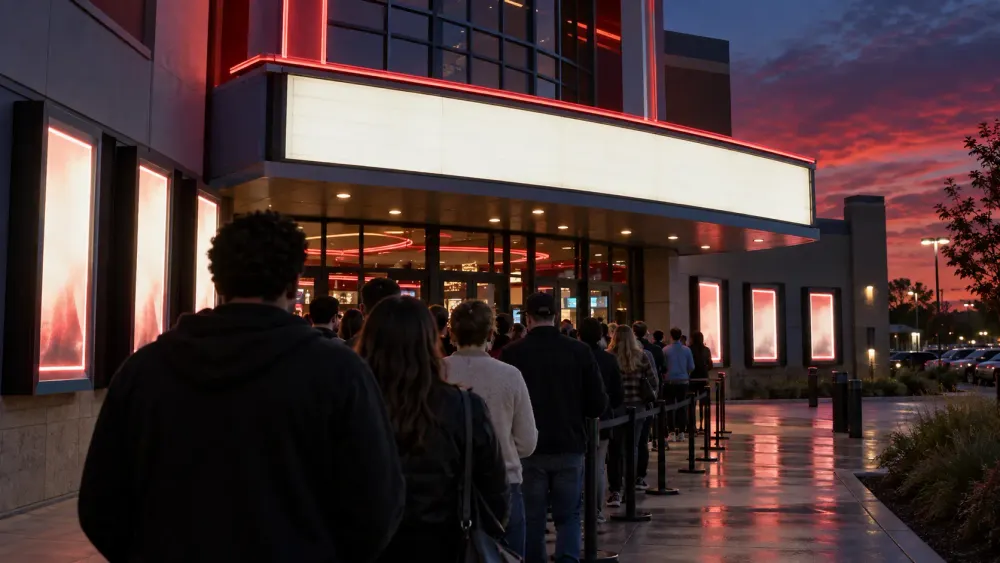
“Resident Evil” opened to an estimated $60 million in North American theaters, delivering the strongest debut in the film franchise and pushing an already robust year for horror toward a new domestic box-office record. The Associated Press reported that the Sony release played in 3,684 locations and added $48.3 million internationally, producing a $108.3 million global opening. The result gives theaters a timely fall hit while showing that audiences will still turn out for a familiar property when the creative approach feels distinct.
A decisive opening
The $60 million domestic estimate is especially notable because it arrived after seven previous live-action films established a wide range of commercial outcomes for the game adaptation. AP described the debut as a franchise best, while noting that 2010’s “Resident Evil: Afterlife” ultimately earned $60.1 million during its entire unadjusted domestic run. The new film effectively matched that total in three days.
Its reported $75 million production budget, which does not include marketing, still means the movie must hold in coming weeks and generate substantial revenue outside North America before profitability can be assessed. Studios and theaters divide ticket sales, and advertising, distribution and participations add costs not reflected in the production figure. Even so, a global start above $100 million creates a stronger foundation than the franchise’s most recent reboot had.
Horror’s unusually strong year
The opening also matters beyond one series. Entertainment Weekly reported that horror films have already matched the genre’s 2017 domestic record of about $1.16 billion, with roughly three months remaining in the year. Earlier releases, including original concepts as well as established properties, helped broaden the audience rather than leaving the category dependent on a single sequel.
Horror remains attractive to studios because many films can be produced below the budgets required for effects-heavy action spectacles. “Resident Evil” is larger than a typical low-cost horror title, but its opening illustrates the same basic appeal: a recognizable hook, a clearly defined audience and marketing that can convey tone quickly. For theaters, the genre can also fill calendar space between summer blockbusters and holiday releases.
The weekend chart also gave the film room to dominate. AP reported that “Practical Magic 2” placed second with $12.2 million, followed by “Spider-Man: Brand New Day” with $6.5 million. That gap does not diminish the new leader’s achievement, but it places the result in context: the release faced no competing opener of comparable scale. Its durability will be judged as fresh titles enter the market and premium screens turn over.
A reboot built around a filmmaker
Sony and its production partners marketed this installment as a film from writer-director Zach Cregger rather than merely another extension of the brand. In an official PlayStation interview, Cregger described drawing on the games while constructing a new story for the screen. The studio’s official trailer likewise emphasized his connection to “Barbarian” and “Weapons,” positioning authorship alongside the franchise name.
That strategy allowed the release to serve two constituencies. Longtime players could recognize the world and survival-horror framework, while moviegoers familiar with Cregger’s earlier work had a reason to view the project as more than a routine adaptation. The approach also reduced the need to recreate a particular game plot beat for beat, an expectation that can limit adaptations when audiences already know every turn.
Reviews lowered the franchise risk
Critical response appears to have helped convert awareness into attendance. The film held a 95 percent critics score and a 91 percent verified-audience score on Rotten Tomatoes on Monday. Those figures can change as more reviews and audience ratings arrive, but they indicate an unusually positive reception for the series at the start of its theatrical run.
AP also reported a B+ CinemaScore from opening-night audiences. That grade is not a guarantee of long legs, particularly for a title whose most committed fans often attend immediately. It does suggest the film met expectations well enough to avoid the sharp rejection that can sink a front-loaded franchise entry. The next weekend’s decline will provide a clearer measure of word of mouth.
What the result signals
The debut reinforces two current industry lessons. First, intellectual property alone is not sufficient; the previous history of a brand can be a burden unless a new installment offers a clear creative proposition. Second, theatrical audiences still respond to genre films that feel designed for communal viewing rather than interchangeable with streaming releases.
The limited-release market offered a smaller but related sign of audience appetite. AP reported that John Wilson’s documentary “The History of Concrete” earned about $90,000 from a single New York screen, one of the strongest single-theater results in recent years. The scale is entirely different, but both performances suggest that distinctiveness can produce urgency at the box office.
“Resident Evil” now faces the ordinary tests of a franchise opening: repeat viewing, competition, international endurance and the cost of marketing. Its first weekend does not settle those questions. It does show that a long-running adaptation can be revived when a studio gives viewers a reason to see the filmmaker and the film—not only the logo. For exhibitors, that is the more durable takeaway from a $60 million start.