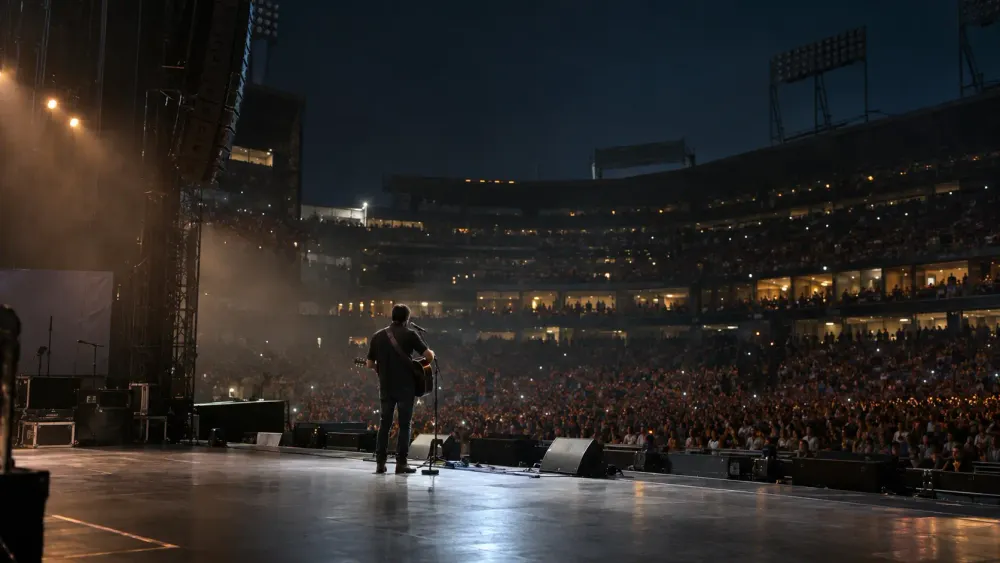
Three opening acts and Ed Sheeran’s backing band had withdrawn from his Loop Tour before the singer returned to the stage in Philadelphia on Saturday, apologized for his handling of the dispute and publicly criticized Israel’s conduct in Gaza. Opening his Sept. 19 concert at Lincoln Financial Field, Sheeran described the Oct. 7, 2023, Hamas attack on Israel as horrific while calling Israel’s subsequent treatment of Palestinians in Gaza catastrophic, unjustifiable and disproportionate. In Reuters reporting from the stadium, he also said he had made mistakes and was sorry.
The remarks were Sheeran’s first public response from a concert stage since rapper Macklemore was removed from the tour after saying “Free Palestine” during a performance at MetLife Stadium. The episode has become a consequential test of who controls speech on a stadium tour: the headliner, promoter, venue owner or performer whose appearance is contractually contingent on all three.
A concert opened without its planned support
Sheeran began the Philadelphia show without the original opening lineup. Finneas, Lukas Graham and Aaron Rowe had withdrawn from future dates after Macklemore’s removal, and Beoga, the Irish group that had served as Sheeran’s live backing band, also left. A People account said Sheeran told the crowd he had never sought to become an activist musician but now found himself inside a dispute about speech and one of the world’s most divisive conflicts.
In video from the concert, Sheeran said his shows should remain places where people with opposing views can stand together and sing the same songs. The formulation marked a substantial change from his earlier written statement, which stressed that audiences, including children, did not attend his concerts expecting a political forum.
The performance nevertheless proceeded, providing an initial answer to the operational question that followed the departures: the tour could continue without the planned supporting artists. It did not resolve whether additional musicians will join later dates or whether the dispute will affect the remaining U.S. schedule.
Venue owners held decisive leverage
Sheeran has said Macklemore’s contract was with the promoter, Messina Touring Group, rather than with him. According to the accounts released by Sheeran, Macklemore and the promoter, multiple venues said they would not host the concerts if Macklemore remained on the bill. The promoter then removed him, citing the risk of cancellations that would affect hundreds of thousands of ticket holders and tour workers.
Macklemore said New England Patriots owner Robert Kraft, whose business controls Gillette Stadium, helped organize the pressure. Kraft confirmed that Gillette would not allow Macklemore to perform there, arguing that the rapper’s recent presentation and past imagery crossed the stadium’s line against hate speech. Macklemore’s statement rejected the characterization and argued that criticism of the Israeli government should not be treated as antisemitism.
The competing accounts reveal the structure beneath a stadium concert. A headliner may define the creative program, but promoters contract with artists, venues control access to their property and local operators carry security and cancellation risks. When one participant threatens to withdraw, the practical decision can move away from the artist whose name is on the ticket.
The commercial signal was mixed
Philadelphia resale prices weakened sharply before the show. The lowest listed single-ticket price fell from $100 early Tuesday to $51 Friday morning, while available resale inventory rose 54%, according to marketplace data reported by Forbes. Another marketplace listed seats as low as $42.
Those figures show deteriorating secondary-market demand, not primary ticket sales, total attendance or the cause of every resale. Prices can move because of weather, timing, remaining inventory and sellers’ willingness to accept losses. The decline coincided with the public controversy and supporting-act exits, but the available data do not establish how much each factor contributed.
People interviewed by Reuters outside the venue expressed mixed views, with some supporting both artists and others saying politics should remain outside concerts. Dozens of pro-Palestinian demonstrators also gathered away from the stadium entrance. The concert’s completion showed that the dispute did not prevent the event; resale data suggest it may still have imposed a commercial cost.
The dispute redirected money toward aid
Macklemore pledged $1 million in net tour earnings to six Palestinian relief organizations. The AP reported that the recipients included Medical Aid for Palestinians, the Palestine Children’s Relief Fund, UNRWA USA, Anera, HEAL Palestine and Gaza Soup Kitchen. Sheeran separately committed $2 million in humanitarian aid, and Kraft said he would match that amount.
The donations produced a measurable result beyond the touring dispute. Anera told the AP that its social-media donations on Wednesday were more than triple the month’s daily average and that it gained more than 8,000 followers after Macklemore identified the organization. Those figures establish increased attention and giving, although they do not resolve the disagreement over the tour decision.
The tour continues under unresolved rules
The next test is whether the Loop Tour restores its planned production without further withdrawals or venue conflict. Sheeran is scheduled to perform at Gillette Stadium on Sept. 25 and 26, the venue at the center of Macklemore’s account. Security, replacement performers and any changes to stage access will determine whether Philadelphia was a workable reset or only a temporary solution.
What changed Saturday was clear: Sheeran moved from a written defense of an apolitical concert space to an onstage apology and direct criticism of the war’s effects on Palestinians, while still condemning the Hamas attack. The tour survived its first performance after the departures. What remains unsettled is whether artists, promoters and stadiums can establish predictable boundaries for political expression before the next dispute threatens another show.