
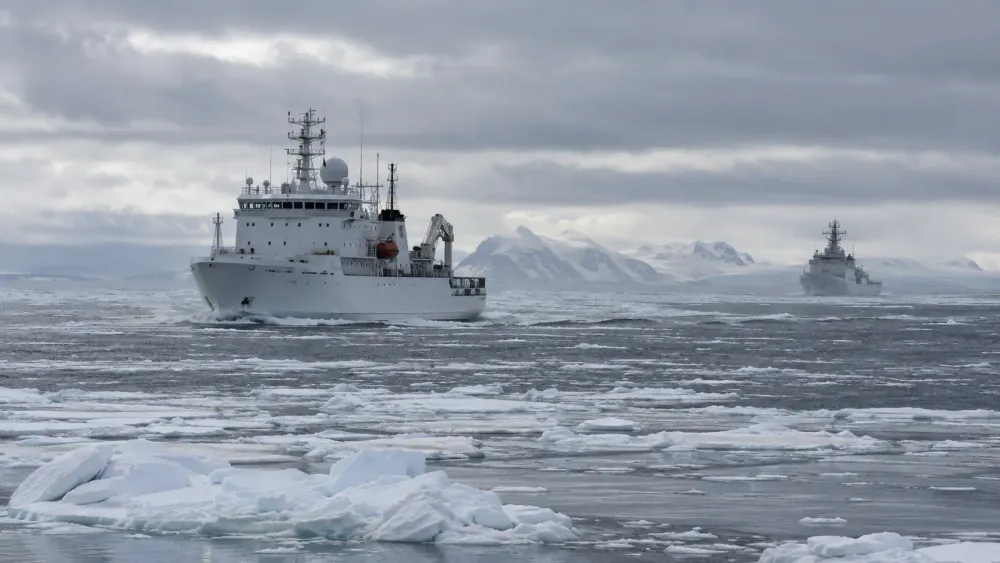
U.S. maritime officials say they are closely watching Chinese research vessels operating across Alaska’s Arctic approaches, where scientific work, commercial access and military competition increasingly overlap. Reuters reported that four Chinese research ships operated in the region this year, one fewer than in 2025, while staying in international waters. The activity is lawful on the high seas, but it is also strategically significant: data collected for civilian science can improve navigation, seabed mapping and sustained operations in a region the Pentagon now treats as an arena of intensifying competition.
What U.S. officials observed
Rear Adm. Bob Little, commander of the Coast Guard’s Arctic District, said the vessels were seen near Alaska, the Aleutian Islands and the Bering Strait, with Chinese activity extending as far north as the North Pole. He told Reuters the service was especially attentive when foreign vessels operated within the U.S. exclusive economic zone or above areas Washington identifies as part of its extended continental shelf. Little did not accuse the ships of violating U.S. law, and the report said the vessels remained in international waters.
That distinction matters. Foreign ships generally may navigate beyond territorial seas, and scientific activity in the Arctic is not inherently military. The security question arises from what modern research platforms can measure. Ocean depth, currents, salinity, ice conditions and the acoustic environment all have civilian value, yet they can also support route planning, undersea awareness and the operation of naval systems. Little said research involving seabed minerals could similarly produce knowledge useful to both commercial planners and defense institutions.
A larger Arctic posture
The Coast Guard’s own Arctic strategy frames the region as a place where safety, environmental stewardship and national security must be managed together. Its missions include enforcing U.S. law, monitoring maritime activity, supporting search and rescue and maintaining awareness across vast waters with limited ports, communications and logistics. The distances involved make routine presence difficult, particularly as retreating seasonal sea ice opens longer operating windows.
The Defense Department reached a similar conclusion in its 2024 strategy. It called for better domain awareness, stronger allied cooperation, more exercises and a calibrated U.S. presence. The strategy described China as seeking greater influence and access in the Arctic while deepening cooperation with Russia. Those judgments do not convert every Chinese voyage into a military operation, but they explain why U.S. agencies increasingly assess research, shipping and security activity as parts of the same operating picture.
China’s stated purpose
Beijing presents its Arctic work as lawful scientific and economic participation. China’s official Arctic policy calls the country a “near-Arctic state” and identifies scientific research, environmental monitoring, shipping routes and resource development as legitimate interests. The document says China will respect Arctic states’ jurisdiction while exercising rights available under international law in high seas and other relevant waters.
The same policy promotes a “Polar Silk Road,” stronger polar technology and expanded observation capabilities. That combination helps explain the competing interpretations. Chinese officials can point to an openly stated research agenda and international navigation rights. U.S. officials can acknowledge those rights while noting that persistent operations, high-resolution environmental data and specialized vessels build capabilities that could be useful in a crisis. The central issue is therefore not simply where a ship sails, but what information it gathers and how that knowledge may later be used.
Why the Bering region matters
The Bering Strait is a narrow maritime gateway between Alaska and Russia connecting the Pacific and Arctic oceans. It carries local traffic, international shipping and military significance far beyond its width. Chinese activity is also occurring amid closer Beijing-Moscow cooperation. In 2024, U.S. officials observed a joint Chinese-Russian coast guard patrol in the Bering Sea, an operation the Associated Press described as the northernmost location where Chinese coast guard ships had operated at that time.
That patrol and this year’s research voyages are different missions and should not be conflated. Together, however, they show that China can send multiple types of government-linked vessels into northern waters and sustain operations near the U.S. maritime frontier. For Washington, the practical challenge is to distinguish lawful presence from behavior that warrants closer scrutiny without treating routine navigation as escalation.
The operational test ahead
Monitoring will depend on more than intercepting individual vessels. The United States needs reliable sensors, communications, aircraft, cutters, ice-capable ships and access to regional facilities. It also needs coordination with Canada and other Arctic allies so information gathered by one government can improve awareness across the region. The Pentagon strategy emphasizes that networked approach because no single service can continuously cover the Arctic’s scale.
Transparency can reduce risk as well. Advance notice of research plans, publication of scientific objectives and professional bridge-to-bridge communication can help separate legitimate study from ambiguous behavior. China’s policy endorses international cooperation and information sharing in several Arctic fields; U.S. officials can test those commitments through specific requests for data and operational notice rather than relying only on broad declarations.
For now, the Coast Guard’s public assessment is measured: Chinese ships are present, they have remained in international waters, and the United States is watching. The consequential shift is the normalization of sustained Chinese operations near Alaska. That development makes maritime awareness, clear legal standards and steady allied coordination essential if the Arctic is to remain governed competition rather than a source of avoidable confrontation.