
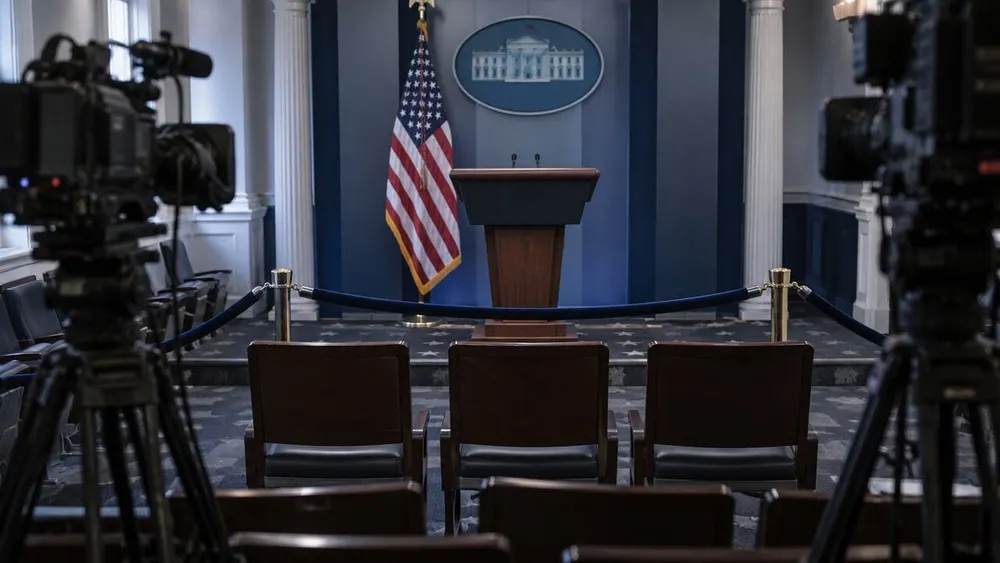
CNN, MS NOW and Politico filed a federal lawsuit Monday seeking an emergency court order restoring their White House access, turning President Donald Trump’s ban on the three news organizations into an immediate constitutional test. The federal suit was filed in the U.S. District Court for the District of Columbia and asks for a temporary restraining order while the case proceeds.
The organizations allege that the administration retaliated against protected newsgathering because officials objected to their coverage. An AP review of the complaint said the plaintiffs raise First Amendment press-freedom claims and Fifth Amendment due-process claims. Those are allegations, not findings: the court has not yet ruled on whether the access restrictions are unconstitutional.
The filing is a material escalation from the access dispute that began Friday, when Trump announced that the outlets would be barred from the White House. By Saturday, their journalists were denied entry, electronic credentials were disabled and some passes were collected by security personnel, according to reporting summarized in TAQ’s earlier coverage. The three organizations said Monday that the action came without notice or a chance to contest it, and that government officials cannot condition access on favorable reporting.
The restrictions have already changed how the presidency is covered. CNN had been scheduled to supply pooled television coverage for Trump’s trip to the United Nations General Assembly, but the network was removed from that assignment. The other television networks in the rotating pool did not provide a replacement camera, leaving the trip without the customary shared video feed, Axios reported. The pool system allows one outlet to cover constrained presidential events on behalf of many others, so disruption can affect news organizations far beyond the three plaintiffs.
The White House Correspondents’ Association has backed the outlets’ challenge, saying access cannot depend on whether a president approves of an organization’s reporting. Its position does not determine the legal outcome, but it underscores the institutional reach of the dispute: credentialing rules govern who can enter secure working areas, while pool assignments determine whether the wider press corps receives images and reporting from spaces too small for every outlet. The immediate disruption also gives the plaintiffs a concrete example of harm as they seek emergency relief.
Trump has defended the ban by accusing CNN, MS NOW and Politico of publishing false and unfair coverage. He has said the move is not an assault on press freedom and has characterized the outlets as a national-security threat, but the administration has not publicly produced evidence supporting that assertion, according to Reuters. The plaintiffs contend that Trump’s own statements show the ban was based on viewpoint rather than neutral security or credentialing rules.
The complaint draws on earlier disputes over access to the White House. Federal judges ordered the restoration of credentials for CNN correspondent Jim Acosta in 2018 and Playboy correspondent Brian Karem in 2019 after the administration revoked their passes. A case summary described those rulings as part of the plaintiffs’ argument that the government must use fair procedures and cannot retaliate against journalists for their coverage.
A more recent dispute involving the Associated Press shows that the legal terrain is not automatic. A trial judge ruled that the White House could not punish the AP over its editorial choice not to adopt Trump’s preferred name for the Gulf of Mexico. But a divided appeals panel later allowed restrictions to remain in certain limited presidential spaces while litigation continued, a Reuters account reported. The new plaintiffs are challenging a broader exclusion from White House grounds and facilities, a distinction the district judge will have to evaluate alongside those precedents.
The immediate question is whether the court will grant temporary relief before full litigation. To win a restraining order, the organizations generally must show, among other factors, a likelihood of success and irreparable harm. Their complaint argues that every day without access impairs newsgathering and deprives the public of independent reporting. The government will have an opportunity to answer and dispute both the facts and the proposed legal standard.
The case also puts a concrete timetable around a confrontation that, until Monday, rested mainly on unilateral executive action. A court could restore access, leave the restrictions in place or fashion narrower interim relief while the merits are litigated. Any emergency ruling could be appealed quickly, as happened in the AP dispute. The court challenge is therefore likely to shape not only whether these three organizations return to the White House, but also how much discretion future administrations have to exclude news outlets over their editorial judgments.