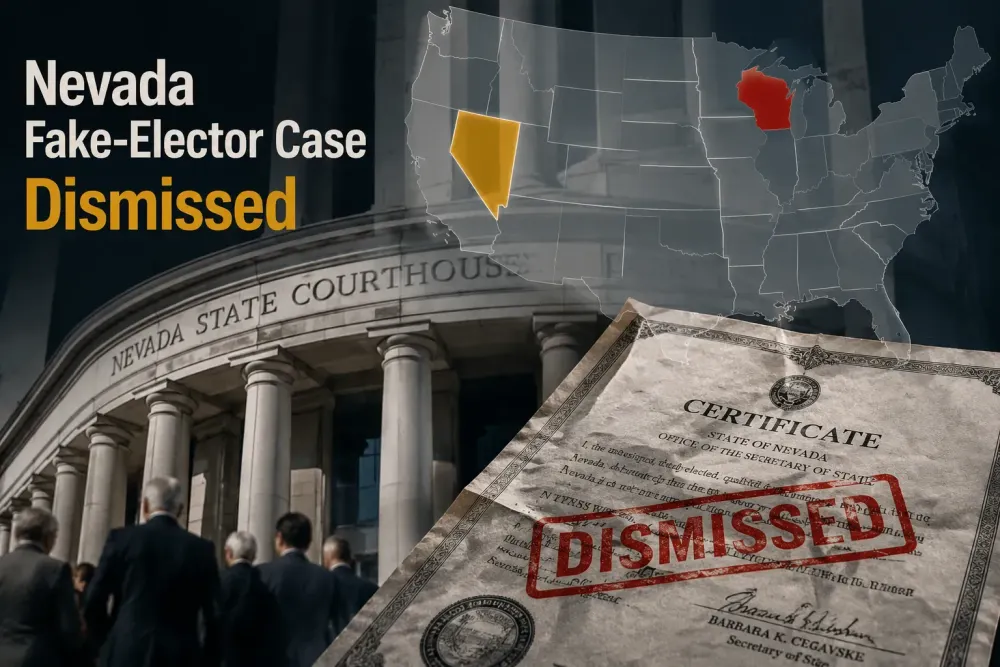
Nearly six years after Republican officials in Nevada signed a document declaring Donald Trump the winner of a state he lost by more than 30,000 votes, a Clark County judge this week has thrown out the criminal case against them for the second time, according to NPR. The ruling, issued Thursday by Judge Mary Kay Holthus, leaves Wisconsin as the only state where a fake-elector prosecution remains active, according to NPR. The decision closes out, at least for now, one of the last remaining criminal accountability efforts tied to the 2020 election's aftermath, and it illustrates the legal difficulty states have faced in fitting an unprecedented scheme into existing criminal statutes.
The six defendants, Nevada Republican Party Chairman Michael McDonald, party Vice Chair Jim Hindle, Republican National Committeeman Jim DeGraffenreid, former Clark County GOP Chairman Jesse Law, Shawn Meehan and Eileen Rice, were indicted by a Clark County grand jury in December 2023 on felony charges of forgery and offering a false instrument for filing, according to the Nevada Independent. All six pleaded not guilty. Prosecutors alleged that in December 2020, the group convened outside the Nevada Legislature, signed a certificate awarding the state's six electoral votes to Trump and then-Vice President Mike Pence, and mailed the documents to federal and state officials, even though Joe Biden had won Nevada's popular vote, according to NPR.
In her written order, Holthus found that state prosecutors had not presented sufficient evidence that the electors intended to deceive government officials into treating their certificate as genuine, according to the Nevada Independent. She pointed to the fact that the electors publicly announced their actions rather than concealing them. "The fact that Defendants openly announced both their actions and their asserted purpose, rather than concealing their conduct or attempting to secretly induce governmental reliance, weighs against a reasonable inference that they acted with fraudulent intent," Holthus wrote, according to the Nevada Independent. She also cited testimony from state officials that the electors' certificate could never have been processed as an authentic document under Nevada or federal law, reasoning that the forgery statute is meant to stop officials from mistakenly acting on documents they believe are genuine, a scenario she said the evidence did not support, according to the Nevada Independent.
Holthus additionally found that prosecutors had "independently undermine[d] the integrity of the indictment" by withholding certain evidence from the grand jury, according to the Nevada Independent. She noted that Attorney General Aaron Ford's office had itself previously acknowledged, before pursuing charges, that Nevada law "did not directly address the conduct in question", a reference to the absence of a statute specifically criminalizing the submission of competing slates of presidential electors, according to the Nevada Independent. Lawmakers introduced bills in two recent legislative sessions that would have explicitly criminalized such conduct, but Republican Governor Joe Lombardo vetoed both, according to the Nevada Independent.
Ford's office, which had charged the electors under existing forgery-related statutes in the absence of a more specific law, said it plans to appeal the dismissal to the Nevada Supreme Court, according to NPR. That path has already played out once: Holthus first dismissed the case in June 2024 on venue grounds, ruling that Clark County had no legal connection to the alleged conduct since the electors signed their certificate in Carson City and mailed it from Douglas County, according to Wikipedia's summary of court filings. The state appealed, and the Nevada Supreme Court unanimously reversed that dismissal in November 2025, sending the case back to Clark County, a jurisdiction prosecutors viewed as more favorable given its Democratic-leaning jury pool, according to the Nevada Independent. That appellate round took roughly sixteen months, and a similar timeline for the current appeal would extend the case well past Ford's current term; he is running for governor in 2026 and is unlikely to remain attorney general by the time any appeal is resolved, according to the Nevada Independent.
Richard Wright, the defense attorney representing McDonald, criticized the state's plan to appeal as "hasty" and "premature" and characterized the continued prosecution as politically motivated, according to NPR. Defense attorneys have separately argued, in filings referenced by NPR, that the electors' actions amounted to "political theater" intended to publicize concerns about the 2020 results rather than an attempt to defraud election officials, according to NPR.
The Nevada outcome fits a broader pattern across the seven states where Trump allies organized competing slates of electors after the 2020 election. Of the four states that filed criminal charges, Georgia, Michigan, Arizona and Nevada, courts have now dismissed the cases in Georgia and Michigan outright, according to NPR. Arizona's case, brought by Democratic Attorney General Kris Mayes, was itself dismissed earlier this summer after the state supreme court declined to revive an indictment a lower court had thrown out for a due-process violation; Mayes has said she intends to present the case to a new grand jury, according to NPR. Wisconsin, where Attorney General Josh Kaul filed charges in June 2024 against individuals who delivered the state's false certificate to Congress, remains the only jurisdiction with an active case, according to NPR. New Mexico and Pennsylvania never filed charges, with officials in both states concluding their forgery statutes did not clearly cover the conduct, according to a tracker maintained by Citizens for Responsibility and Ethics in Washington. A federal case that had charged Trump himself with conspiring to overturn the election was dropped by a special counsel in late 2024 following his election victory, according to NPR.
The pattern reflects a structural, not partisan, obstacle common to most of these prosecutions: state forgery and false-filing statutes were written for conventional document fraud and do not squarely address a scenario in which people openly submit a competing slate of electors while publicly stating their intent, rather than secretly deceiving officials. That gap has now surfaced in rulings from judges in multiple states, including Nevada, Georgia and Michigan, and it is the same gap that led Nevada lawmakers, with Ford's own backing, to twice attempt new legislation that would have explicitly outlawed the practice, only to be vetoed by Lombardo, according to the Nevada Independent. The dismissals in Nevada, Georgia and Michigan have come under both Republican and Democratic attorneys general's watch, and none has been overturned on appeal to date, underscoring that the legal weaknesses are rooted in how existing statutes are written rather than in the practices of any single administration or party.
Separately, the case carries a political dimension for Nevada's current legal landscape: Trump issued pardons in November 2025 to dozens of individuals connected to fake-elector efforts nationally, though that clemency power applies only to federal charges and has no direct bearing on Nevada's state-level prosecution, according to Wikipedia's timeline of the case. Ford's office has not indicated whether it will seek to refile any surviving charges if the appeal fails, and no new hearing date has been set after a proceeding scheduled for this week was canceled following the dismissal, according to the Nevada Independent.
For now, the practical effect is that nearly six years after the 2020 election, only one of seven states where competing elector slates were organized has an unresolved criminal case moving forward. Whether Nevada's appeal revives its prosecution, or whether Wisconsin's case becomes the sole remaining avenue for state-level accountability tied to the scheme, will depend on how the Nevada Supreme Court interprets the same evidentiary gaps that have repeatedly stalled these efforts elsewhere.