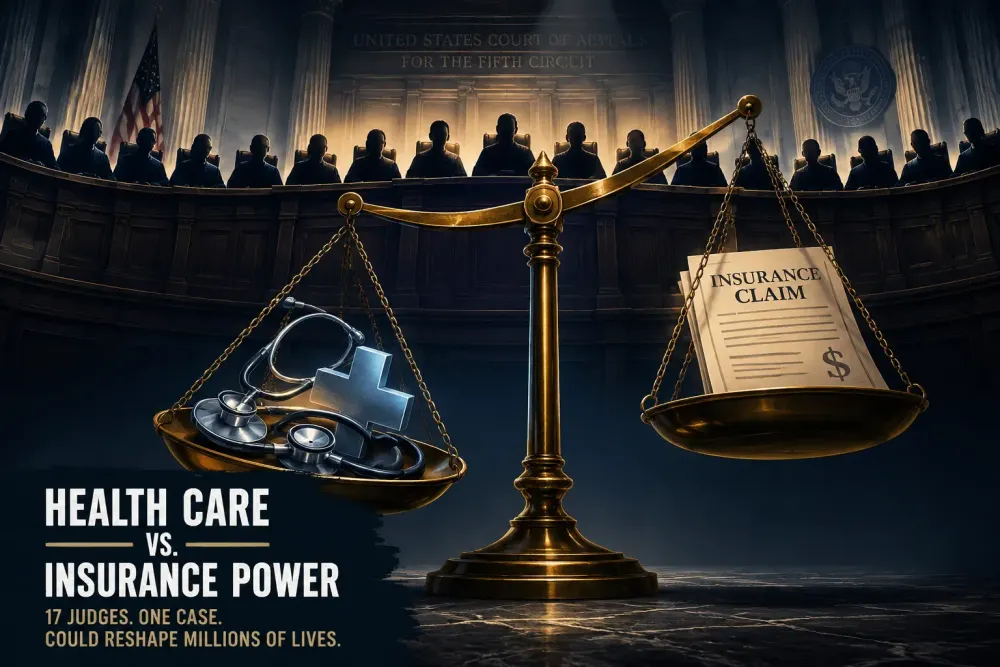
Arbitrators picked a payment rate higher than insurers' own benchmark in 85% of the roughly 1.15 million medical billing disputes decided during the second half of 2025, a lopsided pattern that a full federal appeals court cited this week in striking down key parts of the formula insurers use to price out-of-network care, according to the opinion. The August 11 en banc ruling in Texas Medical Association v. HHS found that federal regulators unlawfully let insurers pad down a key reimbursement benchmark under the 2020 No Surprises Act, handing doctors and hospitals their fourth consecutive win in a multiyear legal fight over how out-of-network medical bills get priced, according to Reuters. Seventeen active judges on the Fifth Circuit reheard the case after a smaller three-judge panel had already ruled on it once, underscoring how unsettled the underlying legal question has remained since the law took effect.
The case centers on an obscure but consequential number called the qualifying payment amount, or QPA, essentially an insurer's median in-network rate for a given service in a given region. Congress built the No Surprises Act around that figure specifically so patients could no longer be billed the gap between what an out-of-network provider charges and what insurance covers for emergency care or certain hospital-based specialists. Instead, providers and insurers were supposed to negotiate the remainder themselves, and if they couldn't agree, take the dispute to a federal arbitration process weighing several factors, with the QPA as a central reference point, according to MedCity News.
The Texas Medical Association and a group of air ambulance operators argued for years that regulators wrote the QPA formula in a way that systematically favored insurers. The 17-judge court, sitting en banc, agreed on two of the group's central complaints. First, it found regulators had wrongly allowed insurers to fold so-called "ghost rates" into the calculation, placeholder prices written into provider contracts for services those providers never actually deliver or negotiate over. Because those rates tend to sit below real market value, including them dragged down the calculated median, according to the court's opinion. The panel was unpersuaded by an earlier agency workaround that excluded only rates of exactly zero dollars while still counting nominal $1 ghost rates; as the majority put it, "either the provider contracted for the rate, or he did not."
Second, the court ruled that regulators erred by letting insurers strip out bonus, risk-sharing and other incentive payments when tallying the QPA, even though such payments often make up a meaningful share of what providers are actually paid under their contracts. The statute's reference to a "total maximum payment," the court held, requires counting the full sum insurers pay providers, not a stripped-down base rate. Insurers did notch one win: the court agreed that one-off, case-specific contracts, the kind often used for single air ambulance transports, can still be excluded from the rate-setting math, since those arrangements aren't the type of standing, generally applicable rates the law contemplated, according to Bloomberg Law.
Underlying the legal reasoning was a data point the court leaned on heavily: the volume of arbitration cases has run roughly 84 times higher than what the responsible agencies originally projected when the law took effect in 2022, and providers have prevailed in more than 80% of resolved disputes, according to the court's opinion. Separate federal data released by the Departments of Health and Human Services, Labor and Treasury this summer show the pattern intensifying rather than fading: more than 1.37 million disputes were filed in the second half of 2025 alone, providers won 85% of decisions, and the winning offer beat the QPA in 87% of cases, according to Healthcare Dive. For emergency-department claims, median awards have landed at roughly three times the QPA in recent quarters, and for some specialties like neurology the multiple has topped 19 times the benchmark, according to industry tracking of the same federal reports cited by HFMA. The court read that lopsided track record as evidence the underlying benchmark itself had been distorted rather than proof that arbitrators were simply exercising discretion Congress gave them.
The ruling does not take the No Surprises Act's core patient protections off the books, and patients themselves are not parties to these disputes and cannot be billed the difference regardless of which side wins. What changes is the input insurers must use when setting that benchmark rate, which in turn shapes both arbitration outcomes and the cost-sharing amount patients owe upfront for protected out-of-network care. The court explicitly declined to let its decision touch off what it called "all-out chaos," noting that the responsible federal agencies have already been exercising enforcement discretion for years while this litigation played out and can keep letting insurers rely on existing QPA calculations until new ones are issued, according to the court's opinion. No deadline has been set for when the Departments must publish a revised methodology, leaving both insurers and provider groups watching for the next round of federal guidance, according to MedCity News.
The decision was not unanimous. A bloc of six judges partially dissented, arguing the majority went too far by ruling that ghost rates must be stripped out regardless of whether a claim was ever paid at that rate, and by mandating the inclusion of bonus and incentive payments; that group would have sent both questions back to the lower court rather than immediately vacating the relevant rule, according to Brownstone, a law firm that tracks the litigation. The split does not track a clean partisan or administration-specific line, the regulations being challenged were issued in July 2021 and have already been through multiple rounds of litigation, appeal, and partial reversal across two presidential administrations, reflecting a structural disagreement over statutory interpretation rather than a dispute rooted in current political alignment. The rule being unwound was written under one administration, defended in court under a second, and is now being rewritten under a third, illustrating a structural, bipartisan pattern of regulatory-drafting disputes rather than a fight tied to any single administration's agenda.
The practical effect will likely be felt first by health plans, hospital systems and physician staffing groups rather than patients directly, at least in the near term. Because a higher QPA generally translates into higher arbitration payouts, insurers are expected to see reimbursement costs climb for exactly the kind of high-volume, high-dollar disputes, emergency medicine, anesthesiology, radiology and neurology chief among them, that already generated over $15 billion in arbitration payouts in 2025, more than triple the prior year's total, according to data compiled by Claritev. Whether those higher costs eventually show up in premiums is a separate, longer-running question that health economists have debated since the arbitration system's caseload first ballooned far beyond what regulators anticipated. For now, the ruling adds another chapter to a five-year legal saga that has repeatedly tested how much discretion federal agencies have to translate a short statutory phrase, "total maximum payment", into the formula that decides who pays for surprise medical bills, and how much.