
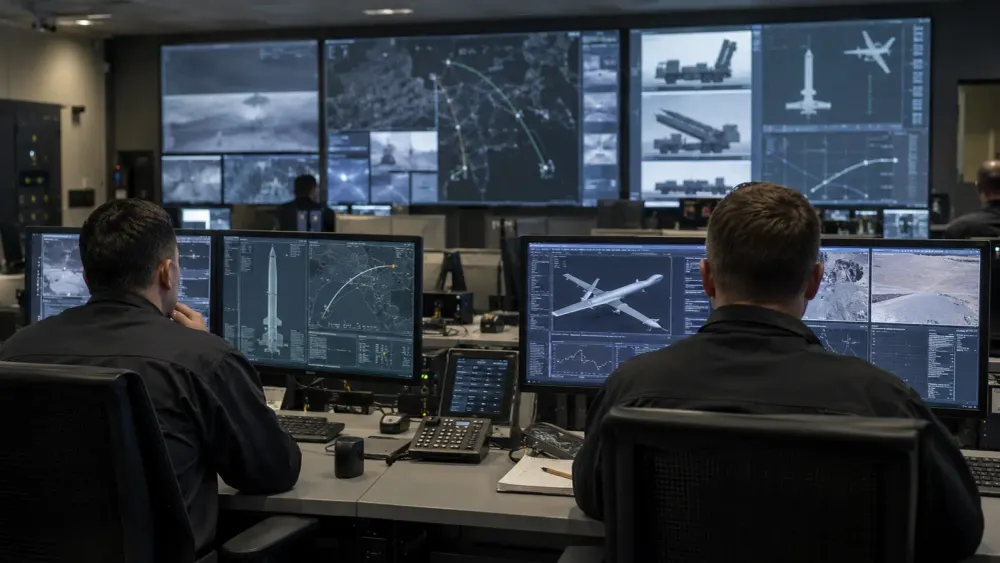
Five North Korean army units fired tactical ballistic missiles, cruise missiles, large-caliber rockets and attack drones in a Sept. 12 live-fire exercise, according to state media, concentrating dissimilar weapons under one command. South Korea independently detected several short-range ballistic missiles traveling about 250 kilometers toward the sea east of the Korean Peninsula, but it did not publicly confirm every system that Pyongyang said participated.
The distinction matters. North Korea presented the event as a successful joint-firepower drill and claimed perfect accuracy, assertions that outside observers cannot independently verify. What can be established is that the launch occurred, that several ballistic missiles flew on a theater-range trajectory, and that North Korea deliberately described the exercise as an integrated operation rather than a test of one new weapon. That framing makes the drill important even without proof of every performance claim.
The exercise followed the conclusion of a five-day U.S.-South Korean-Japanese drill by one day. It also became North Korea’s 13th known ballistic-missile launch event of the year, according to Reuters. Taken together, the timing and composition point to a familiar cycle of allied training and North Korean response, but with a sharper emphasis on the command problem: coordinating weapons that move at different speeds, altitudes and trajectories.
A drill built around integration
North Korea’s official account said the exercise tested an integrated weapons-control system. The reported force package included attack drones, tactical cruise missiles, tactical ballistic missiles and large-caliber multiple-rocket launchers. AP reported that the weapons were fired simultaneously, while South Korean detection data identified several short-range ballistic launches from the Wonsan area on the east coast.
That combination is more consequential than the addition of any single launcher. Ballistic missiles climb and descend rapidly; cruise missiles generally stay lower and follow a flatter path; drones may be slower and more maneuverable; rocket artillery can generate a dense short-range salvo. A defender confronting several categories at once must detect, classify and prioritize tracks while deciding which sensors and interceptors to assign. The operational value lies in compressing those decisions into a shorter period.
Lim Eul-chul of Kyungnam University described the drill as a demonstration of an “integrated strike network,” not a single-system test, in the Reuters report. His assessment—that simultaneous weapons with different flight characteristics could be intended to stress allied defenses—is an expert interpretation, not a confirmed North Korean battle plan. Still, it fits the systems Pyongyang chose to advertise and the emphasis it placed on unified command and control.
Independent evidence remains narrower
The public evidence does not support treating every North Korean claim as established fact. South Korea’s Joint Chiefs of Staff confirmed several short-range ballistic missiles and estimated their flight at about 250 kilometers. The other reported components come from the Korean Central News Agency, which released its account two days after the firing. Yonhap noted that Kim Jong Un was not reported at the exercise; senior military official Pak Jong Chon observed it instead.
The absence of Kim and the delayed report may indicate that Pyongyang wanted to portray the event as routine military training rather than a leadership showcase. It could also reflect ordinary propaganda decisions. Neither explanation can be proven from the public record. The safest conclusion is more limited: North Korea conducted a real ballistic launch and used its state media to present a broader, coordinated-fire narrative.
There is also no public evidence that the Sept. 12 drill included a nuclear-warhead simulation. North Korea has described some theater systems as nuclear-capable in earlier exercises, and its missile force is subject to United Nations measures covering prohibited ballistic-missile programs. The Security Council’s resolution summaries document the expanding restrictions. But nuclear capability and nuclear employment are not interchangeable claims; the latest account did not announce a nuclear mission.
The allied exercise set the immediate context
Freedom Edge 26 concluded on Sept. 11 after five days of training by the United States, South Korea and Japan. According to the U.S. Pacific Command’s official summary, the exercise covered maritime, air, missile-defense, cyber and medical capabilities in international waters and airspace south and east of South Korea and at sites in Japan.
Command-and-control teams practiced synchronizing actions across several domains, and the three countries expanded air-defense communication and real-time data-sharing procedures. Those details make the sequence notable. The allies were rehearsing how to connect sensors, decision-makers and forces across national boundaries; North Korea responded by publicizing its own ability to combine multiple strike systems under a unified command. Both sides were highlighting networks as much as platforms.
The three allied governments describe Freedom Edge as defensive and intended to improve interoperability. Pyongyang portrays such exercises as rehearsals for attack. Those positions have hardened over repeated training cycles, making each side’s readiness measures part of the other’s threat assessment. The Sept. 12 launch does not prove that the allied exercise caused the drill, but the one-day interval and North Korea’s longstanding objections make the timing difficult to dismiss.
A shift from missiles to strike systems
North Korea has spent years expanding a theater-strike inventory that includes solid-fuel ballistic missiles, long-range rocket artillery and cruise missiles. A detailed analysis by 38 North found that cruise missiles increasingly supplemented ballistic systems in exercises and that Pyongyang emphasized survivability, mobility and varied delivery options. The latest drill appears to extend that trajectory from possessing a portfolio of weapons toward operating them together.
That evolution mirrors a broader military lesson from recent wars: relatively inexpensive unmanned aircraft can provide surveillance, targeting support, deception or direct attack while missiles and artillery impose heavier costs. Another 38 North assessment argues that North Korea’s exposure to the Russia-Ukraine war may encourage greater use of low-cost drones and networked artillery. That remains analysis rather than proof about this exercise, but it provides a plausible reason for placing drones inside a combined-fire drill.
Japan’s 2026 defense digest similarly notes North Korean goals involving unmanned assets and electronic warfare, alongside the continued strengthening of nuclear capabilities. The policy challenge for Washington, Seoul and Tokyo is therefore not simply counting missile launches. It is determining whether North Korea is improving the communications, targeting data and disciplined timing needed to make disparate systems function as one force.
What the exercise changes—and what it does not
One drill does not establish that North Korea can execute a large, resilient strike network under wartime pressure. State media supplied no independently verifiable data about launch timing, communications reliability, target selection, electronic interference or the accuracy of the nonballistic systems. A coordinated demonstration on a controlled range is also different from sustaining operations after command nodes and sensors come under attack.
Yet the event provides a useful warning about the direction of travel. Missile defense is often discussed as a contest between a particular interceptor and a particular missile. The Sept. 12 scenario instead points toward a mixed raid in which the defender must solve several different problems at once. Even if some weapons are less accurate or sophisticated, their presence can consume attention, sensor capacity and finite defensive ammunition.
The next indicators will be more informative than Pyongyang’s claim of perfect accuracy: whether future drills repeat the same mix, whether drones appear to support targeting rather than merely strike, whether electronic-warfare units participate, and whether North Korea demonstrates dispersed launch units exchanging data under a common headquarters. Repetition would suggest a developing operational method; a one-time display could remain partly theater.
For allied planners, the appropriate response is measured rather than alarmist. Better data-sharing, layered detection and exercises that force commands to sort mixed tracks are directly relevant to the capability North Korea advertised. Diplomatically, preserving channels that reduce misreading is equally important, because increasingly complex drills leave more room for technical activity to be interpreted as preparation for attack. The latest launch was limited in range, but its central message was broader: North Korea wants its opponents to plan for a system of weapons, not a sequence of isolated tests.