Last updated: August 18, 2026
Quick Answer
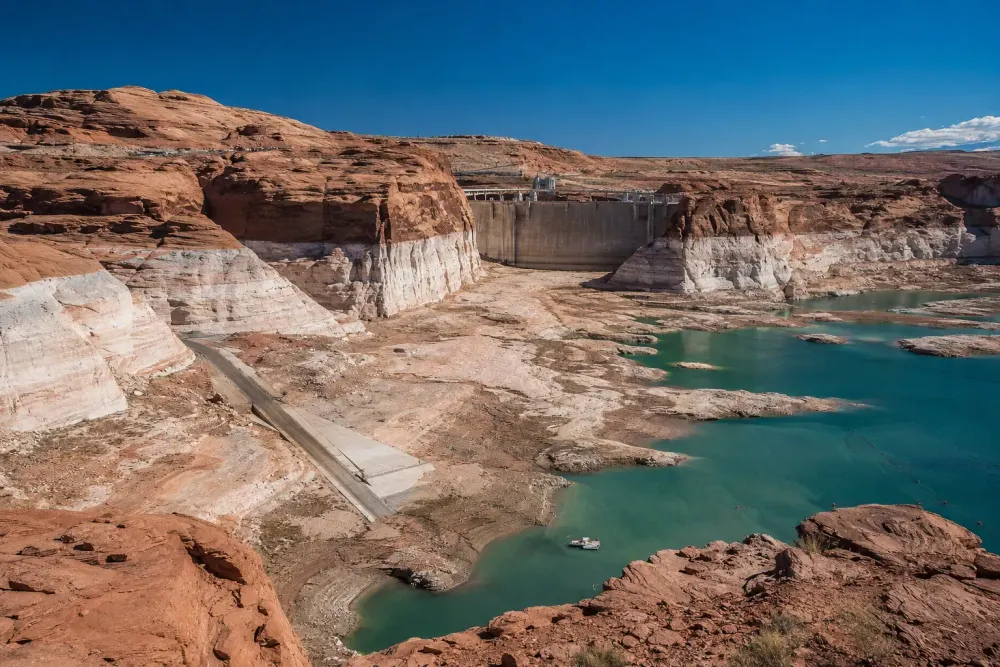
Lake Powell, the second-largest reservoir in the United States, fell to the lowest level ever recorded in its 63-year history in August 2026, dropping below the previous all-time low set in April 2022. The reservoir now sits within roughly 30 feet of "minimum power pool," the elevation at which Glen Canyon Dam can no longer spin its hydroelectric turbines. That single threshold links the fate of drinking water for about 40 million people across seven states to the electricity supply of roughly 5 million customers in the Southwest.
Key Takeaways
- Lake Powell reached a record low elevation in August 2026, breaking the mark set in April 2022, and combined storage in Powell and Lake Mead also set daily record lows through July and August.
- The reservoir is approaching minimum power pool at 3,490 feet above sea level, the point where Glen Canyon Dam's turbines must shut down.
- Bureau of Reclamation projections show a real chance of crossing that threshold in late 2026 or 2027 under continued dry conditions.
- Roughly 40 million people in Arizona, California, Nevada, Utah, Colorado, Wyoming, and New Mexico, plus parts of Mexico, depend on the Colorado River system that Powell regulates.
- Glen Canyon Dam supplies power to about 5 million electricity customers, and lost generation means both blackout risk mitigation costs and a large hit to federal hydropower revenue.
- The primary driver is structural, not seasonal: a 26-year drought plus warming temperatures have cut Colorado River flows below what the 1922 Colorado River Compact assumed.
- Farms take the first and largest cuts, agriculture uses about 70-80% of Colorado River water.
- The 2007 interim guidelines and the 2026 drought response rules expire at the end of 2026, forcing states to negotiate a new operating framework now.
What is Lake Powell and why does it matter
Lake Powell is a man-made reservoir on the Colorado River, straddling the Utah, Arizona border, created when Glen Canyon Dam was completed in 1963. It matters because it is the savings account for the entire Upper Colorado River Basin: Wyoming, Colorado, Utah, and New Mexico store water in Powell so they can meet legal delivery obligations to the Lower Basin states of Arizona, California, and Nevada, even in dry years.
At full pool, Powell holds about 24.3 million acre-feet, roughly two years of the river's average annual flow. It performs three jobs at once:
- Storage and legal compliance, banking water so the Upper Basin can deliver its required share downstream.
- Hydropower, Glen Canyon Dam generates about 5 billion kilowatt-hours in a normal year, sold at cost to municipalities, rural cooperatives, and tribal utilities across six states.
- Flow regulation, smoothing seasonal snowmelt into steady releases to Lake Mead.
When Powell drops, all three functions degrade at the same time. That simultaneity is what makes the current situation different from an ordinary dry year.
How low is Lake Powell right now
As of August 2026, Lake Powell sits at the lowest elevation ever recorded since the reservoir began filling in 1963, below the previous record low of about 3,522 feet reached in April 2022. Through July and August 2026 the reservoir repeatedly set records for the lowest level ever measured for that calendar date, and combined storage across Powell and Mead set daily all-time lows.
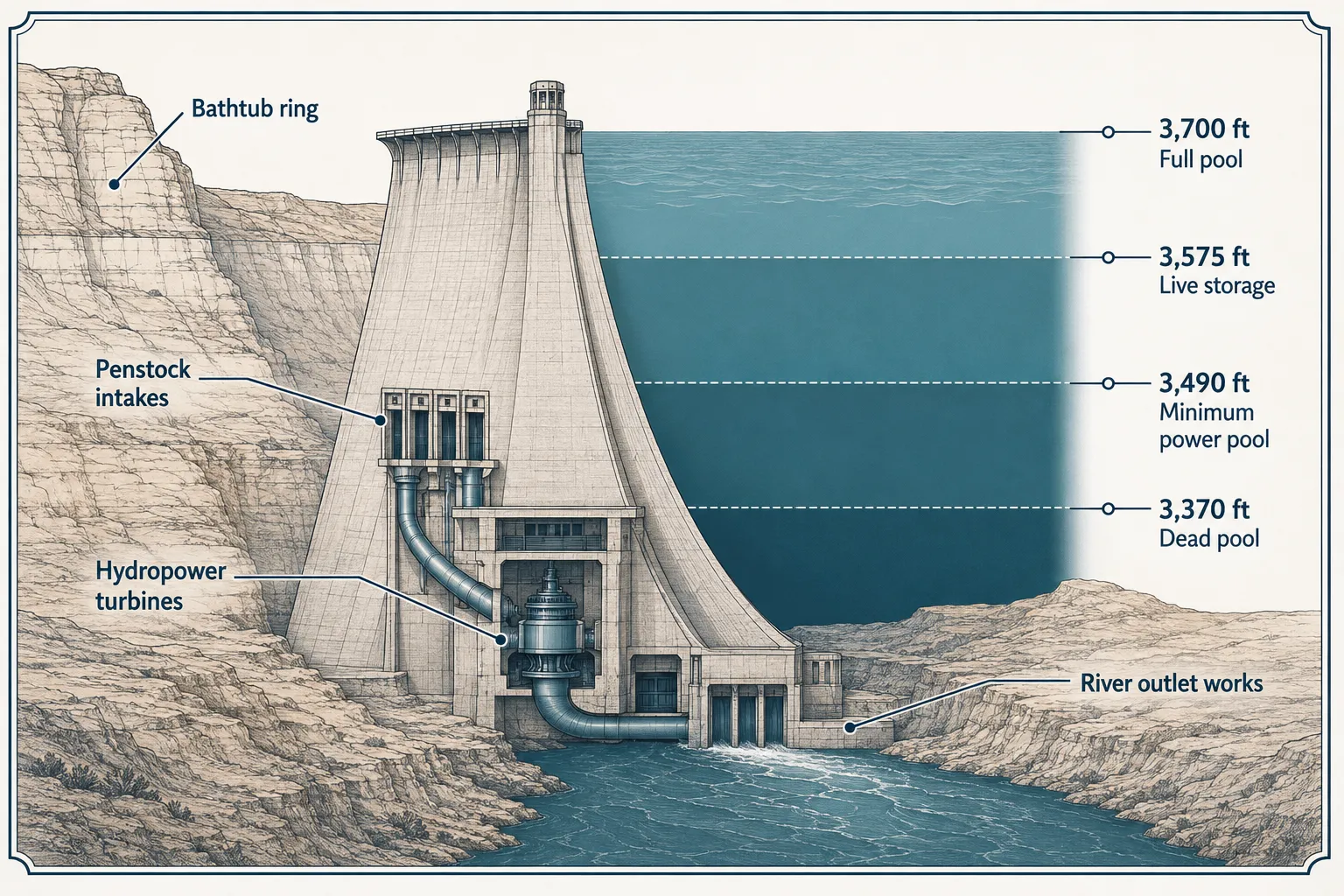
Powell is holding roughly a quarter of its capacity. Water managers track four elevations:
| Threshold | Elevation (feet above sea level) | What happens |
|---|---|---|
| Full pool | 3,700 | Reservoir at capacity |
| Target operating range | 3,575 | Buffer elevation under current rules |
| Minimum power pool | 3,490 | Turbines must stop; hydropower ends |
| Dead pool | 3,370 | No water can pass downstream by gravity |
Brad Udall, a Colorado State University water and climate scientist who has studied the basin for decades, has described the approach to minimum power pool as a "scary threshold." Reclamation's own modeling puts a meaningful probability on reaching it in late 2026 or 2027 if the coming winter delivers another below-average snowpack.
The reservoir is not empty. It is, however, close to the elevation where the dam stops being a power plant and becomes only a plumbing fixture.
What causes Lake Powell water levels to drop
Three forces are pulling the reservoir down, and only one of them is weather. The others are physics and law.
- Long-term drought. The basin has been in drought since 2000. Snowpack in the Rockies, which supplies most of the river's water, has run below average in most of those years.
- Warming temperatures. Higher heat means more evaporation off the reservoir surface, thirstier soils that absorb snowmelt before it reaches streams, and earlier runoff. Researchers attribute a substantial share of the flow decline to temperature rather than precipitation alone, a loss that persists even in wet years.
- Over-allocation. The river was divided in 1922 based on an unusually wet stretch of record. Legal entitlements total more water than the river now produces.
A common misreading: one good snow year fixes it. The 2023 snowpack was well above average and Powell rose sharply, then gave most of it back within three years. Recovery requires several consecutive wet years plus reduced consumption, not a single good winter.
How does Lake Powell affect water supply to Arizona, California and Nevada
Lake Powell does not deliver water directly to Lower Basin cities. It releases water into Lake Mead, and Mead supplies Arizona, California, Nevada, and Mexico. When Powell's storage falls, Reclamation reduces releases to protect the dam's own power pool, which then pushes Mead lower and triggers mandatory shortage cuts under the tiered guidelines.
Who feels it, and in what order:
- Arizona takes the deepest and earliest cuts. Central Arizona Project water serving Phoenix and Tucson is junior in priority, so Pinal County farmers lost most of their allocation first.
- Nevada has the smallest allocation (300,000 acre-feet) but Las Vegas has cut consumptive use sharply through turf removal and near-total wastewater recycling.
- California holds the most senior rights, led by the Imperial Irrigation District. Cuts arrive last but are large in absolute volume when they come.
Decision rule for water managers: if you hold junior priority rights and single-source Colorado River supply, you are exposed first. Utilities with groundwater banking, recycled water, or diversified imports have years of buffer that single-source districts do not.
How many people depend on Lake Powell for drinking water
About 40 million people across seven U.S. states and northern Mexico depend on the Colorado River system that Lake Powell regulates, and Powell's releases are the mechanism that keeps that supply legally and physically reliable. No single city drinks straight from Powell, but Phoenix, Tucson, Las Vegas, Los Angeles, San Diego, Denver, Albuquerque, and Salt Lake City all sit inside the river's service area.
The reservoir also supports roughly 5.5 million acres of irrigated farmland and 30 federally recognized tribes with senior water rights, many of which have not yet fully developed their entitlements.
What happens to hydroelectric power if Lake Powell dries up
If Powell falls below 3,490 feet, Glen Canyon Dam's eight turbines stop generating and water must be routed through the river outlet works, bypass tubes never designed for continuous long-term use. The Western Area Power Administration would then have to buy replacement power on the open market for about 5 million customers, and the federal hydropower revenue that funds basin programs largely disappears.
The consequences stack up:
- Cost shock. Reclamation's 2026 drought response planning identifies large hydropower revenue losses as a central financial risk, since those revenues fund environmental compliance, salinity control, and endangered fish programs.
- Grid strain. Glen Canyon provides fast-responding capacity that helps balance the Southwest grid on peak summer afternoons.
- Infrastructure risk. Reclamation engineers have cautioned against relying solely on the river outlet works. Sustained high-velocity flow through those tubes raises cavitation concerns and leaves no redundancy if a gate fails.
Edge case worth naming: the dam does not need to hit dead pool for serious trouble. Between 3,490 and 3,370 feet, water still moves downstream, but the generation stops and the margin for mechanical error narrows considerably.
Lake Powell record low levels: history timeline
Powell has never refilled since 1999. The trajectory has been a stair-step decline punctuated by brief recoveries.
- 1963-1980, Reservoir fills behind the new Glen Canyon Dam.
- 1983, Record high; spillways damaged by extreme runoff.
- 1999, Last time Powell was essentially full.
- 2005, First deep drawdown low; recovery follows.
- 2021, First-ever Tier 1 shortage declared on the Lower Basin.
- April 2022, Previous all-time record low near 3,522 feet; emergency upstream releases ordered.
- 2023, Big snowpack lifts levels roughly 70 feet.
- August 2026, New all-time record low, with combined Powell, Mead storage at daily record lows and the reservoir near minimum power pool.
What is the Colorado River Compact and why does it matter
The 1922 Colorado River Compact split the river between an Upper Basin (Colorado, Utah, Wyoming, New Mexico) and a Lower Basin (Arizona, California, Nevada), allocating 7.5 million acre-feet annually to each, with a later treaty adding 1.5 million acre-feet for Mexico. The problem is arithmetic: the compact assumed about 16-17 million acre-feet of annual flow, while 21st-century flows have averaged closer to 12-13 million.
Lake Powell exists largely to let the Upper Basin meet its compact obligation without curtailing its own users. If Powell can no longer do that, the Upper Basin faces a "compact call," a legal demand from downstream states that would likely end in the Supreme Court and take years to resolve.
Difference between Lake Powell and Lake Mead
Both are Colorado River reservoirs, but they serve opposite ends of the system. Powell (behind Glen Canyon Dam, Utah/Arizona) stores Upper Basin water and releases it downstream. Mead (behind Hoover Dam, Nevada/Arizona) receives that water and distributes it to Lower Basin cities, farms, and Mexico.
| Feature | Lake Powell | Lake Mead |
|---|---|---|
| Dam | Glen Canyon (1963) | Hoover (1936) |
| Capacity | ~24.3 million acre-feet | ~26 million acre-feet |
| Role | Upper Basin savings account | Lower Basin delivery hub |
| Power customers | ~5 million | ~1.3 million (larger capacity) |
| Critical threshold | 3,490 ft power pool | 950 ft power pool |
They are managed as one connected pool, which is why record-low combined storage is the number specialists watch most closely.
Can Lake Powell recover, or is it permanently shrinking?
Powell can rise, but a full recovery to 1999 levels is not realistic under current climate and demand conditions. Most basin hydrologists expect the reservoir to operate as a smaller, more volatile pool: capable of gaining tens of feet in a strong snow year, incapable of holding those gains through consecutive dry ones.
That reframes the policy question from how do we refill it to how do we operate a permanently smaller river. Options actively debated include running Powell and Mead as one combined reservoir, retrofitting Glen Canyon Dam's intakes to generate at lower elevations, and paying water users to leave water in the system.
What are states doing about the Lake Powell water crisis?
The seven basin states are negotiating a replacement for the operating rules that expire at the end of 2026, while Reclamation has said publicly it remains committed to keeping Powell above critical thresholds. Recent and current actions include:
- Emergency upstream releases from Flaming Gorge, Blue Mesa, and Navajo reservoirs to prop up Powell's elevation.
- Reduced Powell releases to Mead, trading Lower Basin supply for Upper Basin power protection.
- Paid conservation programs compensating farmers and cities for verified water left in the river.
- Municipal demand reduction, including Nevada's ban on ornamental turf and Arizona's groundwater recharge banking.
- Federal backstop authority, which Reclamation has signaled it would use to impose cuts if states fail to agree.
The dispute is structural rather than partisan: Upper and Lower Basin states have split along geographic and legal lines under both Democratic and Republican administrations.
How does the Lake Powell drought affect farmers and agriculture?
Farmers absorb the majority of Colorado River cuts because agriculture consumes roughly 70-80% of the river's water and many irrigation districts hold junior priority. Arizona's Pinal County growers lost nearly all Colorado River allocation after the 2021 shortage declaration and fallowed tens of thousands of acres.
Adaptations underway include shifting from alfalfa and cotton to lower-water crops, deficit irrigation on tree crops, drip conversion, and accepting fallowing payments. Groundwater pumping has increased where it is legal, which trades a surface-water shortage for aquifer depletion.
Are there solutions to the Lake Powell water shortage?
There is no single fix; the realistic path is a stack of partial measures adopted together. Ranked by how quickly they deliver water:
- Demand reduction (fastest, cheapest), paid fallowing, crop switching, urban turf removal.
- Efficiency and reuse, canal lining, wastewater recycling at Las Vegas-scale rates.
- Operational changes, combined Powell, Mead management, revised release rules.
- Dam retrofits, modified intakes to generate power at lower elevations.
- New supply (slowest, most expensive), desalination, interbasin transfers, cloud seeding.
Common mistake: treating desalination or a pipeline as the answer. Those projects take a decade or more and cost billions, while the power pool threshold is a 2026-2027 problem.
Frequently asked questions
What is minimum power pool at Lake Powell? It is elevation 3,490 feet above sea level, the lowest level at which Glen Canyon Dam's turbines can operate. Below that, hydropower generation stops.
What is dead pool? Elevation 3,370 feet, where water can no longer flow downstream through the dam's outlets by gravity. Powell is well above dead pool but nearing power pool.
When did Lake Powell hit its record low? In August 2026, breaking the prior record from April 2022. It also set lowest-for-the-date records repeatedly through July and August 2026.
How many people would lose power? About 5 million electricity customers rely on Glen Canyon Dam output. They would not go dark, but their utilities would buy costlier replacement power.
Which state gets cut first? Arizona, because Central Arizona Project water holds junior priority under the Law of the River.
Did the wet 2023 winter fix Lake Powell? No. It raised levels roughly 70 feet, most of which has since been lost.
Is drought or over-allocation the bigger cause? Both, and they compound. Legal entitlements exceed current flows even in average years.
Could this end up in court? Yes. If the Upper Basin cannot meet its compact delivery obligation, a compact call could reach the Supreme Court.
Conclusion
The record low reached in August 2026 converts a long-running water dispute into a near-term operational deadline. Two dates matter: the end of 2026, when the current operating guidelines expire, and the winter of 2026-2027, when snowpack will determine whether Glen Canyon Dam keeps generating.
Practical next steps by audience:
- Residents in the seven basin states, check whether your utility's Colorado River allocation is senior or junior, and look up local turf-replacement and rebate programs.
- Farmers and irrigation districts, evaluate fallowing compensation and crop-switch economics before mandatory curtailment rather than after.
- Utilities and large power buyers, model replacement power costs under a Glen Canyon generation loss scenario for 2027.
- Policy watchers, track the post-2026 guidelines negotiation and Reclamation's 24-month study updates, which publish revised Powell elevation projections monthly.
The reservoir will still be there in 2027. Whether it will still be a power plant depends on decisions being made this year.
Tags: Lake Powell, Colorado River, Glen Canyon Dam, Lake Mead, western drought, minimum power pool, Colorado River Compact, Bureau of Reclamation, hydroelectric power, Arizona water supply, water shortage, climate and water policy