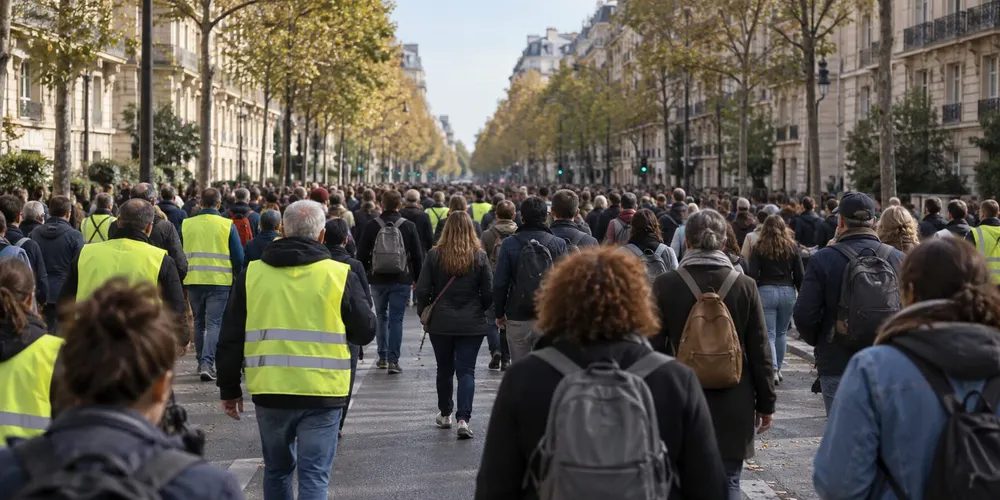
About 550,000 people joined 110 marches across France on Saturday, October 17, according to Interior Minister Laurent Nuñez, as student protests over school conditions expanded into a broader mobilization against living costs and strained public services. Organizers estimated turnout at 800,000, a higher figure that remains their own assessment.
The nationwide scale is corroborated by Reuters and the Associated Press. Hundreds of thousands marched peacefully, while fires, looting and attacks on public buildings were reported in several cities. The distinction matters: the turnout estimates describe the demonstrations as a whole, not the number of people involved in violence.
By late Saturday, Prime Minister Sébastien Lecornu reported about 1,200 arrests and 150 injured police officers and gendarmes, according to Le Monde. Those provisional figures superseded an earlier tally of about 400 arrests. Neither turnout estimate establishes how many people remained in the streets into Sunday morning.
A student movement broadens its demands
The protests brought together students, workers, retirees and supporters of the Yellow Vest movement, whose earlier demonstrations made household purchasing power a central political issue. What began with grievances about teacher shortages and deteriorating facilities has become a wider argument about the services people receive and the costs they face. That convergence gives the movement a broader constituency than a dispute confined to education.
In its October 17 statement, the CGT labor confederation claimed nearly 800,000 participants and demanded increases in wages, pensions and minimum social benefits. It also called for stronger taxation of wealth and changes to the government's budget priorities. Those are the union's policy positions, rather than independent findings about how any proposed measure would affect household finances.
Official price data show a sharper energy squeeze
The economic backdrop includes a measurable acceleration in inflation. France's statistics agency, INSEE, reported on October 15 that consumer prices rose 3.1% in September from a year earlier, compared with 2.4% annual inflation in August. Energy prices were 21.3% higher than a year earlier, while food prices rose 1.4% and services 2.4%. The differences show why a single headline inflation rate can obscure the pressures affecting particular household budgets.
Overall prices actually fell 0.3% from August to September, largely because of seasonal declines in accommodation and transport services. That monthly fall does not contradict the annual increase: they measure different periods. Nor does it mean that fuel-dependent households experienced relief, since energy prices increased 3.9% during the month. The data document price pressure but cannot establish the individual reasons that brought every demonstrator into the streets.
The government has promised school measures
The Education Ministry says its response includes five areas of work: replacing absent teachers, improving school facilities, organizing students' days, clarifying educational guidance and giving students greater involvement in decisions. The roadmap followed an October 4 letter from the prime minister, with initial decisions expected before the end of October. The ministry says initial measures were announced on October 8.
Those announcements included the rapid deployment of more than 3,000 replacement teachers to high schools with the greatest need, authorization for several hundred additional hires and extra hours for short-term cover. These remain government-reported measures, not independent confirmation that disrupted classes have been restored. Their practical effect depends on where staff become available and whether students see improvements in the schools that prompted the mobilization.
The ministry is also collecting anonymous student contributions through its Agora consultation until October 23, with a national summary expected at the end of the month. That creates a dated opportunity to compare the concerns students submit with the decisions ministers subsequently announce, rather than judging the response solely by meetings or promises.
Violence and police conduct face separate scrutiny
The disorder included a fire at Limoges city hall, damage in Lyon and incursions into Marseille's city hall. Officials attributed violence to radical groups and looters; such claims do not establish the affiliation or guilt of everyone detained. Arrest totals also should not be read as conviction totals. In Paris, police used tear gas as confrontations developed around the demonstrations.
AP reported that authorities opened an investigation after a young protester lost a hand in Saint-Etienne. Nuñez did not confirm reports attributing that injury to a police grenade. The incident leaves an important factual question for investigators rather than supporting a settled account of responsibility. A verified nationwide total of injured demonstrators was not available in the reporting reviewed.
Pressure now turns to the government's response
The government's position already combined recognition of grievances with accusations of political exploitation. Its official cabinet account from October 14 said President Emmanuel Macron regarded young people's anxieties as legitimate while condemning their transformation into urban violence. He requested concrete responses and a detailed assessment of school buildings. That establishes what the government instructed, not whether its response will satisfy protesters.
The CGT has called for continued peaceful mobilization and preparations for a November 5 inter-union strike and demonstration. The next test is whether the wider coalition sustains participation and whether promised education measures produce observable changes. Saturday's turnout confirms a substantial national protest; its competing crowd counts and still-developing damage and injury assessments require continued attribution and verification.