
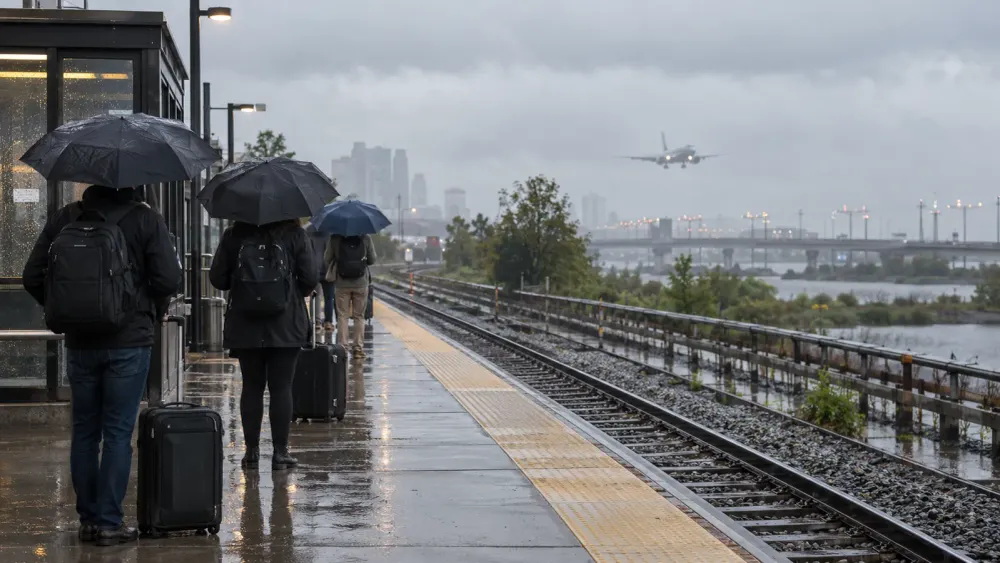
Nearly seven inches of rain fell in parts of coastal Connecticut on Sunday, flooding roads and tracks, interrupting New York-to-Boston rail service and temporarily closing the departures terminal at Tweed New Haven Airport. National Weather Service rainfall data showed 6.98 inches in Branford, 5.95 inches in Fairfield and 5.14 inches in Stamford, with other communities along the Interstate 95 corridor recording several inches in a matter of hours.
The storm’s travel effects spread across the region’s transportation network. Metro-North and Amtrak reported delays and cancellations on the New Haven Line, while flooding and storm debris later halted Amtrak service between New York and Boston. Tweed told departing passengers not to come to the airport until further notice after water reached its terminal. Roads closed across Connecticut, Westchester County and northern New Jersey as emergency crews rescued people from vehicles and homes.
The rain had largely tapered by Sunday afternoon, but the damage demonstrated how a localized weather event can disrupt several transportation systems at once. According to the AP, some places saw rain rates of 3 to 4 inches an hour, fast enough to overwhelm drainage and make standing water hazardous before travelers could reroute. No deaths or severe injuries had been reported by Sunday evening, but the corridor’s recovery depended on track inspections, debris removal and the reopening of flooded access routes.
Flooding reached every major travel mode
The rail disruption developed in stages. Flooding first forced suspensions along parts of Metro-North’s New Haven Line, which carries commuters and intercity passengers through southwestern Connecticut. By 5:46 p.m., Amtrak said high tides and debris near New Haven had stopped service between New York and Boston, with no immediate estimate for full restoration. An official Amtrak alert later said crews were inspecting the affected tracks and that passengers could encounter delays, cancellations or alternative transportation.
The storm compounded a planned capacity reduction already in effect for work on the WALK Bridge in Norwalk. The Connecticut Department of Transportation had warned that September 12 and 13 would bring significantly limited Metro-North service between Stamford and New Haven and extremely limited Amtrak service between New York and New Haven. The CTDOT notice described that weekend as the first of five reduced-service periods through November 1. Flooding therefore struck when fewer scheduled trains and less operating flexibility were already available.
Air travelers encountered a different kind of bottleneck. Tweed’s departure terminal closed because of local flooding, separating the airport’s runway status from passengers’ ability to enter, check in and board. Larger Northeast airports also recorded weather delays during the storm, although the Federal Aviation Administration’s FAA dashboard showed no national ground-delay programs or ground stops early Monday. That indicated the broader air-traffic system was recovering, but it did not erase individual cancellations, missed connections or aircraft and crews left out of position.
Road travel remained the most immediate safety concern. Westport firefighters conducted 13 rescues of people trapped in vehicles, while officials in Paterson, New Jersey, reported about 20 rescues from rising water. Connecticut officials urged drivers not to cross standing water or bypass barricades. The state’s live road map remained the most direct official source for current closures because conditions could change faster than a static list could be updated.
A narrow corridor magnified the disruption
The New Haven segment is not an isolated commuter route. It is part of the Northeast Corridor linking Washington, New York and Boston, and it carries both Metro-North trains and Amtrak’s Northeast Regional and Acela services. The NEC Commission says the corridor and its connecting routes support more than 703,000 weekday trips across eight commuter railroads and Amtrak, on infrastructure divided among four owners.
That scale creates resilience in ordinary operations but also concentrates risk at constrained points. A train canceled near New Haven can affect passengers far beyond Connecticut because equipment and crews cycle across the network. Travelers may shift to buses, rental cars or flights, increasing demand on systems exposed to the same weather. When roads around stations are flooded, even trains running on intact track may be difficult for passengers and employees to reach.
Shared infrastructure also makes restoration a coordinated process. Metro-North maintains the line used by Amtrak in parts of Connecticut, so inspections and operating decisions affect both commuter and intercity schedules. Crews must verify that ballast has not washed away, signals and power systems are functioning, and debris is clear before normal speeds resume. Dry weather alone does not establish that a railroad is safe to reopen.
Tweed’s closure exposed a known weakness
The terminal shutdown at Tweed was not the first evidence of flood vulnerability. A July federal court ruling concerning the airport’s expansion described the current terminal as an undersized former hangar that is prone to flooding. The same opinion said the airport authority’s proposed project would replace it with a new terminal and extend the runway by roughly 1,000 feet.
The ruling also summarized the FAA’s stormwater analysis. The agency recognized that new impervious surfaces could increase runoff but said the project would include replacement floodplain areas, infiltration measures and stormwater detention systems. The court upheld the FAA’s environmental review, finding that the agency had reasonably considered the project’s effects. Sunday’s closure does not establish how the unbuilt project would perform, but it reinforces the operational problem the replacement terminal is intended to address.
Tweed matters because it has become a growing regional alternative to larger airports around New York and Boston. The court record said the FAA projected annual passenger boardings could rise from about 350,000 in 2022 to more than 1.2 million by 2031, driven by demand and expanding service. More passengers increase the consequences of losing terminal access, even when flight infrastructure itself remains usable.
Recovery can outlast the storm
By Sunday afternoon, the heaviest rain had ended across much of Connecticut, and many power outages were being resolved. Transportation recovery was less immediate because railroads had to inspect waterlogged territory and operators had to reposition trains. Airlines faced the same sequencing problem: one delayed inbound aircraft can push a later departure off schedule, while a stranded crew may be unable to operate its next segment within federal duty limits.
For passengers, a reopening announcement is therefore not the same as a return to the published timetable. Amtrak advises customers to verify train status and be prepared for alternate transportation when flood inspections disrupt the corridor. Metro-North’s storm guidance directs riders to real-time service information in the MTA and TrainTime applications. Travelers with separate rail and airline tickets face additional exposure because one carrier may not be responsible for a connection missed on another.
The absence of reported fatalities is important, but it should not obscure the intensity of the event. Rain fell at rates capable of turning low-lying roads into moving water within minutes, and emergency crews repeatedly had to reach people who entered or were caught in flooded areas. Delaying a trip until an official route reopens is not simply a convenience decision when floodwater can conceal washed-out pavement, debris or electrical hazards.
The next test is Monday’s operating pattern
The central question for Monday travelers is whether the physical network can absorb delayed demand after inspections and repairs. Rail operators must restore track capacity while accommodating passengers displaced from Sunday trains. Airlines must work through aircraft and crew imbalances, and local roads must reopen sufficiently for travelers to reach stations and terminals. Each mode can appear operational while still carrying residual delays from the previous day.
The storm also offers a concrete measure of the region’s infrastructure plans. The Northeast Corridor Commission says aging bridges, tunnels, electrical systems and signals remain prone to failures, while the WALK Bridge work is already reducing capacity on selected weekends. At Tweed, a new terminal proposal directly addresses a building that the public record identifies as flood-prone. Future resilience will depend not only on larger projects, but also on drainage, floodplain design, redundant access and operating plans that function when several modes fail together.
What changed Sunday was not merely the weather forecast. A short, intense burst of rain severed parts of a nationally important travel corridor and exposed the dependencies among roads, rail and air service. The evidence shows the immediate danger eased as the rain moved out; what remained unresolved was how quickly inspections, cleanup and repositioning could return the New York-to-Boston network to a reliable schedule.