
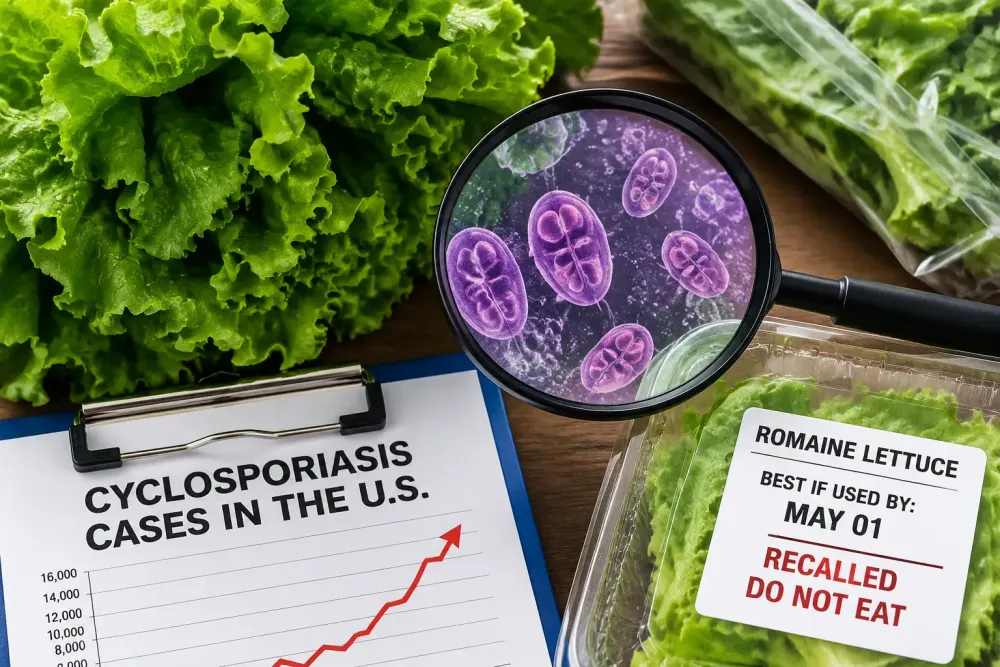
The CDC has recorded 15,716 laboratory-confirmed U.S.-acquired cases of cyclosporiasis since May 1, more than 13 times the 1,180 cases reported during a comparable May-through-August period last year, with at least 828 hospitalizations and two deaths reported amid several concurrent clusters. The CDC says another 11,841 possible cases remain under investigation, while state totals can be higher because states may apply broader reporting criteria.
A major portion of the 2026 surge has been associated with processed iceberg lettuce sourced from central Mexico, but the national case count should not be interpreted as one single lettuce outbreak. Federal investigators have identified multiple clusters, and the source of several remains unresolved.
The distinction is important because a national epidemic curve can combine infections acquired through different foods, distribution networks and geographic areas. Identifying which cases belong together determines whether investigators can trace a contamination event back to a field, processor, water source or handling facility.
Cyclospora is unusually difficult to trace compared with many foodborne bacteria
Cyclosporiasis is caused by Cyclospora cayetanensis, a microscopic parasite rather than a bacterium such as Salmonella or E. coli.
That biological difference complicates outbreak investigation.
Symptoms can begin days or even weeks after exposure, making it difficult for patients to remember exactly what they ate. Fresh produce may have been consumed long before illness is diagnosed, and packaging or receipts may no longer be available.
The CDC also cannot use the same mature whole-genome sequencing approach that has transformed investigation of many bacterial foodborne outbreaks. Instead, investigators combine epidemiology, purchase records, food-distribution data and developing genetic tools to determine whether cases are related.
That means surveillance can lag behind transmission.
By the time a contaminated item is identified, the original product may already have moved through restaurants, distributors and consumer kitchens.
A large lettuce supply chain can distribute efficiency and risk at the same time
The 2026 outbreak has focused attention on Taylor Farms, one of the largest fresh-produce processors in North America. Federal investigators connected a major cluster to iceberg lettuce processed through the company's Mexican operations and distributed through food-service customers, according to Reuters.
Scale creates substantial benefits.
Large processors can standardize refrigeration, packaging, traceability, transportation and safety protocols. Restaurant chains can purchase consistent products across thousands of locations without building individual relationships with hundreds of farms.
But the same centralization can magnify a contamination event.
If one contaminated shipment is incorporated into a widely distributed product, illness can appear across many states before investigators recognize that geographically separated patients share the same source.
That is not evidence that large processors are inherently less safe than smaller ones. It is evidence that distribution scale changes the consequences when a safety barrier fails.
Taylor Farms says it spends more than $200 million annually on food safety, according to Reuters. The size of that investment illustrates an uncomfortable reality of food safety: substantial preventive spending can reduce risk without reducing it to zero.
The economic effects extend far beyond the patients who become ill
Foodborne outbreaks create financial damage through consumer behavior before investigators necessarily establish responsibility for every case.
Wholesale lettuce prices fell sharply this summer as restaurants, distributors and consumers reduced demand amid the outbreak, according to Reuters. Smaller growers can experience those losses even when their own produce was never linked to contamination.
That occurs because consumers rarely possess enough information to distinguish one field or processor from another at the moment a warning becomes public.
Demand falls for the category.
A restaurant may temporarily remove lettuce from menu items. A distributor may source alternatives. Consumers may buy different produce.
Those decisions can protect against uncertainty, but they also transfer some of the economic cost to uninvolved growers.
Concentrated supply chains amplify the effect. When a dominant processor supplies numerous national restaurant chains, substituting another supplier immediately may be logistically difficult even if alternative lettuce exists.
Michigan's much larger state count does not contradict the CDC national total
Michigan has reported more than 14,000 cases under its own surveillance framework, a number that can appear impossible beside a national CDC total of 15,716.
The CDC explicitly warns that state counts may exceed the number included in federal surveillance because states can include probable or otherwise classified cases that do not meet the CDC's narrower national case definition, according to its surveillance guidance.
Those counts therefore should not simply be added together.
A confirmed federal case, a probable state case and a person still under investigation represent different surveillance categories. Combining them without adjusting for overlap would exaggerate the number of distinct infections.
This is a common challenge during outbreaks: the public sees several rapidly changing numbers produced for different purposes.
The most reliable interpretation is to describe each number together with the definition used to generate it.
Falling weekly case counts are encouraging but do not close the investigation
Recent Michigan data suggest the pace of newly identified infections has slowed substantially from the peak, according to current Reuters reporting. That is consistent with an outbreak that may be receding rather than accelerating.
But a decline in newly reported cases does not immediately establish that every contaminated source has been identified or removed.
Cyclospora's incubation period, delays in seeking care and laboratory reporting can stretch the epidemic curve. Multiple clusters also mean one outbreak can decline while investigators continue examining another.
The national CDC surveillance page specifically identifies several clusters whose food source has not yet been determined, according to its case summary.
The most important evidence is therefore moving in two directions.
The scale is extraordinary: 15,716 confirmed U.S.-acquired infections compared with 1,180 during last year's comparable seasonal reporting period.
The trajectory appears more encouraging: some of the hardest-hit areas are reporting far fewer new cases than at the peak.
Both can be true.
The 2026 cyclosporiasis event is becoming less a story about whether one contaminated food sickened thousands of people and more a demonstration of how difficult it can be to reconstruct a modern fresh-food supply chain after the illness has already been distributed across it.